Bust-Down Books
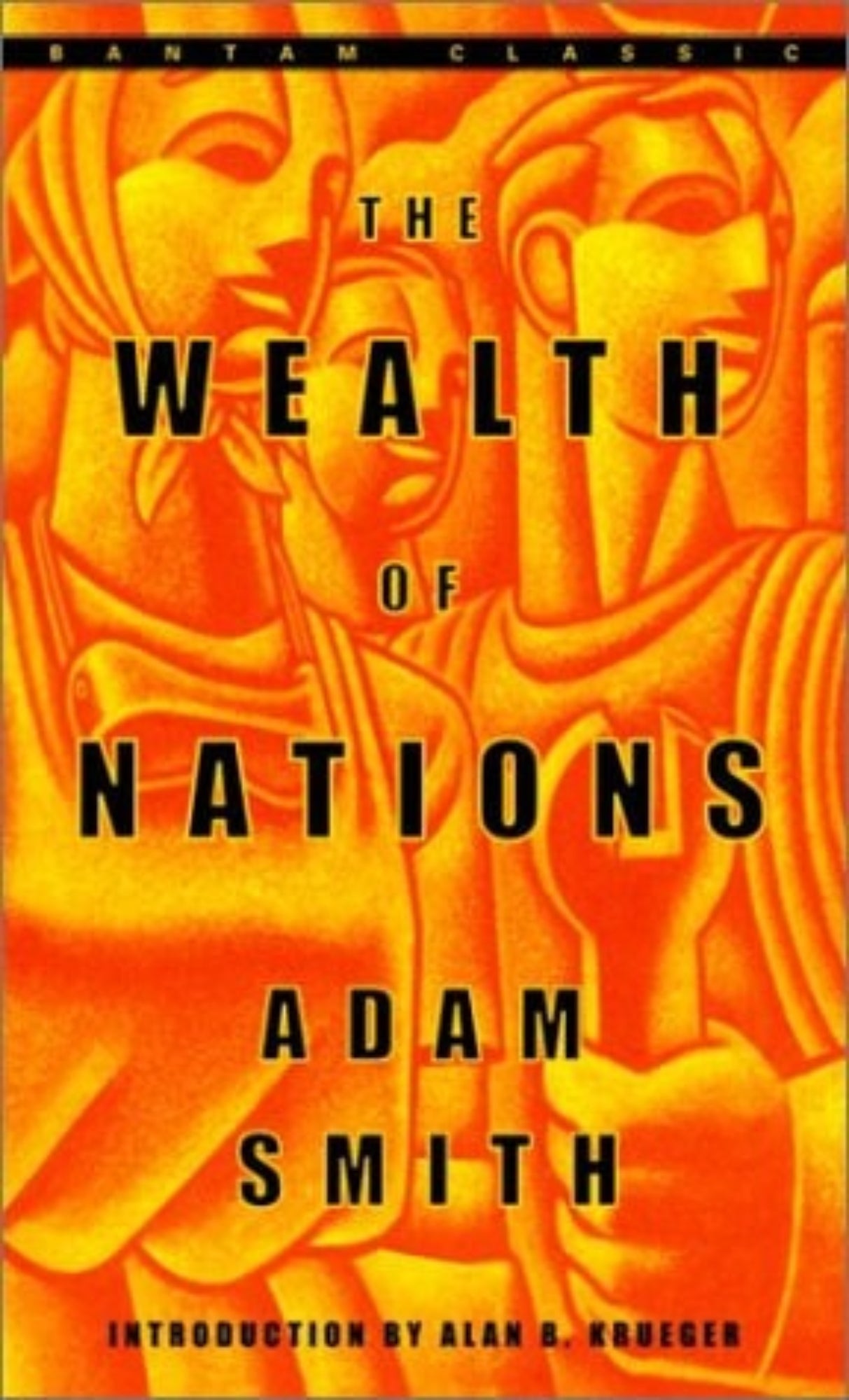
The Wealth of Nations | Adam Smith
The Wealth of Nations | Adam Smith
Couldn't load pickup availability
The Wealth of Nations
| ISBN-13 | 9780553585971 |
|---|---|
| ISBN-10 | 0553585975 |
| Author | Adam Smith |
| Credits | Edwin Cannan (Editor), Alan B. Krueger (Introduction) |
| Format | Mass Market Paperback |
| Publisher | Random House Publishing Group (Bantam Classics) |
| Publication Date | March 04, 2003 |
| Page Count | 1264 |
| Subjects | Economic Theory, Economic History, Revolutionary Period History |
Extended Synopsis
Adam Smith's The Wealth of Nations is widely considered the foundational text of modern economics. In this groundbreaking work, Smith argues that a nation's true wealth is not determined by its reserves of gold, but by its productive capacity. This capacity is fundamentally driven by the division of labor and the mechanics of free markets. He posits that when individuals pursue their own economic self-interest, they are guided by an "invisible hand" that ultimately benefits society as a whole through increased efficiency, innovation, and lower prices.
Beyond the invisible hand, Smith advocates for a "laissez-faire" approach, arguing that government intervention in the economy should be strictly limited to essential functions such as national defense, public works, and the enforcement of justice. By thoroughly examining the role of capital accumulation and the benefits of breaking down complex production into specialized tasks, The Wealth of Nations established the intellectual framework for free-market capitalism that continues to influence global economic policy today. This Bantam Classics edition features expert notes by Edwin Cannan and an introduction by Alan B. Krueger.
Key Economic Concepts
- The Invisible Hand: The principle that individual self-interest naturally promotes the greater public good in a free-market system.
- Division of Labor: Breaking production into specialized, smaller tasks to drastically increase productivity and efficiency.
- Laissez-Faire Capitalism: The argument for minimal government intervention, allowing free markets to dictate the production and distribution of goods.
- Role of Capital: Explores how the accumulation and intelligent deployment of capital are vital for sustained economic growth.
Reader Targeting
- Students and scholars of economics, political science, and history.
- Investors and financial professionals seeking to understand the historical roots of modern market theory.
- Readers interested in the intellectual origins of the Enlightenment and the American Revolutionary period.
About the Author
Adam Smith (1723–1790) was a pioneering Scottish moral philosopher and political economist. A key figure of the Scottish Enlightenment, Smith is best known for two classic works: The Theory of Moral Sentiments (1759) and An Inquiry into the Nature and Causes of the Wealth of Nations (1776). His profound insights laid the theoretical foundations for the classical free market economic system.
Bust-Down Books: The People's Bookstore
Share