Bust-Down Books
Blueberries for Sal: A Dolly Parton's Imagination Library Book | Robert McCloskey
Blueberries for Sal: A Dolly Parton's Imagination Library Book | Robert McCloskey
Couldn't load pickup availability
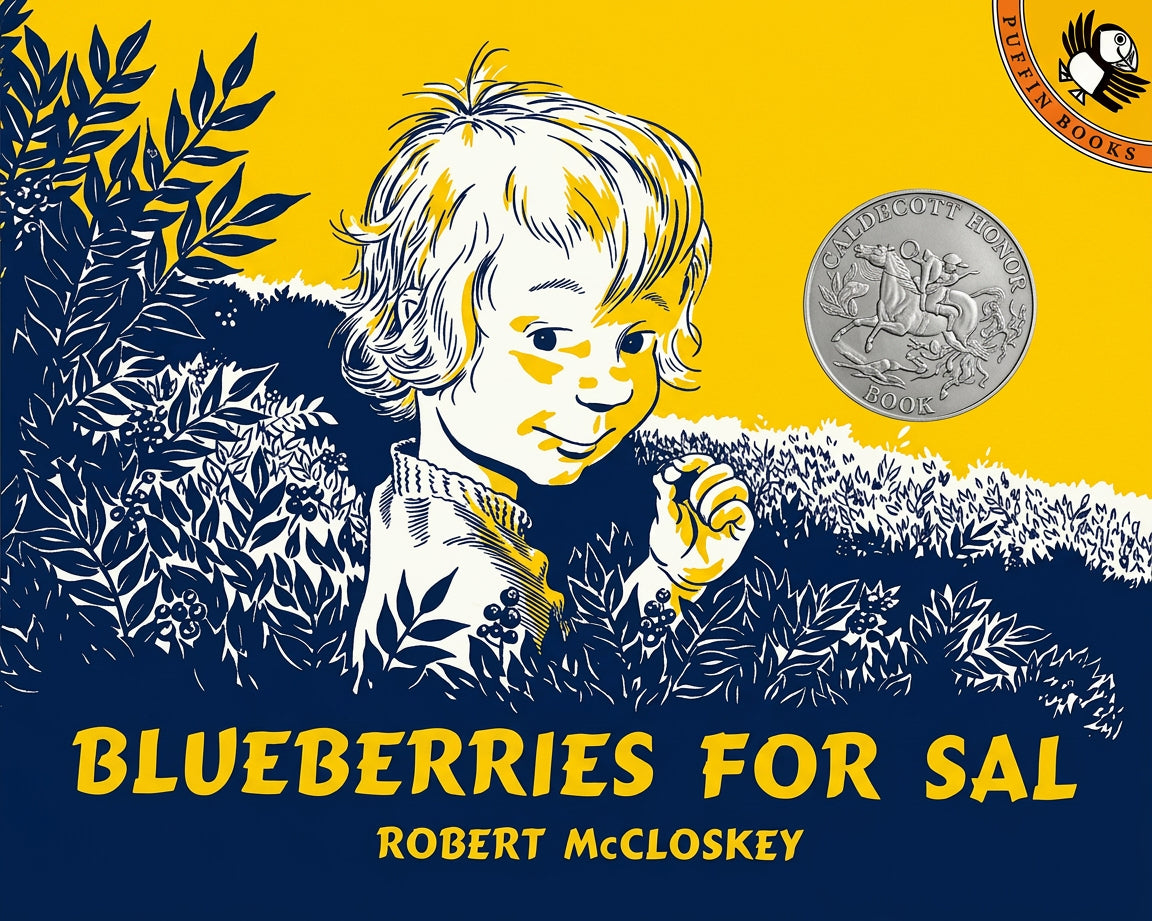
A beloved Caldecott Honor classic from two-time Caldecott Medalist Robert McCloskey. In Blueberries for Sal (Dolly Parton's Imagination Library special paperback edition), young Sal and a curious bear cub accidentally swap mothers while foraging for wild blueberries on a sunlit Maine hillside.
Book Overview & Core Themes
On a bright summer day on Blueberry Hill in coastal Maine, young Sal and her mother set out with tin pails to gather wild blueberries to can for the winter. On the other side of the very same hillside, Little Bear and his mother are busily eating berries to store up fat for their long winter hibernation.
When both little Sal and the baby bear wander away from their mothers—lured by the irresistible kuplink, kuplank, kuplunk of berries dropping into Sal's tin pail—they inadvertently follow the wrong parent in a gentle comedy of errors before happily reuniting. Inspired directly by McCloskey’s own wife and daughter on the coast of Maine, this timeless picture book celebrates curiosity, maternal care, and the quiet wonders of nature.
Key artistic and narrative highlights explored within this volume include:
- Symmetrical Storytelling: Weaving parallel human and animal families preparing for winter in the exact same way.
- Unforgettable Read-Aloud Rhythm: Featuring playful onomatopoeia (kuplink, kuplank, kuplunk) cherished by generations of young listeners.
- Iconic Blueberry-Blue Lithography: Crafted in deep single-color blueberry ink on cream paper, evoking classic blue-and-white willowware china and coastal New England scenery.
- Dolly Parton's Imagination Library Edition: Issued in a 56-page paperback edition by Puffin Books (Penguin Random House).
About the Author & Illustrator
Robert McCloskey (1914–2003) was one of America’s most celebrated author-illustrators of children’s books. Born in Hamilton, Ohio, and trained at the Vesper George School of Art in Boston and the National Academy of Design in New York, he became the first artist to win two Caldecott Medals—for Make Way for Ducklings (1942) and Time of Wonder (1958)—alongside three Caldecott Honors, including Blueberries for Sal and One Morning in Maine. He was named a "Living Legend" by the Library of Congress in 2000.
Core Audience & Intended Use
- Parents, Grandparents & Early Educators: An essential, gentle read-aloud bedtime and classroom story for toddlers and early readers.
- Collectors of Caldecott Winners & Imagination Library Books: A cherished paperback edition for families building a classic childhood library.
- Lovers of Maine & Nature Storytelling: Ideal for families who appreciate New England coastal life, wildlife, and nostalgic picture books.
Awards & Critical Acclaim
- Named a 1949 Caldecott Honor Book following its original 1948 publication.
- Universally recognized as a cornerstone of twentieth-century American children's literature, passed down across generations for over seventy-five years.
Product Specifications
| Full Title | Blueberries for Sal (A Dolly Parton's Imagination Library Book) |
|---|---|
| Author(s) & Illustrator | Robert McCloskey |
| Publisher & Imprint | Puffin Books (Penguin Random House; Dolly Parton's Imagination Library Special Edition) |
| Publication Date | 2011 (Special Paperback Edition; Originally published 1948) |
| Binding Format | Paperback (PB) |
| Print Length | 56 Pages |
| Language | English |
| ISBN-13 / ISBN-10 | 9780142419489 / 0142419486 |
| Primary Genre (BISAC) | JUV002030 / JUVENILE FICTION / Animals / Bears |
| Sub-Genres (BISAC) | JUV013000 / FAMILY / GENERAL; JUV051000 / CLASSICS |
| Item Condition | Pre-Owned / Very Good |
| Dimensions & Weight | 10.60 x 0.20 x 8.40 inches | 8.80 oz (approx. 0.55 lbs) |
Frequently Asked Questions About Blueberries for Sal
What is the central narrative premise, rural setting, and plot trajectory in Blueberries for Sal?
Set on Blueberry Hill in coastal Maine, the story follows young Sal and her mother as they hike up the hill with tin pails to pick blueberries for winter canning, while on the opposite side of the hill, Little Bear and his mother roam the same slopes eating berries to fatten up for winter hibernation. When both Sal and Little Bear lag behind their mothers, they inadvertently wander off following the wrong parent—resulting in a gentle, suspenseful mix-up before each mother realizes the switch and reunites with her own child.
How does Robert McCloskey use monochrome lithography and rhythmic sound effects in the storytelling?
McCloskey illustrated the entire book in rich, single-color blueberry-blue ink on cream paper, capturing the rugged beauty of the Maine landscape and the expressive innocence of both child and cub. He pairs this visual simplicity with unforgettable onomatopoeia—most notably the iconic kuplink, kuplank, kuplunk! of berries dropping into Sal's empty metal pail—creating an auditory rhythm tailored for reading aloud.
Where does Blueberries for Sal fit within Robert McCloskey's bibliography and American children's literature?
Originally published in 1948 and awarded a Caldecott Honor in 1949 (and reissued here under ISBN 9780142419489 for Puffin Books and Dolly Parton's Imagination Library), Blueberries for Sal stands alongside McCloskey's Make Way for Ducklings and One Morning in Maine as a defining cornerstone of mid-20th-century American picture books.
How is this picture book classic evaluated by educators, librarians, and families?
Generations of parents, early childhood educators, and children's literature scholars celebrate the book for its timeless warmth, gentle humor, and realistic depiction of curiosity and maternal care, keeping it a permanent fixture in preschool classrooms and home libraries.
What artistic and literary background defines author and illustrator Robert McCloskey?
Robert McCloskey (1914–2003) was an acclaimed American author and illustrator of children's books who became the first artist to win two Caldecott Medals (for Make Way for Ducklings and Time of Wonder). Drawing directly from his own family life on Deer Isle, Maine, he modeled the characters of Sal and her mother after his own daughter Sally and wife Peggy.
Condition Notice: Pre-Owned / Second-Hand Product
All books, box sets, and multi-volume collections offered by Bust-Down Books are sold in pre-owned, used, and second-hand condition, unless explicitly designated as new in the individual product listing.
Condition Details & Grading:
- Previous Ownership: These items have been previously owned, handled, and read. As such, copies may exhibit typical signs of shelf wear, including but not limited to minor creasing, scuffing, edge wear, bent page corners, remainder marks, or spine softening. Paperback editions may show light cover creasing or edge rubbing.
- Markings & Personalization: Items may occasionally contain inscriptions, gift notes, library stamps, owner names, marginalia, or highlighting. Individual item descriptions reflect significant deviations from standard acceptable condition.
- Supplemental Materials: Secondary and digital components—such as publisher access codes, CD-ROMs, bonus inserts, registration keys, or workbook activity pages—are not guaranteed to be included, active, or unredeemed unless specifically stated in the product description.
First Sale Doctrine & Non-Affiliation Statement:
All items sold on this platform are original, lawfully acquired copies being resold under the protection of the First Sale Doctrine (codified under U.S. copyright law, 17 U.S.C. § 109, and applicable international equivalents permitting the secondary resale of lawfully manufactured goods).
Bust-Down Books, LTD. is an independent, secondary-market bookseller. We are not affiliated with, endorsed by, authorized by, or sponsored by the original authors, copyright holders, publishers, or trademark owners of the titles offered for sale. All registered trademarks, author names, book titles, and publisher imprints remain the sole property of their respective owners and are used strictly for nominative identification and descriptive purposes.
Share