Bust-Down Books
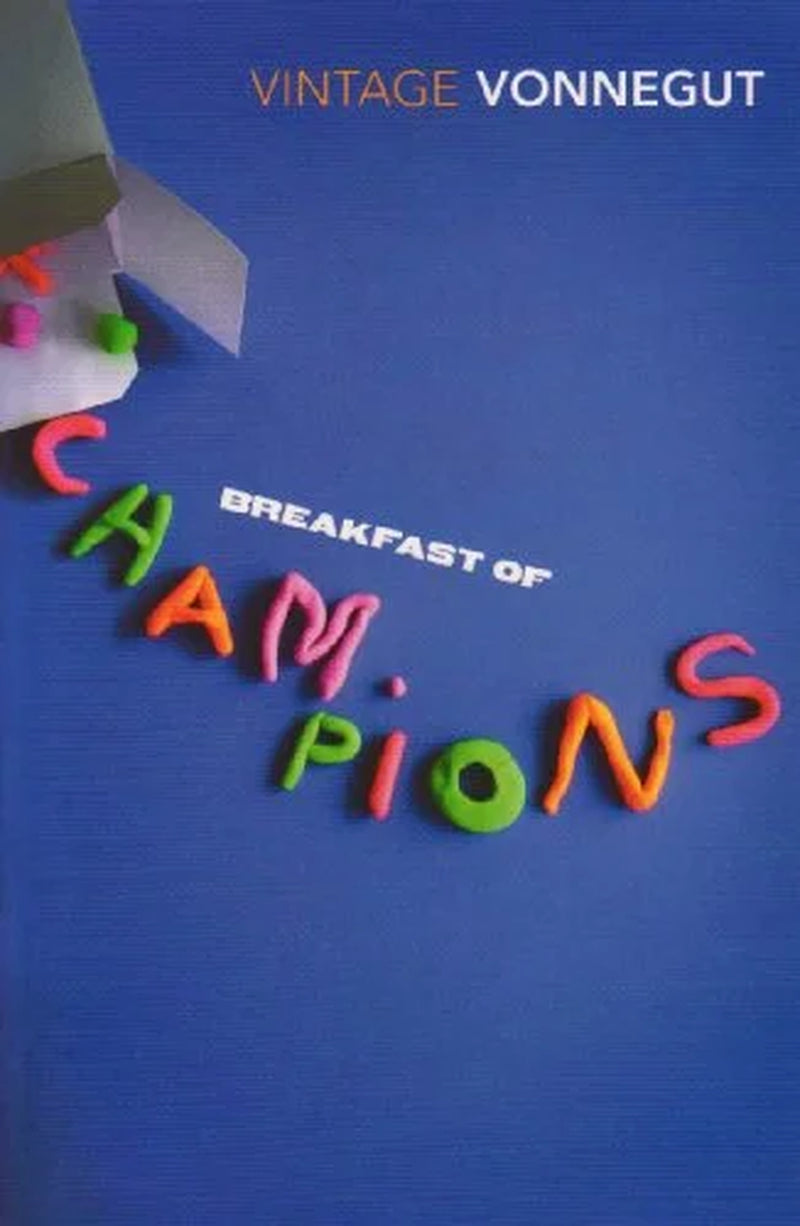
Breakfast of Champions | Kurt Vonnegut
Breakfast of Champions | Kurt Vonnegut
Couldn't load pickup availability
“Outrageous, witty, thought-provoking, unputdownable, scintillating, invigorating, ennobling, enlightening and masterly”—Spectator
Book Overview
Discover Vonnegut’s funny absurdist novel about the human condition. In a frolic of cartoon and comic outbursts against rule and reason, a miraculous weaving of science fiction, memoir, parable, fairy tale and farce, Kurt Vonnegut attacks the whole spectrum of American society, releasing some of his best-loved literary creations on the scene.
Set in the mundane, decaying Midwestern town of Midland City, the novel chronicles the catastrophic collision course of two very different men: Kilgore Trout, an obscure, deeply cynical, and completely unread science fiction writer, and Dwayne Hoover, a wealthy, heavily medicated Pontiac dealer who is rapidly spiraling into severe clinical psychosis. Their paths meet at a local arts festival, triggering a violent mental breakthrough when Dwayne takes one of Trout’s pulp novels as absolute, literal truth.
Featuring dozens of the author’s own crude felt-tip pen illustrations and an avant-garde metafictional structure where Vonnegut breaks the fourth wall to enter his own narrative, Breakfast of Champions, or Goodbye Blue Monday! is a masterclass in dark comedy, free will, and social satire.
About the Author
Kurt Vonnegut was a legendary American author whose darkly comedic, satirical works blended science fiction and humanism. Best known for masterpieces like Slaughterhouse-Five, Cat's Cradle, and Breakfast of Champions, Vonnegut's writing fearlessly interrogated modern alienation, war, and societal absurdity, cementing his status as a cornerstone of twentieth-century American literature.
Core Audience & Intended Use
- Kurt Vonnegut & Satire Enthusiasts: Readers looking for groundbreaking, irreverent counterculture literature and dark social commentary.
- Science Fiction & Postmodern Literature Scholars: Academics studying avant-garde metafiction, fourth-wall breaking, and unconventional novel structures.
- Classic Fiction Readers: Fans of mid-century American classics exploring the psychological absurdities of modern consumer society.
Product Specifications
| Full Title | Breakfast of Champions, or Goodbye Blue Monday! |
|---|---|
| Author(s) | Kurt Vonnegut |
| Publisher & Imprint | Vintage (An imprint of Penguin Books UK) |
| Publication Date | January 11, 1994 (Continuous Vintage UK Paperback Printing Profile) |
| Binding Format | B-Format Trade Paperback (PB) |
| Print Length | 320 Pages (Includes numerous integrated felt-tip pen illustrations by the author) |
| Language | English |
| ISBN-13 / ISBN-10 | 9780099842606 / 0099842604 |
| Primary Genre (BISAC) | FIC004000 / FICTION / Classics |
| Sub-Genres (BISAC) | FIC019000 / FICTION / Literary; FIC027250 / FICTION / Science Fiction / Satire; FIC042000 / FICTION / Humorous / General |
| Item Condition | Pre-Owned / Very Good |
| Dimensions & Weight | 5.08 x 0.79 x 7.80 inches (12.9 x 2.0 x 19.8 cm) | 7.8 oz (approx. 220g) |
Frequently Asked Questions About Breakfast of Champions
What is the main narrative hook and core fictional setting driving the novel?
The book is set in the mundane, decaying Midwestern town of Midland City. The plot centers on the catastrophic collision course of two very different men: Kilgore Trout, an obscure, deeply cynical, and completely unread science fiction writer, and Dwayne Hoover, a wealthy, heavily medicated Pontiac dealer who is rapidly spiraling into severe clinical psychosis. Their paths meet at a local arts festival, triggering a violent mental breakthrough when Dwayne takes one of Trout's pulp novels as absolute, literal truth.
What specific structural layout and unusual visual formatting does the author use?
The novel utilizes a radically fragmented, avant-garde metafictional layout. Vonnegut strips away traditional literary prose to explain the world as if writing for an alien visitor, breaking up the text with dozens of his own crude, felt-tip pen illustrations depicting everything from underpants and hamburgers to electric chairs. Furthermore, Vonnegut actively breaks the fourth wall, physically entering the narrative as a god-like character sitting in the Midland City cocktail lounge watching his own creations.
What primary psychological and social themes are explored in the text?
The text delivers a profound, dark comedy investigation into free will, mental illness, racism, and consumer capitalism. Through Trout's sci-fi premise—that every human being on Earth is a mindless, pre-programmed biological robot except for the reader—Vonnegut explores the toxic psychological danger of absolute loneliness and critiques how easily American society reduces human beings into disposable machinery.
Did this iconic counterculture book receive any major cinematic adaptations?
Yes. The novel served as the direct creative basis for a highly polarizing 1999 Hollywood feature film adaptation written and directed by Alan Rudolph. The cinematic version features an avant-garde ensemble cast starring Bruce Willis as Dwayne Hoover, Nick Nolte as his troubled mechanic, and Albert Finney as Kilgore Trout, attempting to capture the book's manic, chaotic energy on screen.
Why is this book uniquely significant to the author, Kurt Vonnegut, and his broader literary career trajectory?
This work represents an extraordinary, definitive milestone because Kurt Vonnegut explicitly designed it as his own fiftieth birthday present to himself—a deliberate, therapeutic act to clear his head of his own past creations. Having achieved sudden, colossal global fame with Slaughterhouse-Five, Vonnegut found himself completely overwhelmed by public expectations and his own deep-seated depression. This book served as a creative turning point where he chose to systematically bring back and “set free” his most famous recurring characters, including Kilgore Trout and Eliot Rosewater. By confronting his own suicidal ideations and childhood traumas directly on the page, Vonnegut used the text to consciously reinvent his writing style for the second half of his life, making it his most deeply personal, vulnerable, and identity-defining literary exorcism.
Condition Notice: Pre-Owned / Second-Hand Product
All books, box sets, and multi-volume collections offered by Bust-Down Books are sold in pre-owned, used, and second-hand condition, unless explicitly designated as new in the individual product listing.
Condition Details & Grading:
- Previous Ownership: These items have been previously owned, handled, and read. As such, copies may exhibit typical signs of shelf wear, including but not limited to minor creasing, scuffing, edge wear, bent page corners, remainder marks, or spine softening. Paperback editions may show minor cover curling, spine creasing, or edge rubbing.
- Markings & Personalization: Items may occasionally contain inscriptions, library stamps, owner names, marginalia, or highlighting. Individual item descriptions reflect significant deviations from standard acceptable condition.
- Supplemental Materials: Secondary and digital components—such as publisher access codes, CD-ROMs, bonus inserts, registration keys, or workbook activity pages—are not guaranteed to be included, active, or unredeemed unless specifically stated in the product description.
First Sale Doctrine & Non-Affiliation Statement:
All items sold on this platform are original, lawfully acquired copies being resold under the protection of the First Sale Doctrine (codified under U.S. copyright law, 17 U.S.C. § 109, and applicable international equivalents permitting the secondary resale of lawfully manufactured goods).
Bust-Down Books, LTD. is an independent, secondary-market bookseller. We are not affiliated with, endorsed by, authorized by, or sponsored by the original authors, copyright holders, publishers, or trademark owners of the titles offered for sale. All registered trademarks, author names, book titles, and publisher imprints remain the sole property of their respective owners and are used strictly for nominative identification and descriptive purposes.
Share