Bust-Down Books
Can you Outsmart an Economist? | Stephen Landsburg
Can you Outsmart an Economist? | Stephen Landsburg
Couldn't load pickup availability
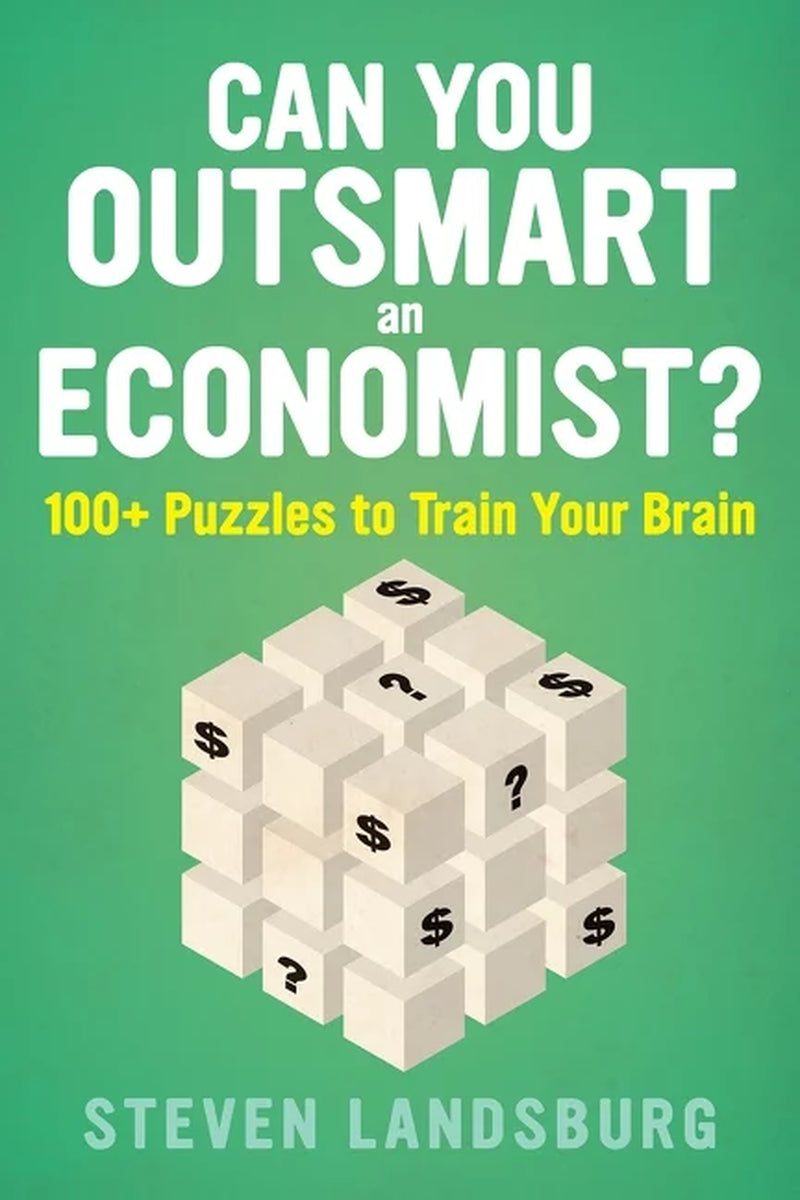
Can You Outsmart an Economist? 100+ Puzzles to Train Your Brain
Extended Synopsis
In Can You Outsmart an Economist?, celebrated economic theorist and academic Steven E. Landsburg delivers an intellectually sharp riddle matrix that sits at the distinct overlap of casual logic puzzles and rigorous fundamental analysis. Landsburg establishes a compelling behavioral thesis: thinking like an economist does not require memorizing stale financial formulas, but demands an unyielding commitment to parsing hidden operational incentives, distinguishing raw correlation from true causation, and running calculated, counter-intuitive probability checks against standard human instinct.
Rather than arranging the material in a dry textbook format, the author coordinates his logical training ground across three distinct analytical pillars. The text launches with a collection of rapid-fire cognitive warm-ups engineered to catch the reader's natural cognitive biases off guard, exposing how default human reasoning consistently miscalculates basic probability and simple conditional statistics. The core of the volume elevates the structural difficulty by introducing practical applications of game theory—including the Prisoner's Dilemma, zero-knowledge proofs, and complex option strategies—translating abstract mathematical formulas into lively, real-world thought experiments regarding pricing models and risk allocation.
The collection climbs to its structural climax by applying economic logic directly to complex macro puzzles involving law, institutional design, and societal ethics. Landsburg walks the reader through intricate exercises in reverse reasoning and incentive auditing to reveal the unintended systemic consequences of seemingly virtuous public policy initiatives. This celebrated Mariner Books trade paperback functions as an essential, high-value reference resource for anyone looking to master the raw, tactical infrastructure of logical and strategic deduction.
Accolades & Praise
“Ingenious... you may even end up smarter than Google.”
— George Gilder, author of Life After Google
“Read it, expand your mind, and have fun!”
— N. Gregory Mankiw, Robert M. Beren Professor of Economics, Harvard University
Author Biography
Steven E. Landsburg is a renowned professor of economics at the University of Rochester and the acclaimed author of The Armchair Economist, Fair Play, and More Sex Is Safer Sex. He has written regular columns for Slate, The Wall Street Journal, and Forbes, and is highly regarded for his ability to make complex mathematical, logical, and economic concepts accessible and entertaining to the general public.
Reader Targeting
- Students, educators, and lifelong learners seeking an engaging, puzzle-driven introduction to microeconomics and strategic interaction.
- Logic puzzle enthusiasts, data analysts, and game theory hobbyists looking to test their deductive abilities against advanced mathematical paradoxes.
- Academic libraries, behavioral economics research collections, and professionals eager to eliminate cognitive biases from their decision-making frameworks.
Bibliographic & Physical Specifications
| Publisher | Mariner Books (An imprint of HarperCollins Publishers) |
|---|---|
| Publication Date | September 25, 2018 |
| Format & Binding | First Edition / Trade Paperback (Perfect bound with smooth matte laminate protective casing) |
| ISBN-13 / ISBN-10 | 9781328489869 / 1328489868 |
| Page Count & Features | 304 pages (Includes over 100 puzzle blocks, complete worked solutions, line diagrams, and probability matrices) |
| Dimensions & Weight | 8.01 x 5.33 x 0.79 inches | 8.7 oz (247 grams) |
| BISAC Categories | BUSINESS & ECONOMICS / Decision-Making & Problem Solving GAMES & ACTIVITIES / Logic & Brain Teasers BUSINESS & ECONOMICS / Economics / General |
Frequently Asked Questions
Do I need an advanced degree in mathematics or economics to solve these puzzles?
No advanced degree or financial training is required. The book relies on curiosity, strategic thinking, and a willingness to challenge common cognitive biases. It provides full, clear, worked-out explanations for every puzzle included.
What specific logical and mathematical topics are covered?
The challenges span across basic probability models, reverse reasoning, statistical paradoxes, and core game-theoretic concepts like the Prisoner's Dilemma, scarcity models, and calculated risk allocation patterns.
Bust-Down Books: More Than a Bookstore
Share