Bust-Down Books
The Clash of the Cultures | John C. Bogle
The Clash of the Cultures | John C. Bogle
Couldn't load pickup availability
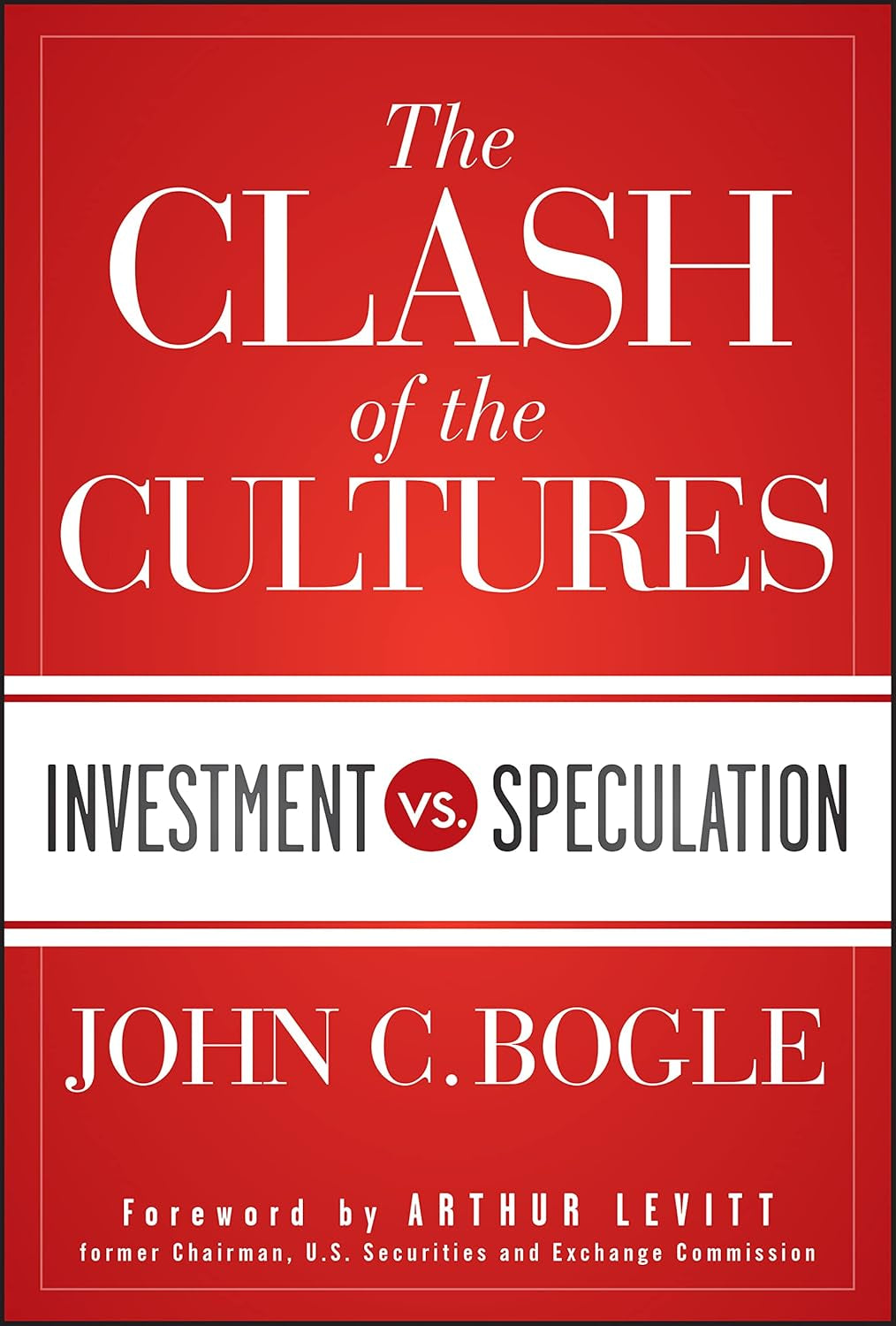
The Clash of the Cultures: Investment vs. Speculation
Extended Synopsis
In the definitive macro-economic critique The Clash of the Cultures: Investment vs. Speculation, legendary Vanguard Group founder and index fund pioneer John C. Bogle analyzes the structural parameters of institutional financial shifting, the tactical subversion of the fiduciary principle, and the systemic cost drag of financial intermediation. Published as a commanding 384-page hardcover volume by John Wiley & Sons, this urgent work serves as Bogle’s definitive warning regarding the structural decay of the American corporate investment matrix. Bogle establishes an unyielding empirical thesis: the financial sector has undergone a catastrophic cultural mutation, shifting from a long-term, relationship-driven “culture of investment” to a short-term, hyper-transactional “culture of speculation” that systematically extracts wealth from retail investors to enrich corporate intermediaries.
Rather than arranging his final broadside as a collection of loose market anecdotes, the author choreographs his comprehensive financial diagnostic across three prominent structural pillars. The paradigm of capital transformation and fiduciary decay sets the primary baseline comparison by charting the historical transformation of corporate stock ownership over the past century. He contrasts the traditional model—where individual owners held corporate shares for decades based on underlying business metrics and dividend yields—with the modern era, where hyper-active institutional fund managers trade billions of dollars in equities daily using computerized algorithms. This initial module demonstrates how the vital concept of stewardship was replaced by salesmanship, turning mutual funds from fiduciary guardians of public retirement capital into aggressive marketing machines focused primarily on gathering assets under management to maximize corporate fee structures.
Moving from corporate ethics to raw corporate mathematics, the architecture of the intermediation tax and the tyranny of costs details the tactical mathematical framework. Bogle presents devastating statistical data showing that aggressive short-term trading, management fees, transaction overhead, and marketing charges create a massive intermediation tax that quietly liquidates investor returns over a long-term horizon. This segment mathematically proves that in the aggregate financial economy, a standard passive index strategy that captures gross market returns will systematically outperform high-cost, actively managed speculation vehicles. Finally, the sovereign resolution of the federal fiduciary standard and retail safeguards builds to its practical climax by outlining a sweeping structural blueprint to rescue the American retirement ecosystem through extreme cost minimization, long-term asset allocation stability, and unwavering reliance on low-cost broad-market index vehicles.
Accolades & Praise
- Warren Buffett Recommendation – Explicitly selected and highlighted as highly recommended reading by Warren Buffett in his March 2013 annual Letter to Shareholders.
- Distinguished Foreword – Features an introductory foreword by Arthur Levitt, Former Chairman of the U.S. Securities and Exchange Commission (SEC).
Author Biography
John C. Bogle (1929–2019) was the legendary founder of the Vanguard Group and the creator of the world's first retail index mutual fund. Over a celebrated sixty-year career in the mutual fund industry, he was a tireless champion for retail investors, pioneering low-cost passive investing frameworks and structural corporate governance reform. Named by Time magazine as one of the world's 100 most powerful and influential people, Bogle authored numerous bestselling financial texts, completing his definitive macro-economic trilogy with this volume.
Reader Targeting
- Individual retail investors, personal finance managers, and retirement planners seeking actionable, low-cost wealth protection architectures.
- Institutional money managers, financial analysts, and corporate trustees evaluating fiduciary standards and market ethics.
- Scholars and students of macroeconomics, securities portfolio management, and financial history.
Bibliographic & Physical Specifications
| Publisher & Imprint | John Wiley & Sons | Wiley |
|---|---|
| Publication Date | August 14, 2012 |
| Format & Binding | Hardcover (First Edition / First Printing; premium cloth bound structural library casing with heavy glossy commercial dust jacket) |
| ISBN-13 / ISBN-10 | 9781118122778 / 1118122778 |
| Page Count | 384 pages (Includes foundational empirical appendices, asset allocation index tables, fund cost analysis charts, and a complete analytical master index) |
| Illustrations | Yes (Includes quantitative financial charts, comparative line graphs, and asset allocation data matrices) |
| Dimensions & Weight | 9.30 x 6.20 x 1.30 inches | 22.4 oz (1.40 lbs / 635 grams) |
| BISAC Categories | BUSINESS & ECONOMICS / Investments & Securities / General BUSINESS & ECONOMICS / Personal Finance / Investing BUSINESS & ECONOMICS / Finance / General |
Frequently Asked Questions
What exactly does John C. Bogle mean by the “tyranny of compounding costs”?
Bogle demonstrates that while market returns compound positively, the costs of active financial intermediation (such as management fees, transactional friction, and marketing charges) compound negatively. Over a long investment horizon, this passive extraction tax dramatically shrinks an individual's net capital accumulation compared to low-cost indexing options.
How does this book differentiate between investment and speculation?
According to Bogle, investment focuses on long-term enterprise value, steady dividend yields, and multi-decade fiduciary stewardship. Speculation, conversely, relies on short-term market timing, algorithmic trading, public sentiment manipulation, and rapid institutional turnover designed to extract transaction fees rather than generate genuine business utility.
Bust-Down Books: More Than a Bookstore
Share