Bust-Down Books
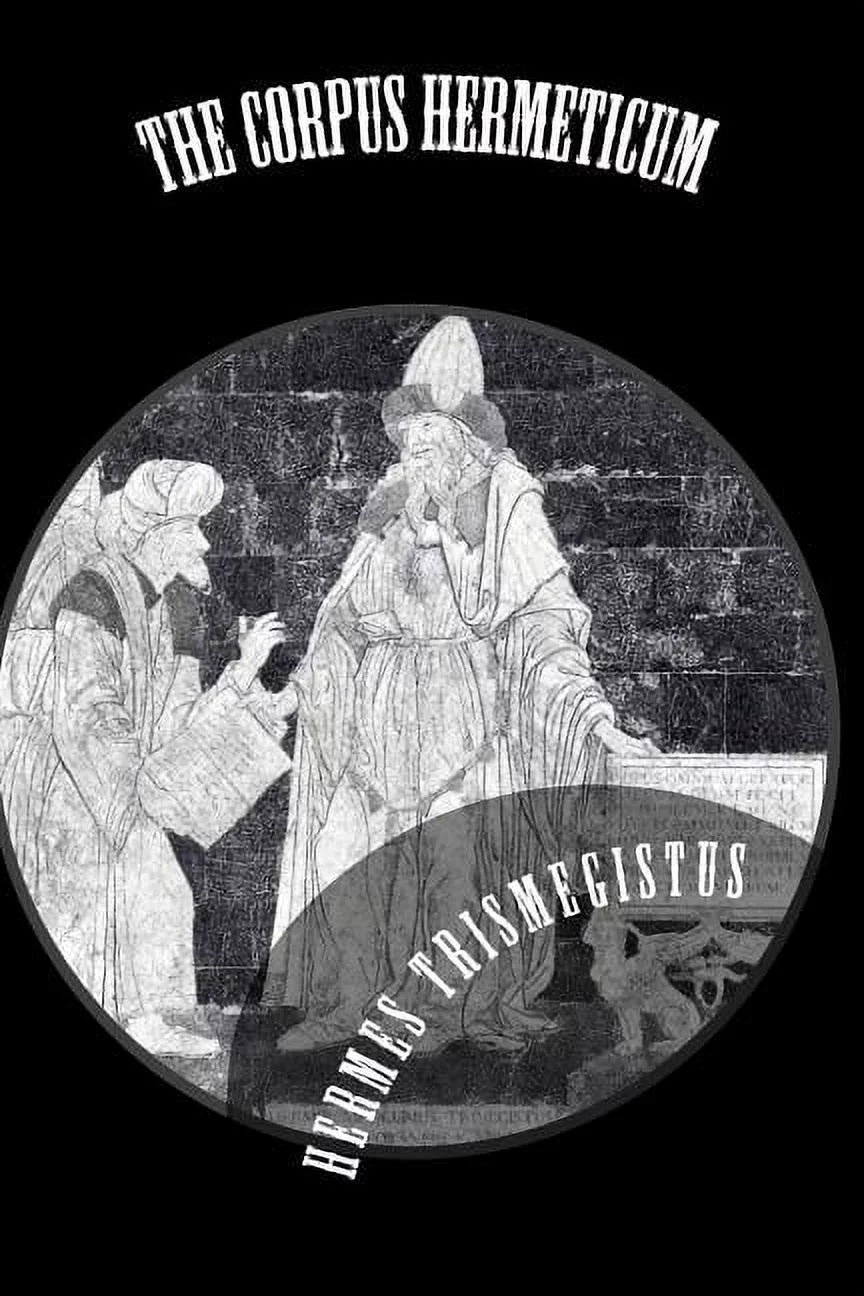
The Corpus Hermeticum | Hermes Trismegistus
The Corpus Hermeticum | Hermes Trismegistus
Couldn't load pickup availability
The Corpus Hermeticum
Extended Synopsis
In the foundational esoteric classic The Corpus Hermeticum, traditionally attributed to the legendary sage Hermes Trismegistus, the text analyzes the structural parameters of Greco-Egyptian religious syncretism, the tactical implementation of initiatory dialogue frameworks, and the systemic deconstruction of physical dualism. Published in this highly portable 104-page trade paperback layout by IAP, this collection of texts represents the intellectual bedrock of Hermeticism, composed primarily between the 1st and 3rd centuries A.D. The text establishes an unyielding theological thesis: the cosmos is a unified, living, and rational manifestation of the divine mind (Nous), and human beings can achieve genuine salvation and spiritual immortality not through blind institutional faith or legalistic rituals, but through the deliberate awakening of the intellect to achieve direct experiential knowledge (Gnosis) of the universe and its Creator.
Rather than arranging its esoteric doctrines into rigid systematic dogmas, the short anthology coordinates its classic philosophical insights across three prominent narrative and conceptual movements. The paradigm of the divine mind and Poimandres establishes the primary revelatory baseline. The collection launches with the famous Poimandres discourse, where a visionary seeker encounters the supreme “Shepherd of Men”—the absolute cosmic Mind. The dialogue maps the intricate spiritual architecture of creation, tracking how the divine word separated light from darkness and formed the seven celestial governors (the planetary spheres). This initial module establishes that human souls possess a dual nature: an immortal, divine essence bound within a mortal, physical vessel, setting the stage for an individual’s internal quest to break free from material limits and ascend back through the stars.
Moving through successive instructional dialogues between Hermes and his disciples, Tat and Asclepius, the architecture of regeneration and the ascent of the soul outlines the deep mechanics of spiritual rebirth. The instruction rejects external material priorities, framing the human body’s base physical senses as sleeping illusions that blind the rational mind. This module teaches that the soul must systematically shed its negative spiritual vices—such as ignorance, malice, greed, and arrogance—as it journeys upward through the planetary spheres, slowly transforming the human consciousness until it merges back into the absolute harmony of the divine essence. Finally, the sovereign resolution of the synthesis of nature and divinity achieves its structural peak by asserting the essential goodness and sacred beauty of the physical universe, directly countering the radical anti-material views held by contemporary Gnostic groups. Hermetic philosophy argues that because God is the active animator of all living systems, the material world functions as a beautiful, reflective mirror of the invisible divine realm.
Historical Significance
First compiled in classical antiquity, these dialogues were recovered during the European Renaissance and translated into Latin by Marsilio Ficino in 1471, rapidly becoming a cornerstone of Renaissance humanism, Neoplatonism, and speculative philosophy. The text's ancient lineage and profound philosophical framework were further validated in 1945 following the discovery of related Hermetic textual fragments within the Nag Hammadi library in Egypt, solidifying its place as a primary reference asset for university philosophy archives and researchers of early Christian-era heterodoxy.
Author Biography
Hermes Trismegistus (Hermes the Thrice-Greatest) is the legendary Hellenistic figure resulting from the syncretic cultural blending of the Egyptian god Thoth (the patron of wisdom, writing, and magic) and the Greek god Hermes (the messenger of the gods and guide of souls). Under this composite persona, an anonymous lineage of Alexandrian philosophers and esotericists composed a vast body of initiatory dialogues, cosmological discourses, and theological tractates between the 1st and 3rd centuries A.D., laying the foundational roots of Western alchemy, Renaissance magic, and holistic natural philosophy.
Reader Targeting
- Scholars of ancient and classical philosophy, historians of religion, seminarists, and researchers tracking Greco-Egyptian syncretism and early Gnostic movements.
- Analytical readers investigating the conceptual origins of Western esotericism, Renaissance magic, historical alchemy, and Neoplatonist metaphysics.
- Academic libraries, institutional research repositories, and philosophy collections seeking a highly portable reference edition of foundational Hellenistic text blocks.
Bibliographic & Physical Specifications
| Publisher & Imprint | IAP (Information Age Publishing / Independent Academic Press) |
|---|---|
| Publication Date | December 12, 2008 |
| Format & Binding | Paperback (Standard Trade Paperback Edition / First Printing Thus; perfect binding utilizing a flexible cardstock casing over lightweight acid-free book print stock with a clear protective layout wrap) |
| ISBN-13 / ISBN-10 | 9788562022104 / 8562022101 |
| Page Count | 104 pages (Contains the core collection of foundational Hellenistic philosophical dialogues, primary theological speech blocks, and historical textual overviews) |
| Dimensions & Weight | 9.00 x 6.00 x 0.24 inches | 5.3 oz (0.33 lbs / 150 grams) |
| BISAC Categories | PHILOSOPHY / History & Surveys / Ancient & Classical BODY, MIND & SPIRIT / Hermetism & Rosicrucianism RELIGION / Gnosticism |
Frequently Asked Questions
What is the core distinction between Hermeticism and contemporary Gnostic views on the physical universe?
Unlike many radical Gnostic groups of the 1st to 3rd centuries A.D. who viewed the physical world as an inherently evil or flawed creation, Hermetic philosophy asserts the essential goodness and sacred beauty of the cosmos. It argues that because God is the active animator of all living systems, the material world serves as a beautiful, reflective mirror of the invisible divine realm.
How does the text define the mechanism of salvation or spiritual liberation?
The text establishes that human beings achieve genuine salvation and spiritual immortality not through blind institutional faith or legalistic rituals, but through the deliberate awakening of the intellect to achieve Gnosis—direct, experiential knowledge of the cosmic architecture, the soul's dual nature, and the Creator.
Bust-Down Books: More Than a Bookstore
Share