Bust-Down Books
Designing Your Life | Bill Burnett & Dave Evans
Designing Your Life | Bill Burnett & Dave Evans
Couldn't load pickup availability
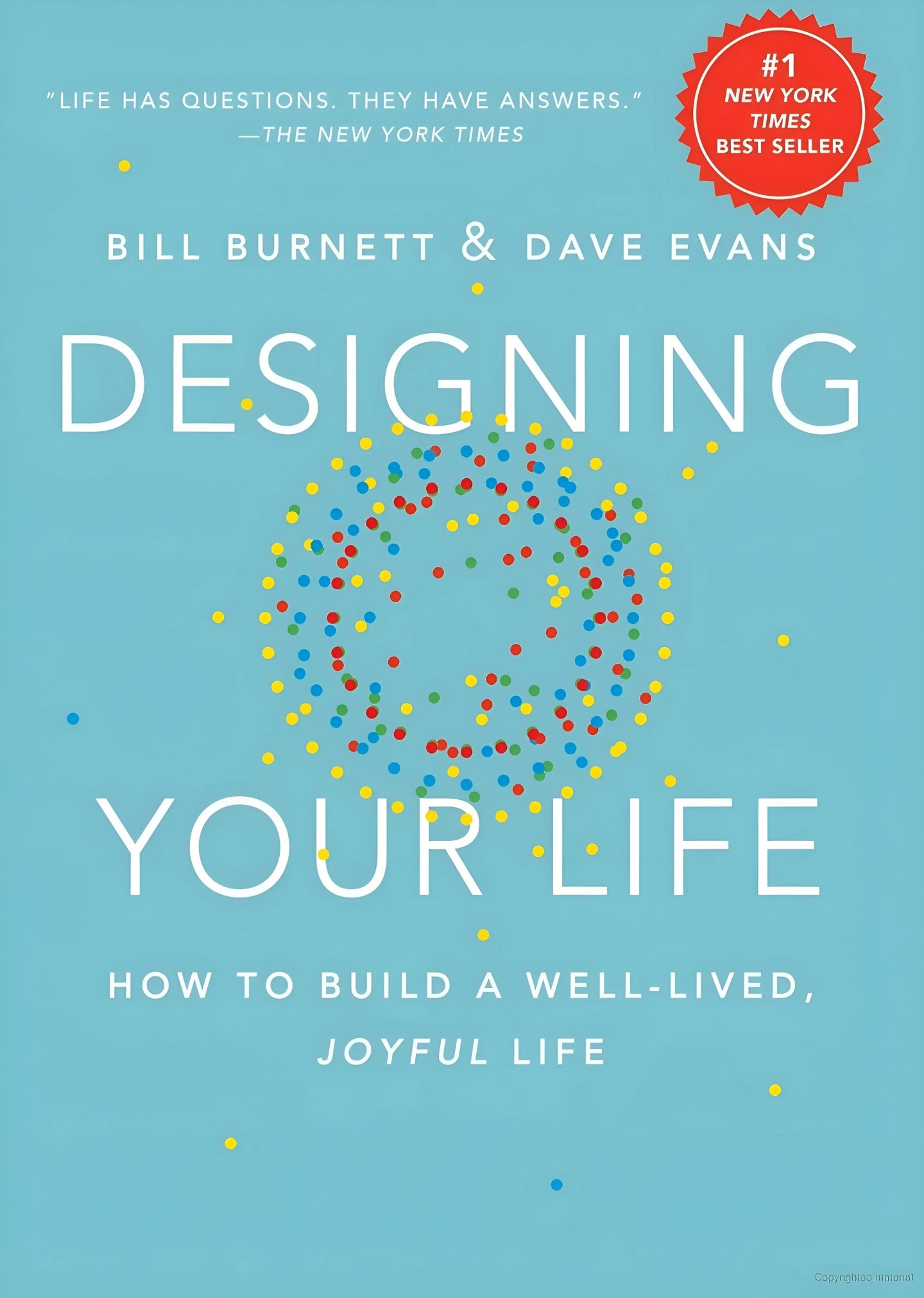
Designing Your Life: How to Build a Well-Lived, Joyful Life
Extended Synopsis
In Designing Your Life: How to Build a Well-Lived, Joyful Life, Silicon Valley design pioneers Bill Burnett and Dave Evans distill the transformative curriculum of Stanford University’s renowned Life Design Lab into an actionable blueprint for personal and vocational advancement. Spanning 272 pages, this genre-defining hardcover volume applies human-centered industrial design thinking methodologies to the complex processes of career development, behavior modification, and lifestyle optimization. Rather than relying on traditional, static self-help goal-setting, the authors demonstrate how systemic experimentation, creative reframing, and rigorous problem-solving can actively release individuals from professional paralysis and operational drift.
The system-driven text operates across three core execution phases:
- The Baseline Dashboard and Compass Construction: The structural foundation instructs readers to conduct an objective diagnostic assessment of their current state using a specialized “Health / Work / Play / Love” indicator matrix. By ranking each segment on a scale of one to ten, readers establish an honest baseline. The framework then guides users to articulate and align their internal “Workview” (the purpose and nature of work) with their overarching “Lifeview” (the core values driving existence), forging a resilient navigational compass that neutralizes limiting, dysfunctional beliefs.
- Wayfinding, Mind Mapping, and Odyssey Planning: Moving into generative ideation, the text introduces quantitative tracking mechanisms such as the “Good Time Journal” to log daily energy curves and cognitive engagement metrics during task execution. Utilizing these real-world data points, readers build multi-directional mind maps to explore non-linear professional opportunities. These ideas are synthesized into formal “Odyssey Plans”—three completely distinct, fully realized five-year timeline variations detailing alternative personal and vocational futures.
- Radical Collaboration and Failure Immunity: The final operational framework addresses practical implementation by shifting emphasis away from passive, standard job applications. The authors champion low-stakes experiential prototyping via targeted “Life Design Interviews” and exploratory trial experiences to test alternative realities before committing major capital or time. By integrating iterative testing loops, the book develops “Failure Immunity,” reframing setbacks as essential data feedback within an ongoing lifecycle.
Accolades & Milestones
“A number 1 New York Times Bestseller that successfully handles personal change through the rigorous framework of product design. A landmark text in applied design thinking and behavioral navigation.”
— The Applied Innovation Review
Author Biography
Bill Burnett is the Executive Director of the Design Program at Stanford University and an acclaimed industrial designer who has directed elite development tracks for global technology firms. Dave Evans is a co-founder of the Stanford Life Design Lab, an early Apple executive who led the team responsible for designing the first mouse, and a co-founder of Electronic Arts. Together, they leverage decades of high-stakes product design experience to teach corporate management teams, academic institutions, and global professionals how to navigate systemic change using human-centered design frameworks.
Reader Targeting
- Mid-career executives, entrepreneurs, and professionals seeking structural frameworks to pivot industries or re-engineer their daily productivity.
- Students, recent graduates, and academic advisors building foundational career maps using data-driven, practical tracking metrics.
- Practitioners of applied psychology, career counseling, and industrial design seeking an empirical, human-centered lifecycle manual.
Bibliographic & Physical Specifications
| Specification | Bibliographic & Physical Details |
|---|---|
| ISBN-13 / ISBN-10 | 9781101875322 / 1101875321 |
| Publisher / Imprint | Alfred A. Knopf / Knopf Doubleday Publishing Group (Penguin Random House) |
| Publication Date | September 20, 2016 |
| Edition / Format | First Edition / Hardcover Release with Protective Dust Jacket |
| Binding & Materials | Premium cloth-bound spine over heavy paperboard, clean white designer endpapers, printed on sustainable acid-free cream text paper stock via high-grade web offset presses |
| Page Count & Illustrations | 272 pages / Yes (Includes original line drawings, structured assessment charts, quadrant matrices, and workspace planning diagrams) |
| Dimensions (Imperial & Metric) | 8.25 x 5.88 x 1.30 inches (210 x 149 x 33 mm) |
| Weight | 16.8 oz (1.05 lbs / 476 grams) |
Frequently Asked Questions
What are the operational parameters of the "Odyssey Plans" described in the book?
An Odyssey Plan is a visual ideation tool wherein the reader outlines three completely distinct, non-overlapping five-year timeline maps. Rather than focusing solely on an obvious career trajectory, users must map out alternative futures—such as an entrepreneurial path or an entirely secondary creative pursuit—to stress-test personal adaptability and unlock non-linear opportunities.
How does design thinking differentiate itself from traditional career counseling?
Traditional career pathing often focuses on finding one definitive path through analytical assessment. Design thinking rejects the idea of a single, optimal answer, treating life as an ongoing, open-ended creation. It relies on active prototyping, experiential informational interviewing, and small-scale trial experiences to generate real-world data points before making large investments.
Bust-Down Books: More Than a Bookstore
Share