Bust-Down Books
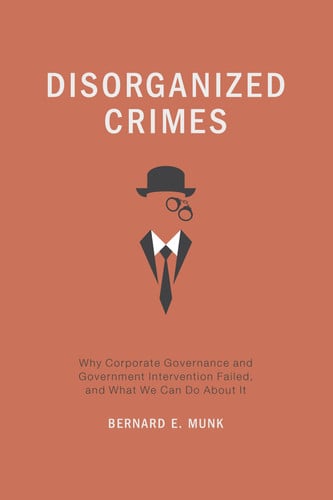
Disorganized Crimes: Why Corporate Governance and Government Intervention Failed, and What We Can Do About It | Bernard E. Munk
Disorganized Crimes: Why Corporate Governance and Government Intervention Failed, and What We Can Do About It | Bernard E. Munk
Couldn't load pickup availability
Disorganized crimes—outbreaks of corporate misgovernance growing out of the inherent conflict of interest between managers and shareholders—are no new thing. Economists since Adam Smith have been aware of the dilemma of having professional managers in charge of "other people's money." In Disorganized Crimes: Why Corporate Governance and Government Intervention Failed, and What We Can Do About It, Bernard E. Munk explains how and why these disruptions occur and how we can modify current governance practices and government regulation to reduce losses and avoid serious macroeconomic disturbances.
Book Overview & Core Themes
Linking major corporate breakdowns of the past decade—such as the Enron Era and the Credit Crisis of 2007–2008—the book illustrates what is common to each financial fiasco. Munk details how industry monitors such as boards of directors, external auditors, and rating agencies break down, while executive compensation and promotion structures leave corporate leaders insulated from personal liability and shareholders exposed to catastrophic losses.
Key areas examined within this work include:
- The principal-agent dilemma and agency costs inherent in modern corporate ownership.
- Systemic regulatory failures and how top-down government mandates often exacerbate corporate misconduct.
- Breakdowns in oversight among independent directors, accounting firms, and credit rating agencies.
- Designing market-aligned regulatory mechanisms to restore executive accountability and market stability.
About the Author
Bernard E. Munk holds a Ph.D. in economics from the University of Chicago and brings decades of experience as an entrepreneur and industrial executive across the agricultural, commodity, and petroleum sectors. Munk possesses unique dual authority as both a trained Chicago-school economist and a hands-on corporate leader, offering a pragmatic, market-grounded perspective on governance reform.
Core Audience & Intended Use
- Corporate Directors & Executives: Essential reading for business leaders seeking to align management incentives and eliminate dangerous liability gaps.
- Economists & Policy Analysts: A rigorous analysis of regulatory failure, market mechanisms, and financial policy reform.
- Finance & Law Scholars: An authoritative reference for business school curricula, corporate governance courses, and institutional policy research.
Product Specifications
| Full Title | Disorganized Crimes: Why Corporate Governance and Government Intervention Failed, and What We Can Do About It |
|---|---|
| Author(s) | Bernard E. Munk |
| Publisher & Imprint | Palgrave Macmillan |
| Publication Date | October 23, 2013 |
| Binding Format | Hardcover (HC) |
| Print Length | 336 Pages |
| Language | English |
| ISBN-13 / ISBN-10 | 9781137330260 / 1137330260 |
| Primary Genre (BISAC) | BUS008000 / BUSINESS & ECONOMICS / Business Ethics |
| Sub-Genres (BISAC) | BUS027000 / FINANCE; POL005000 / ECONOMIC POLICY; LAW018000 / CORPORATE |
| Item Condition | Pre-Owned / Very Good |
| Dimensions & Weight | 6.14 x 0.75 x 9.21 inches | 23.04 oz |
Frequently Asked Questions About Disorganized Crimes
What is Disorganized Crimes by Bernard E. Munk actually about?
The book provides an incisive economic and institutional analysis of corporate governance breakdowns and regulatory failures. Bernard E. Munk explores "disorganized crimes"—widespread corporate misgovernance born from agency costs and conflicting interests between executive managers and shareholders. He examines why traditional regulatory interventions fail and proposes market-aligned mechanisms to prevent financial crises.
How is the information presented in Disorganized Crimes by Bernard E. Munk? Is it a difficult read?
It is a structured, analytical work of economic and corporate policy literature. Munk bridges classical economic theory with empirical case studies, making the book highly engaging for finance professionals, corporate directors, and policy analysts. The narrative combines rigorous economic reasoning with accessible real-world examples to explain complex governance structures.
What are the main underlying messages or themes in Disorganized Crimes by Bernard E. Munk?
The text centers on the principal-agent dilemma, systemic regulatory failure, aligned incentives, and market-based governance reform. Munk argues that top-down government mandates often exacerbate corporate misconduct by creating perverse incentives, advocating instead for structural regulatory reforms that harness market forces to enforce executive accountability.
Did Disorganized Crimes by Bernard E. Munk win any major awards or get adapted into a movie?
While not adapted into a film, Disorganized Crimes earned praise within economic policy, academic, and financial governance circles. Published by Palgrave Macmillan, it remains an authoritative reference for researchers, business school curricula, and institutional policymakers focusing on corporate finance and financial regulation.
Why did Bernard E. Munk write Disorganized Crimes, and what makes the text uniquely significant to his personal career or background authority?
Munk wrote the book to offer a pragmatic, market-grounded alternative to ineffective financial legislation following major global economic downturns. Holding a Ph.D. in economics from the University of Chicago and bringing decades of experience as an entrepreneur and industrial executive across the agricultural, commodity, and petroleum sectors, Munk possessed unique dual authority as both a trained Chicago-school economist and a hands-on corporate leader.
Condition Notice: Pre-Owned / Second-Hand Product
All books, box sets, and multi-volume collections offered by Bust-Down Books are sold in pre-owned, used, and second-hand condition, unless explicitly designated as new in the individual product listing.
Condition Details & Grading:
- Previous Ownership: These items have been previously owned, handled, and read. As such, copies may exhibit typical signs of shelf wear, including but not limited to minor creasing, scuffing, edge wear, bent page corners, remainder marks, or spine softening. Hardcover editions may show minor dust jacket wear, edge chipping, or board rubbing.
- Markings & Personalization: Items may occasionally contain inscriptions, library stamps, owner names, marginalia, or highlighting. Individual item descriptions reflect significant deviations from standard acceptable condition.
- Supplemental Materials: Secondary and digital components—such as publisher access codes, CD-ROMs, bonus inserts, registration keys, or workbook activity pages—are not guaranteed to be included, active, or unredeemed unless specifically stated in the product description.
First Sale Doctrine & Non-Affiliation Statement:
All items sold on this platform are original, lawfully acquired copies being resold under the protection of the First Sale Doctrine (codified under U.S. copyright law, 17 U.S.C. § 109, and applicable international equivalents permitting the secondary resale of lawfully manufactured goods).
Bust-Down Books, LTD. is an independent, secondary-market bookseller. We are not affiliated with, endorsed by, authorized by, or sponsored by the original authors, copyright holders, publishers, or trademark owners of the titles offered for sale. All registered trademarks, author names, book titles, and publisher imprints remain the sole property of their respective owners and are used strictly for nominative identification and descriptive purposes.
Share