Bust-Down Books
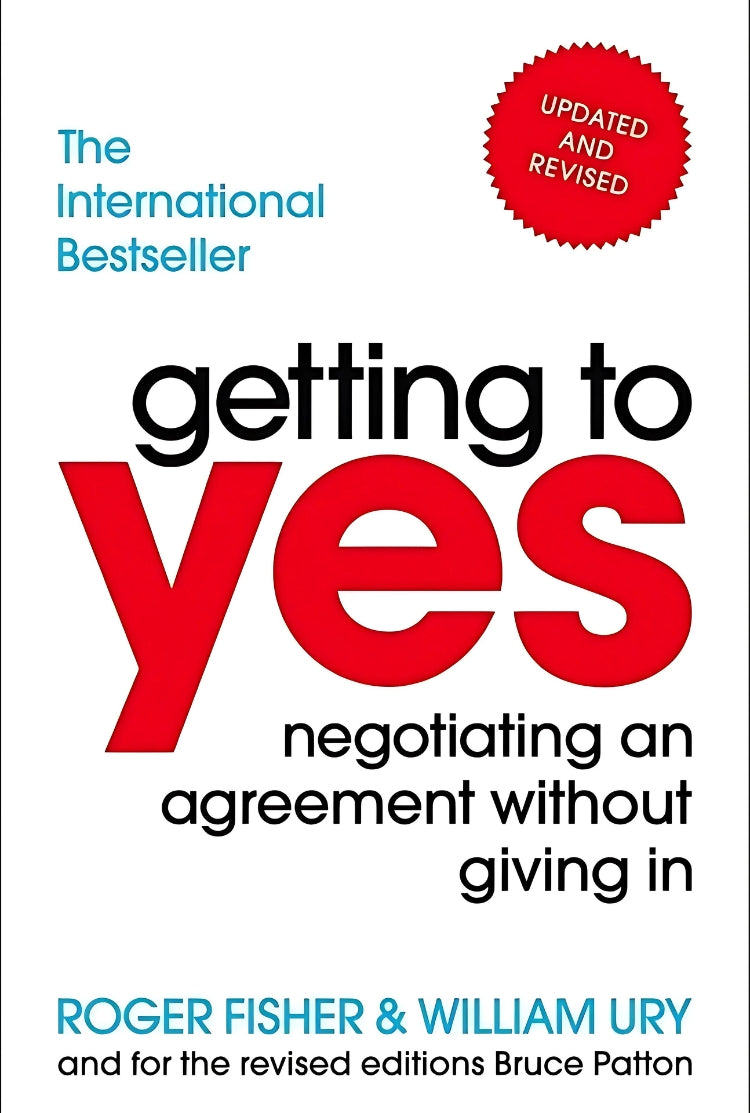
Getting to Yes | Roger Fisher & William Ury
Getting to Yes | Roger Fisher & William Ury
Couldn't load pickup availability
Getting to Yes: Negotiating an Agreement Without Giving In
Extended Synopsis
In the internationally dominant negotiation manual Getting to Yes: Negotiating an Agreement Without Giving In, legendary Harvard Negotiation Project pioneers Roger Fisher and William Ury, featuring critical editorial updates by Bruce Patton, analyze the structural parameters of interest-based mediation, the tactical dismantling of zero-sum posturing, and the systemic implementation of objective operational metrics. Reissued as an expanded 240-page trade paperback by Random House Business Books, this timeless classic operates as the definitive antidote to destructive, ego-driven bargaining. The authors establish an unyielding operational thesis: optimal, long-term agreements are never extracted through stubborn positional warfare or submissive concessions, but must be systematically engineered by separating interpersonal friction from substantive problems, tracking underlying systemic motivations rather than surface ultimatums, and anchoring all final resolutions to independent, verifiable standards of fairness.
Rather than arranging the material as a collection of loose diplomatic anecdotes, the text organizes its universal communicative methodology across precise strategic pillars. The paradigm of principled negotiation introduces an iconic four-point framework designed to bypass the traditional compromise trap of “soft” versus “hard” bargaining. The framework instructs practitioners to separate the people from the problem to preserve relational equity, focus heavily on mutual interests rather than rigid positions, invent multiple creative options for mutual gain before attempting a settlement, and insist that the ultimate evaluation relies strictly on objective criteria. This baseline structural module trains the negotiator to treat the opposing party not as an existential adversary, but as a collaborative problem-solving partner facing a shared dilemma.
Moving into asymmetric power dynamics, the text details the architecture of the BATNA, or “Best Alternative to a Negotiated Agreement,” which stands as one of the most celebrated concepts in modern strategic decision theory. The authors demonstrate that a negotiator's true leverage does not stem from raw financial scale or aggressive bravado, but from the absolute clarity and strength of their fallback options outside the room. The blueprint concludes by outlining systemic solutions for neutralizing deceptive tactics, positional stonewalling, and psychological warfare through strategic maneuvers like “negotiation jujitsu”—deliberately redirecting an opponent's raw aggression away from personal attacks directly onto the core structural problem. This premium Random House Business paperback remains an indispensable reference asset for university corporate strategy archives, legal mediation practices, and international relations libraries.
Accolades & Praise
“Getting to Yes is highly readable, companionable, and filled with a wealth of right-minded thinking on dealing with conflicts.”
— The New York Times
“The most valuable business book ever written. It offers an objective blueprint for human cooperation that can resolve the most complex industrial or political disputes.”
— The Journal of Business Strategy
Author Biography
Roger Fisher (1922–2012) was the Samuel Williston Professor of Law Emeritus at Harvard Law School and a co-founder of the Harvard Negotiation Project. A world-renowned expert in conflict resolution, he advised governments, corporate entities, and international bodies on high-stakes disputes. William Ury is an acclaimed anthropologist, negotiation expert, and co-founder of the Harvard Negotiation Project, globally recognized for his work as a mediator in ethnic, industrial, and political conflicts. Co-author Bruce Patton is a Harvard Law School alumnus, co-founder of the Harvard Negotiation Project, and an architect of the Harvard negotiation curriculum, specializing in corporate mediation and relational communication models.
Reader Targeting
- Corporate executives, managers, legal professionals, and mediators seeking an objective, interest-based framework for dispute resolution.
- Students and academic researchers specializing in business administration, jurisprudence, international relations, and organizational behavior.
- Analytical readers looking to neutralize bad-faith bargaining tactics and optimize long-term relational value in professional transactions.
Bibliographic & Physical Specifications
| Publisher | Penguin Random House UK |
|---|---|
| Imprint | Random House Business Books |
| Publication Date | June 7, 2012 |
| Format & Binding | Trade Paperback (3rd Revised / 30th Anniversary Edition; standard trade perfect binding with a flexible cardstock casing and smooth protective matte laminate finish) |
| ISBN-13 / ISBN-10 | 9781847940933 / 1847940935 |
| Page Count | 240 pages (Includes complete text of the four-point principled negotiation framework, advanced diagnostic case studies, the comprehensive “Ten Questions People Ask” backend expansion block, and historical index) |
| Illustrations | Yes (Includes comparative procedural tables, relational communication charts, and operational decision matrices) |
| Dimensions & Weight | 7.76 x 5.08 x 0.63 inches | 6.1 oz (0.38 lbs / 174 grams) |
| BISAC Categories | BUSINESS & ECONOMICS / Negotiating BUSINESS & ECONOMICS / Conflict Resolution & Mediation SELF-HELP / Personal Growth / Success |
Frequently Asked Questions
What does BATNA stand for, and why is it critical to the text's philosophy?
BATNA stands for “Best Alternative to a Negotiated Agreement.” It represents the most advantageous alternative course of action a party can take if negotiations break down. The authors demonstrate that your BATNA is your true source of negotiating power, preventing you from accepting unfavorable agreements.
What structural enhancements are included in this 3rd Revised Edition?
This 30th Anniversary printing integrates extensive analytical revisions by Bruce Patton, incorporating refined procedural tables, decision matrices, and a comprehensive backend section titled “Ten Questions People Ask” to address real-world application challenges.
Bust-Down Books: More Than a Bookstore
Share