Bust-Down Books
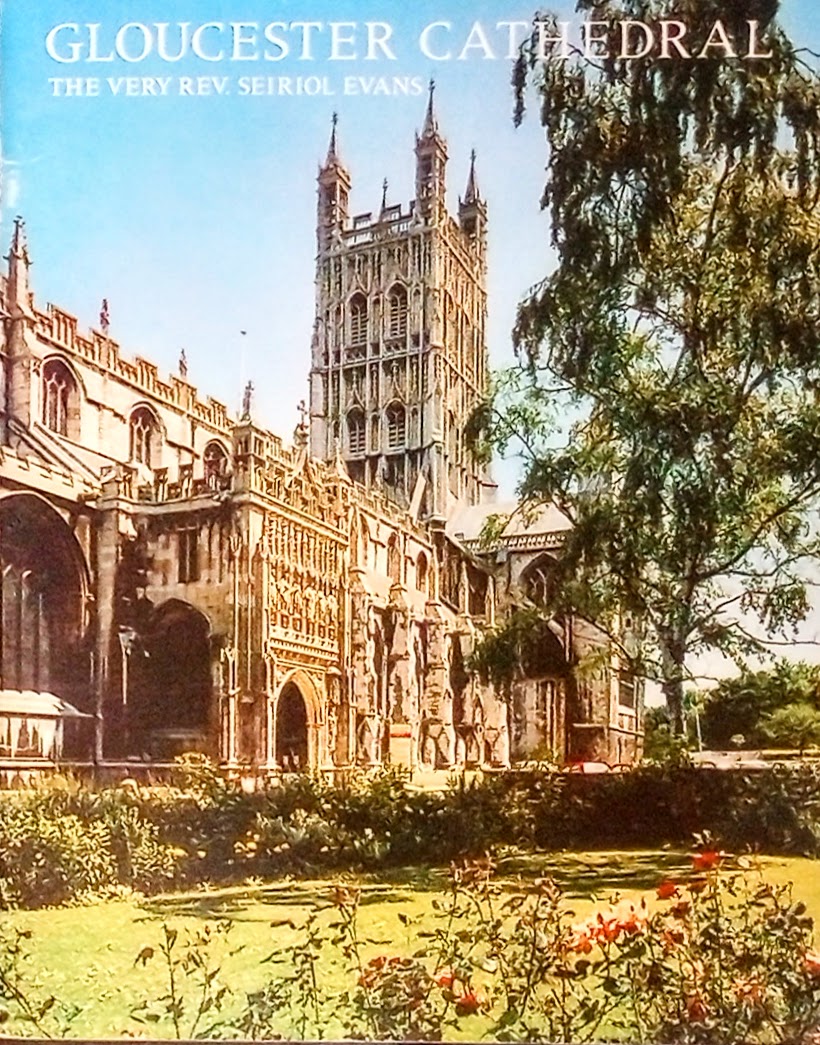
Gloucester Cathedral: Pride of Britain | The Very Rev. Seiriol Evans
Gloucester Cathedral: Pride of Britain | The Very Rev. Seiriol Evans
Couldn't load pickup availability
Gloucester Cathedral
The Very Rev. Seiriol Evans
Gloucester Cathedral which has been described as the sixth most beautiful building in Europe, has a long history, but the site on which it stands had been holy ground for a great deal longer. In the cathedral library there is a manuscript which tells how King Ethelred gave Osric, a local chief, permission to found a monastery in Gloucester in honour of St. Peter in 681.
In the unsettled state of England, this monastery was twice destroyed, but was refounded by Aldred, bishop of Worcester, in 1048. Gloucester from the 7th to 11th century was one of the great meeting places of the kingdom, and was emphatically a royal city. A document printed in Dugdale's Monasticon tells us that King Edward the Confessor stayed in Gloucester at the time when the Danes were expelled from the country, and held a Witan in the old part of the monastery.
Ethelfleda, the daughter of King Alfred, called the "Lady of the Mercians", dying in her castle of Tamworth, was brought to Gloucester for burial, and the Anglo Saxon Chronicle records that her body lies in "the east porch of St. Peter's Church". Nevertheless, Aldred's monastery did not flourish, and when William the Conqueror turned his attention to it, he found only two monks and eight novices.
The Norman Church
To William I also Gloucester was an important place; not only because of its traditional connection with the Old English royalty, but because it commanded a ford of the river Severn. In 1072 therefore he determined to revive the monastery. and he made his friend and chaplain Serlo, who had been trained at Mont St. Michel in Normandy, the first abbot of the new foundation.
Serlo ruled the house for thirty-three years, and at his death in 1104 there were a hundred monks in the house; he had rebuilt the monastic buildings, and had begun in 1089 a church, which he saw con 1100. After his death, commemorated him in verses speak of him as "the wall of the Church, the sword of virtue, and the clarion of justice".
Serlo destroyed the Sase and began again. A great abbey church is still standing. The choir rests upon a crypt entered from the south transept. Its arrangement corresponds exactly to the plan of the upper storey. Its floor is about eight feet below ground level and its centre aisle is divided by two rows of small piers, irregularly placed, from which spring round arches carrying the floor of the choir above.
The whole of the centre of the crypt is encircled ambulatory, the vault springs from the small piers and is supported on the outer walls. It seems clear that the weight of the choir above proved too much for the crypt piers, and soon after building was finished they had to be reinforced with the drum-like casings which appear in the ambulatory.
The date of the crypt must be 1089 but it is a matter of some uncertainty whether the piers in the centre are of this date.
Some authorities consider that they may belong to the crypt of Bishop Aldred's church and were reused by Abbot Serlo. The crypt was strengthened again when the choir was heightened and enlarge 14th century, and the two huge shapeless piers at the east end were added to carry the weight.
We are now able to res history of the Norman abbey church as a whole. Beginning in 1089, seventeen years after his arrival, Abbot Serlo built first his crypt and choir, and completed the transepts to abut a central tower. The striking contrast between the short stocky piers of the Norman choir and the enormous cylindric piers of the nave, seems to demand an explanation. Can they be the work of the one architect, or must we suppose that a different mind planned the nave arcades at a somewhat later date?
Featured Photos:
The nave arcade, with its great cylindrical piers, is part of Serlo's Norman church, and is roofed by the plain 13th century vault. The choir screen of 1820 replaces the medieval pulpitum.
Gloucester Cathedral | The Very Rev. Seiriol Evans
Share