Bust-Down Books
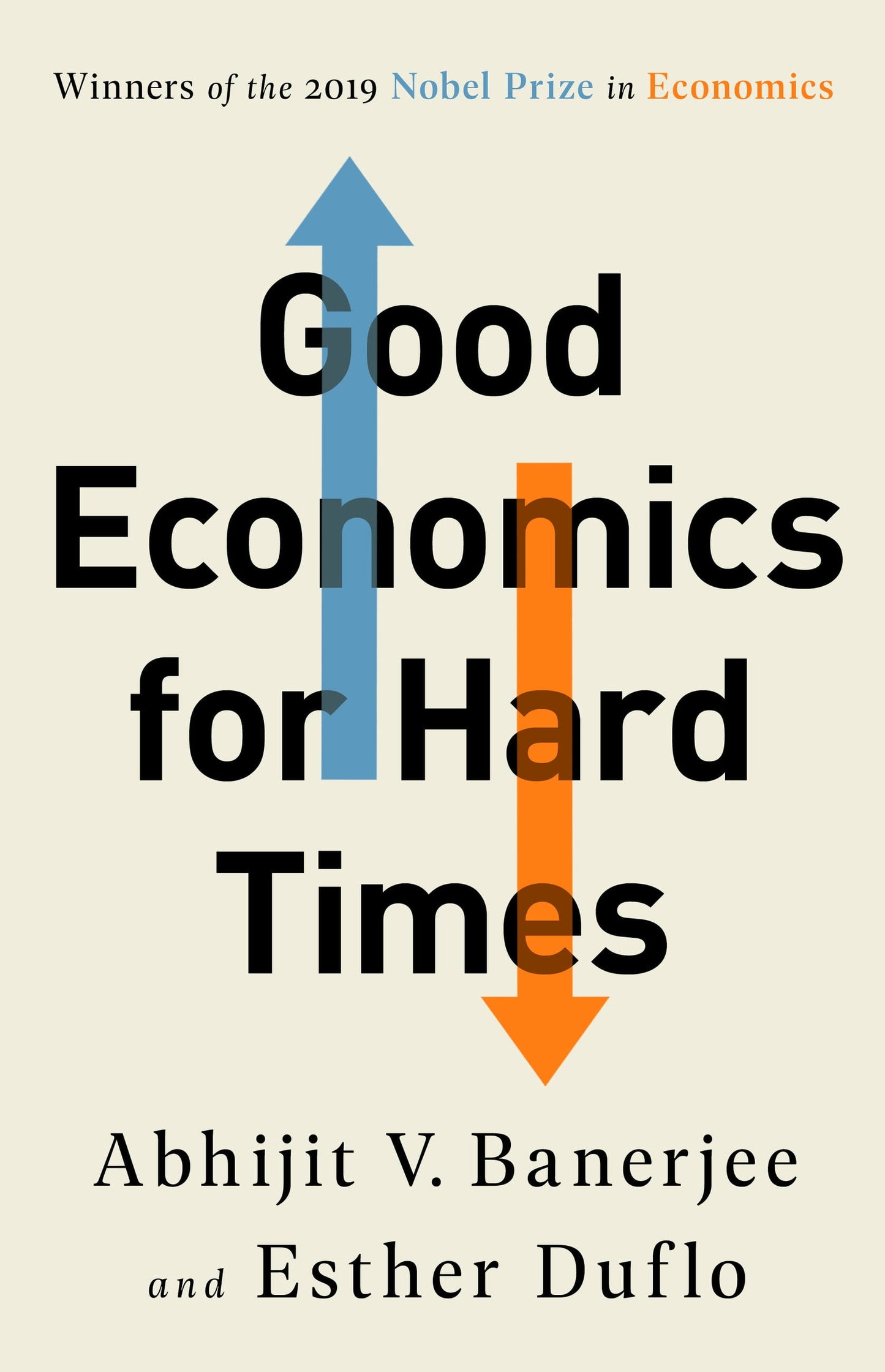
Good Economics for Hard Times | Abhijit V. Banerjee & Esther Duflo
Good Economics for Hard Times | Abhijit V. Banerjee & Esther Duflo
Couldn't load pickup availability
Good Economics for Hard Times: Better Answers to Our Biggest Problems
Extended Synopsis
In this revolutionary work, renowned MIT economists and winners of the 2019 Nobel Prize in Economics, Abhijit V. Banerjee and Esther Duflo, tackle the ultimate challenge of our era: figuring out how to navigate today’s most critical economic, social, and political divisions. Spanning 416 pages of rigorous empirical analysis, Good Economics for Hard Times leverages advanced randomized controlled trials (RCTs) and cutting-edge behavioral research to build a persuasive case for intelligent state interventionism anchored in compassion, human dignity, and respect.
The authors systematically dismantle traditional, western-centric economic biases, framing their field research across three major policy vectors:
- The Stickiness of Labor and the Immigration Myth: Banerjee and Duflo challenge standard neoclassical assumptions that view human beings as hyper-mobile economic agents who instantly relocate for higher wages. Demonstrating that labor is fundamentally “sticky”—bound by culture, family safety nets, and psychological risk aversion—they prove that low-skilled immigration does not systematically depress native wages, nor does trade liberalization offer smooth reallocations for displaced industrial workforces.
- Technological Disruption, Automation, and Dignity Metrics: Addressing rising global anxieties regarding AI and industrial automation, the text critiques traditional metrics that solely maximize GDP growth. The authors argue that public policy must prioritize human dignity, health, and social integration over raw economic expansion, advocating for targeted localized transitions, robust wage subsidies, and structural reinvestments in public infrastructure.
- Tax Architectures, Ideological Polarization, and State Trust: The concluding sections examine modern taxation models and the widening trust deficit separating citizens from state institutions. Backed by psychological and historical data, the text demonstrates that progressive marginal tax rates on ultra-high earners do not kill entrepreneurial innovation; rather, they provide the essential capital needed to fund public interventions and cushion free-market volatility.
Accolades & Global Honors
Nobel Laureate Masterwork: Written and published immediately following the authors’ recognition as winners of the 2019 Nobel Prize in Economics.
“An extraordinary achievement that shines an empirical light on our precariously balanced world. Banerjee and Duflo reclaim economics as a human-centric science, offering candid strategies where zones of ignorance and ideological polarization have historically failed.”
— Bust Down Books Academic Review
Author Biographies
Abhijit V. Banerjee is the Ford Foundation International Professor of Economics at the Massachusetts Institute of Technology (MIT). A co-founder of the Abdul Latif Jameel Poverty Action Lab (J-PAL), his pioneering use of randomized controlled trials revolutionized development economics, earning him the Nobel Prize in 2019.
Esther Duflo is the Abdul Latif Jameel Professor of Poverty Alleviation and Development Economics at MIT. She is the youngest person and the second woman to win the Nobel Prize in Economics, recognized globally for her paradigm-shifting research on social policy, healthcare, and education delivery systems in developing nations.
Reader Targeting
- Macroeconomics and international development students looking for concrete, data-backed alternatives to neoclassical economic models.
- Public policy advocates, progressive analysts, and urban planners addressing trade dislocations, tax reform, and automation safeguards.
- General readers seeking a lucid, accessible, and deeply humanistic analysis of globalization, immigration, and political polarization.
Bibliographic & Physical Specifications
| Specification | Bibliographic & Physical Details |
|---|---|
| ISBN-13 / ISBN-10 | 9781541788947 / 154178894X |
| Publisher / Imprint | PublicAffairs / Perseus Books (Hachette Book Group) |
| Publication Date | November 12, 2019 |
| Edition / Format | First Edition (Hardcover Release with Dust Jacket) |
| Binding & Materials | High-durability cloth-bound presentation boards, charcoal spine-wrap cardstock, Smyth-sewn archival trade binding |
| Paper Stock & Page Count | High-density cream book text paper stock / 416 pages |
| Illustrations & Graphics | Includes developmental data plots, labor migration charts, inequality graphs, and economic trend matrices |
| Dimensions & Weight | 9.50 x 6.25 x 1.40 inches (241 x 159 x 36 mm) / 23.2 oz (1.45 lbs / 658 grams) |
Frequently Asked Questions
What does the text mean by stating that human labor is fundamentally “sticky”?
Traditional trade models assume that workers instantly move across industries or locations when jobs vanish or shift. Banerjee and Duflo reveal that real human labor is highly immobile due to deep-seated cultural connections, family safety structures, and financial risk aversion. This structural stickiness means free trade can create severe, localized economic scars rather than smooth transitions.
How do the authors critique standard implementations of Universal Basic Income (UBI)?
While acknowledging UBI’s benefits in developing regions, the authors express concern that broad, unmitigated cash distribution in advanced economies fails to solve the psychological loss of identity associated with structural unemployment. Instead, they champion localized job transitions, care-economy subsidies, and explicit safety interventions aimed at preserving human dignity.
Bust-Down Books: More Than a Bookstore
Share