Bust-Down Books
HBR's 10 Must Reads on Strategy | Michael E. Porter
HBR's 10 Must Reads on Strategy | Michael E. Porter
Couldn't load pickup availability
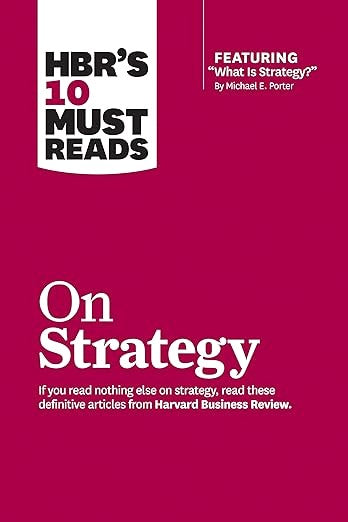
HBR's 10 Must Reads on Strategy: If You Read Nothing Else on Strategy, Read These Definitive Articles from Harvard Business Review: Volume-1
Extended Synopsis
In HBR's 10 Must Reads on Strategy: Volume 1, Harvard Business Review compiles ten of the most definitive, historically significant articles from its archives to construct a definitive reference manual for modern corporate leadership. Spanning 288 pages, this curated anthology explores how organizations build, maintain, and defend sustainable market advantages in highly volatile environments. Featuring cornerstone academic frameworks from legendary strategists like Michael E. Porter, W. Chan Kim, and Renée Mauborgne, the volume clarifies the complex operational mechanics required to translate high-level executive visions into daily corporate victories.
The compilation anchors its strategic theory across three vital corporate vectors:
- Operational Effectiveness Versus True Strategy: Anchored by Michael E. Porter’s foundational essay “What Is Strategy?”, the text establishes a rigid boundary between operational optimization and authentic strategic positioning. While operational effectiveness focuses on executing similar corporate activities better than rivals, true strategy dictates performing entirely different activities, or executing similar activities in radically distinctive ways. Sustained profitability relies on building a unique, integrated system of complementary processes that competitors cannot easily copy.
- Value Innovation and Market Reclamation Models: The volume details W. Chan Kim and Renée Mauborgne’s paradigm-shifting “Blue Ocean Strategy” framework. Leaders are guided to reject destructive, head-to-head competition within overcrowded “red oceans” and instead break the traditional cost-value trade-off. Through deliberate Value Innovation, companies systematically reduce or eliminate low-impact industry standards while scaling entirely unprecedented value offerings, constructing uncontested market territory where competition becomes irrelevant.
- Balanced Strategic Metrics and Organizational Alignment: To address execution bottlenecks, the text introduces Robert S. Kaplan and David P. Norton’s “Balanced Scorecard” methodology. Recognizing that relying exclusively on short-term financial indicators creates structural blindness, this matrix tracks performance across four interconnected organizational perspectives: financial outcomes, customer value, internal business efficiency, and continuous learning and growth. This holistic configuration transforms abstract corporate goals into concrete, measurable frontline operations.
Accolades & Praise
“An indispensable collection bringing together the most influential strategic thinking in modern commerce to help businesses allocate capital, establish clear differentiation, and make high-stakes corporate decisions with absolute clarity.”
— Bust Down Books Editorial Review
Author & Contributor Biographies
Harvard Business Review (HBR) is the preeminent global destination for smart management thinking and classic corporate strategy. Through its flagship magazine, academic press editions, and digital platforms, HBR provides corporate executives, research scholars, and consultants with rigorous empirical insights designed to improve leadership excellence.
Michael E. Porter is the Bishop William Lawrence University Professor at Harvard Business School. The author of nineteen books and over 125 articles, he is widely recognized as the father of modern business strategy and the creator of the Five Forces framework, which remains a cornerstone curriculum requirement across global business schools.
Reader Targeting
- Chief Executive Officers, corporate directors, and managing partners seeking to transition their operations away from price-war commoditization toward high-margin market insulation.
- Executive MBA candidates, corporate consultants, and business analysts requiring a unified academic reference manual on competitive positioning and corporate governance frameworks.
- Mid-level managers and cross-functional team leaders looking to align local metrics and department workflows with high-level corporate visions.
Bibliographic & Physical Specifications
| Specification | Bibliographic & Physical Details |
|---|---|
| ISBN-13 / ISBN-10 | 9781422157985 / 1422157989 |
| Publisher / Imprint | Harvard Business Review Press / Harvard Business School Publishing |
| Publication Date | February 1, 2011 |
| Edition / Format | First Edition / Trade Paperback |
| Binding & Materials | Heavy-gauge flexible softcover cardstock, protective matte laminate finish, commercial thermal perfect binding, clean high-opacity white acid-free text stock |
| Page Count & Charts | 288 pages / Includes detailed matrix frameworks, strategic positioning charts, data tables, and corporate diagrams |
| Dimensions (Imperial & Metric) | 8.25 x 5.50 x 0.70 inches (210 x 140 x 18 mm) |
| Weight | 11.2 oz (0.70 lbs / 318 grams) |
Frequently Asked Questions
What is the fundamental difference between operational effectiveness and business strategy?
Operational effectiveness focuses on performing identical activities better, faster, or at a lower cost than your competition. While vital for short-term survival, it is easily emulated and leads to industry convergence. Business strategy, conversely, requires creating a unique and sustainable market position by either performing entirely different activities or performing similar activities in a uniquely distinct way.
How does a Balanced Scorecard prevent traditional corporate strategic blindness?
Standard strategic systems often rely exclusively on retrospective financial metrics, which only highlight past performance. The Balanced Scorecard prevents strategic blindness by expanding assessment criteria across three additional forward-looking indicators: customer perspectives, internal process efficiency, and organizational learning and growth frameworks, creating a balanced path to long-term alignment.
Bust-Down Books: More Than a Bookstore
Share