Bust-Down Books
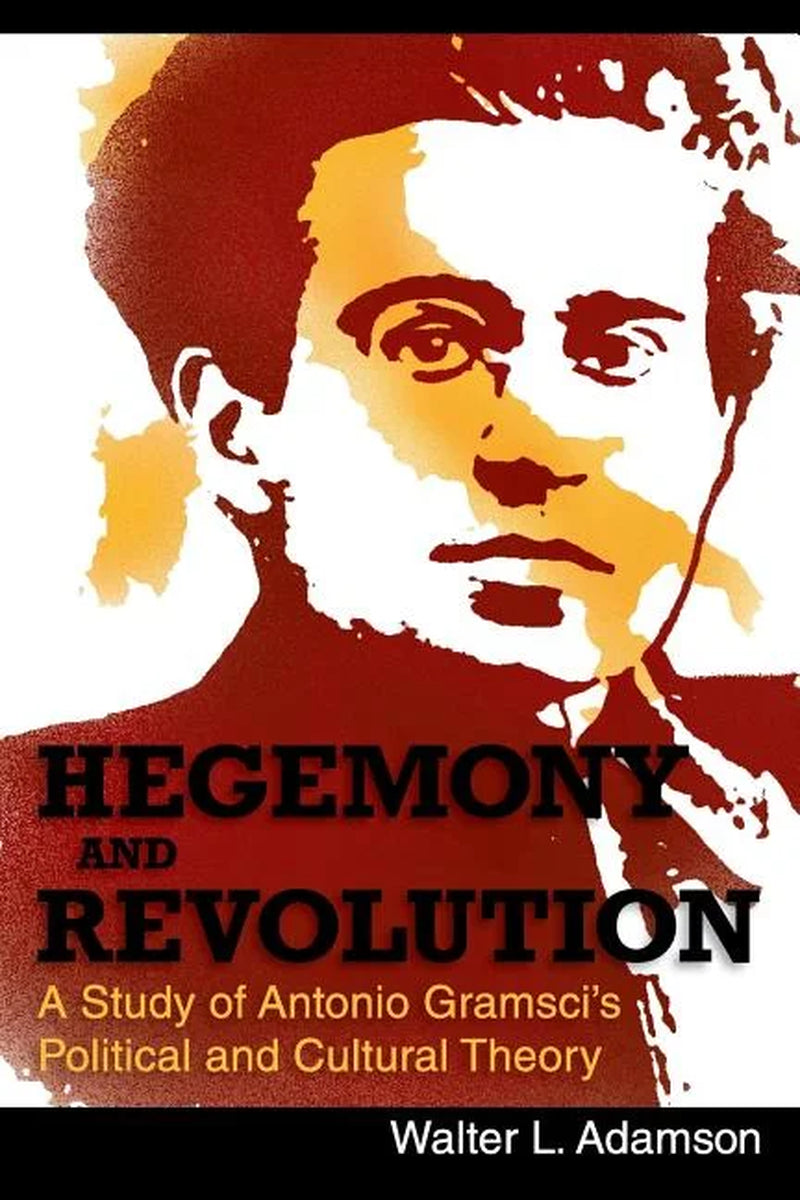
Hegemony and Revolution | Walter L. Adamson
Hegemony and Revolution | Walter L. Adamson
Couldn't load pickup availability
Hegemony and Revolution
Extended Synopsis
In the definitive scholarly masterpiece Hegemony and Revolution: A Study of Antonio Gramsci’s Political & Cultural Theory, preeminent political historian Walter L. Adamson analyzes the structural parameters of cultural hegemony, the tactical orchestration of working-class counter-institutions, and the systemic deconstruction of classical economic determinism. Reissued in this durable 316-page academic trade paperback format by Echo Point Books & Media, this foundational text moves past simplistic ideological slogans to map the rigorous intellectual trajectory of Italy’s most original Marxist theorist. Adamson establishes an unyielding analytical thesis: Gramsci’s legendary concept of “hegemony” was not a sudden, detached discovery made inside his fascist prison cell, but a deeply considered evolution derived directly from his practical, street-level experiences with the Turin factory council movements of the Biennio Rosso (1919–1920).
Rather than arranging the conceptual critique as an unstructured biography, the author coordinates his comprehensive theoretical parsing across three primary structural pillars. The paradigm of the pre-prison militancy and councilism sets the historical-operational baseline. The volume meticulously reconstructs Gramsci's early career as an active journalist, socialist organizer, and co-founder of L'Ordine Nuovo. Adamson details how Gramsci's intense focus on the Turin factory councils formed his baseline understanding of worker self-governance, viewing these councils not merely as blunt instruments for staging industrial strikes, but as the active, embryonic framework for a completely new proletarian state culture.
Moving deep into the complex architecture of the Prison Notebooks, the architecture of cultural hegemony and the historic bloc details the tactical sociological framework. The text systematically deconstructs Gramsci's breakthrough realization of how the modern bourgeois state maintains absolute power. Adamson maps how the capitalist ruling class cements its dominance not merely through raw military force or economic coercion, but through the active cultivation of cultural hegemony—using civil society institutions like schools, churches, and the press to turn their localized class interests into universal “common sense.” This layer explores the creation of a “historic bloc”—the intricate web of alliances and cultural ideas that binds subordinate classes to the status quo, requiring a sophisticated “war of position” to dismantle. The volume achieves its ultimate peak by outlining the sovereign resolution of the war of position and organic intellectuals, outlining the practical, long-term counteroffensive necessary to generate leaders emerging directly from the populace to critique bourgeois myths and construct an alternate, liberating worldview.
Accolades & Awards
- Winner of the Howard R. Marraro Prize – Awarded by the Society for Italian Historical Studies for its outstanding contribution to the history of Italy and Italian cultural theory.
Author Biography
Walter L. Adamson earned his PhD in the History of Ideas from Brandeis University in 1976. A recipient of the Mellon Fellowship in the Humanities at Harvard University, Dr. Adamson joined the faculty at Emory University in 1978, where he later served as the Chair of the History Department. He teaches modern European intellectual history and Italian history from the Risorgimento forward, with specialized research emphasis on fascism, nationalism, avant-garde cultures, and imperialism. He is also the author of Marx and the Disillusionment of Marxism, Avant-garde Florence, and Embattled Avant-gardes.
Reader Targeting
- Scholars, faculty, and graduate students of political science, Marxist philosophy, historical sociology, and critical theory.
- Researchers analyzing twentieth-century European intellectual history, Italian fascism, counter-hegemonic social movements, and subaltern class structures.
- Academic libraries and research repositories seeking an authoritative monograph tracking the evolution of the Prison Notebooks.
Bibliographic & Physical Specifications
| Publisher & Imprint | Echo Point Books & Media |
|---|---|
| Publication Date | October 14, 2014 |
| Format & Binding | Trade Paperback (Standard Academic Facsimile Reprint / First Printing Thus; standard perfect binding with a flexible cardstock casing over cream text stock) |
| ISBN-13 / ISBN-10 | 9781626549098 / 1626549095 |
| Page Count | 316 pages (Includes full analytical introduction parts, structural notes on the Prison Notebooks, extensive academic citation logs, and a comprehensive topical master index) |
| Dimensions & Weight | 9.00 x 6.00 x 0.67 inches | 15.0 oz (0.94 lbs / 426 grams) |
| BISAC Categories | POLITICAL SCIENCE / History & Theory PHILOSOPHY / Political SOCIAL SCIENCE / Criminology |
Frequently Asked Questions
What central thesis does Walter Adamson present regarding Gramsci's theoretical evolution?
Adamson argues that Gramsci's concept of cultural hegemony was not a detached discovery formulated entirely during his political imprisonment. Instead, it was an explicit, logical extension of his pre-prison career as a militant journalist and organizer during the Turin factory council movements of 1919–1920.
How does Gramsci's theory of hegemony impact fields outside of traditional Marxism?
By shifting the analysis from purely economic determinism to the domains of culture, ideology, and language, Gramsci's theories laid the groundwork for modern subaltern studies, postcolonial theory, and Foucault-style critiques of institutional discursive practices.
Bust-Down Books: More Than a Bookstore
Share