Bust-Down Books
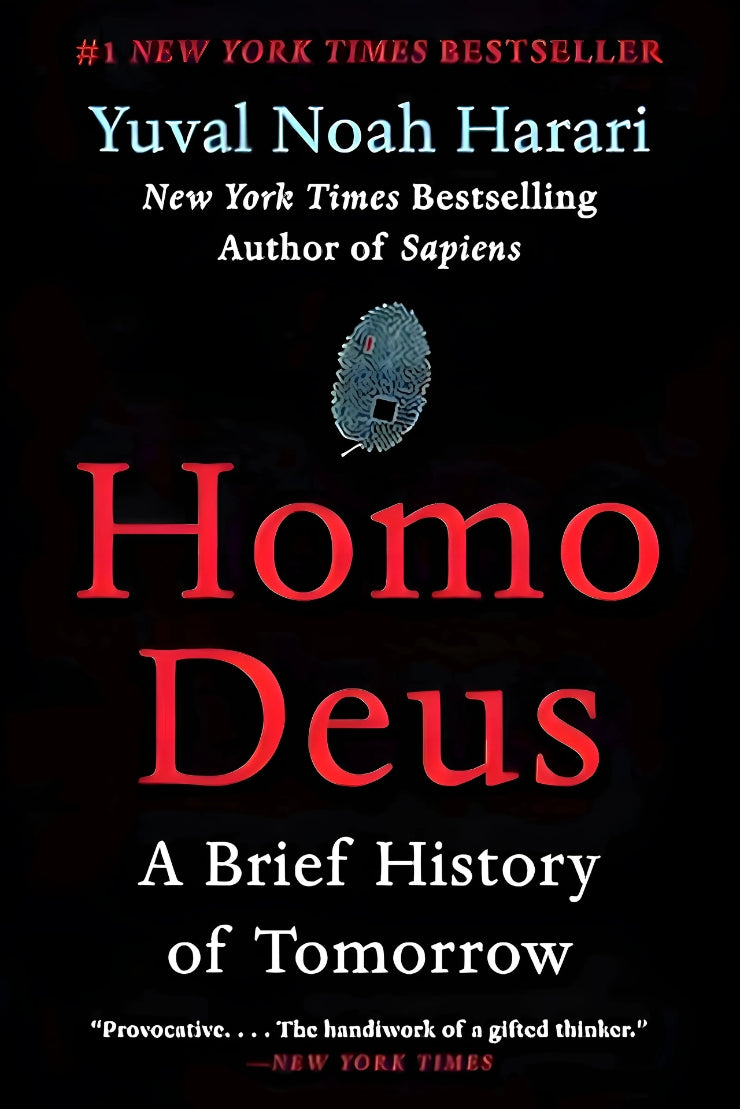
Homo Deus | Yuval Noah Harari
Homo Deus | Yuval Noah Harari
Couldn't load pickup availability
Homo Deus: A Brief History of Tomorrow
Extended Synopsis
In Homo Deus: A Brief History of Tomorrow, acclaimed historian and philosopher Yuval Noah Harari turns his gaze forward to explore the next defining stage of human evolution. Having charted humanity's past in his global phenomenon Sapiens, Harari investigates the profound projects, dreams, and nightmares that will shape the twenty-first century. As civilization successfully manages historical scourges like famine, plague, and war, humanity’s primary agendas are shifting toward grander, unprecedented ambitions: the acquisition of immortality, the optimization of absolute happiness, and the pursuit of godlike attributes (“divinity”).
Blending evolutionary science, history, and deep philosophy, Harari provides a provocative analysis of how contemporary systems are shifting from humanism—worshipping human experience—to Dataism, an absolute reliance on algorithms, biotechnology, and big data. He constructs an essential critique of how these structural innovations may rapidly render the traditional concepts of individual agency, free will, and liberal democracy obsolete. This groundbreaking study challenges conventional wisdom and forces readers to confront the impending technological choices that will fundamentally redefine what it means to be human.
Author Biography
Yuval Noah Harari is an internationally recognized historian, philosopher, and professor at the Hebrew University of Jerusalem. He is the author of the landmark bestsellers Sapiens: A Brief History of Humankind and 21 Lessons for the 21st Century. His multidisciplinary work, focusing on macro-historical questions and the intersection of science and history, has transformed global conversations around biotechnology, artificial intelligence, and human evolution.
Reader Targeting
- Readers of modern philosophy, macro-history, anthropology, and future studies.
- Tech professionals, entrepreneurs, and investors seeking to understand the socio-political implications of artificial intelligence, algorithms, and bioengineering.
- Academic researchers and students exploring the evolution of humanism, secularism, and institutional frameworks in the tech era.
Accolades & Awards
- Praised by Daniel Kahneman, Nobel Laureate and author of Thinking, Fast and Slow: “Homo Deus will shock you. It will entertain you. Above all, it will make you think in ways you had not thought before.”
- A critically acclaimed international bestseller and highly cited contemporary text in future studies and ethical philosophy.
Bibliographic & Physical Specifications
| Specification | Bibliographic & Physical Details |
|---|---|
| ISBN-13 / ISBN-10 | 9780062464347 / 0062464345 |
| Publisher / Imprint | Harper Perennial / HarperCollins |
| Publication Date | September 03, 2018 |
| Edition | Trade Paperback Edition |
| Format | Trade Paperback; Paperbound (Issued without dust jacket) |
| Page Count | 464 pages (Includes maps and diagrams) |
| Dimensions & Weight | 9.0 x 6.0 x 1.1 inches / 33.8 oz (2.11 lbs) |
Frequently Asked Questions
What is the main premise of Homo Deus?
The book argues that having largely mastered historical threats like famine, disease, and warfare, humanity’s next logical pursuits will be upgrading human biological capabilities to attain immortality, perpetual happiness, and godlike powers, shifting our social framework from human-centric values to data-driven algorithms.
Do I need to read Sapiens before reading Homo Deus?
While reading Sapiens provides a valuable foundational history of human development, Homo Deus is structured to stand completely on its own as a forward-looking investigation into the technological and philosophical destiny of the species.
Does the book include visual materials?
Yes, this Trade Paperback edition features specialized maps and structural diagrams that help illustrate the historical timelines and algorithmic systems analyzed in the text.
Bust-Down Books: More Than a Bookstore
Share