Bust-Down Books
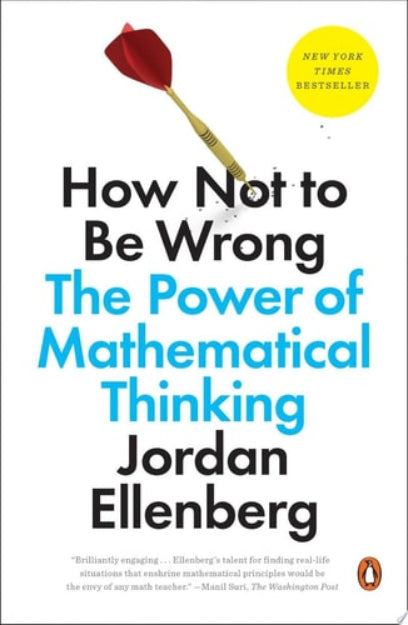
How Not to Be Wrong: The Power of Mathematical Thinking | Jordan Ellenberg
How Not to Be Wrong: The Power of Mathematical Thinking | Jordan Ellenberg
Couldn't load pickup availability
A witty, accessible exploration of applied logic from mathematician Jordan Ellenberg. In How Not to Be Wrong: The Power of Mathematical Thinking (Penguin Books paperback edition), readers discover how the hidden structures of mathematics underpin everyday decision-making, politics, finance, and human reasoning.
Book Overview & Core Themes
Challenging the common misconception that math is merely an abstract, formula-memorizing chore, Ellenberg demonstrates that mathematical thinking is "an atomic-powered prosthesis that you attach to your common sense, vastly multiplying its reach and strength." Organized around five core mathematical pillars—Linearity, Inference, Expectation, Regression, and Existence—this 480-page bestseller reveals how quantitative reasoning exposes hidden fallacies in the world around us.
Through sharp storytelling and intuitive visual reasoning—minus the intimidating jargon—the book investigates fascinating real-world puzzles, from how early to arrive at the airport and why tall parents have shorter children to Abraham Wald’s WWII bomber armor analysis (survivorship bias) and MIT students gaming the Massachusetts state lottery.
Key conceptual frameworks and real-world applications explored within this volume include:
- Survivorship Bias & Inference: Learning to look at missing data and avoid flawed statistical conclusions in medicine, business, and history.
- Non-Linearity in Policy & Economics: Why straight-line assumptions fail when analyzing everything from Reaganomics to public opinion polls.
- Probability & Expectation: Evaluating financial risks, lottery schemes, and everyday uncertainty with mathematical precision.
- Regression to the Mean: Understanding natural statistical fluctuations in sports performance, genetics, and psychological research.
About the Author
Jordan Ellenberg is the John D. MacArthur Professor of Mathematics at the University of Wisconsin–Madison, specializing in number theory and arithmetic geometry. A former Putnam Fellow, his writing on mathematics and culture has appeared in The New York Times, The Wall Street Journal, The Washington Post, and Slate. He is also the author of the novel The Grasshopper King and the bestselling book Shape.
Core Audience & Intended Use
- Curious General Readers: Anyone looking to sharpen their critical thinking, spot misleading news statistics, and make better daily decisions without needing advanced math training.
- Fans of Behavioral Economics & Data Science: An ideal companion to modern analytical classics like Nate Silver's The Signal and the Noise, Daniel Kahneman's Thinking, Fast and Slow, and Steven Strogatz's The Joy of x.
- Students & Educators: A compelling, jargon-free bridge connecting classroom concepts in probability, statistics, and geometry to real-world human dilemmas.
Publishing Standing & Recognition
- Originally published in hardcover by Penguin Press in May 2014 and released in paperback by Penguin Books on May 26, 2015.
- A New York Times bestseller praised by Scientific American, mathematicians, and educators for making high-level quantitative reasoning urgent and entertaining.
Product Specifications
| Full Title | How Not to Be Wrong: The Power of Mathematical Thinking |
|---|---|
| Author(s) | Jordan Ellenberg |
| Publisher & Imprint | Penguin Books (An imprint of Penguin Random House) |
| Publication Date | May 26, 2015 (Paperback Edition; Originally published May 2014) |
| Binding Format | Paperback (PB) |
| Print Length | 480 Pages |
| Language | English |
| ISBN-13 / ISBN-10 | 9780143127536 / 0143127535 |
| Primary Genre (BISAC) | MAT000000 / MATHEMATICS / General |
| Sub-Genres (BISAC) | MAT029000 / PROBABILITY & STATISTICS; SCI075000 / SCIENCE / PHILOSOPHY & SOCIAL ASPECTS |
| Item Condition | Pre-Owned / Very Good |
Frequently Asked Questions About How Not to Be Wrong
What is the central premise, analytical scope, and conceptual focus in How Not to Be Wrong?
Challenging the common misconception that mathematics is merely an abstract, formula-memorizing chore, mathematician Jordan Ellenberg demonstrates that math is an essential extension of common sense that prevents us from drawing flawed conclusions in daily life. Organized around five core mathematical pillars—Linearity, Inference, Expectation, Regression, and Existence—the book uses fascinating real-world case studies, from Abraham Wald's World War II bomber armor analysis (survivorship bias) and MIT students gaming the Massachusetts state lottery to Supreme Court gerrymandering debates and baseball statistics, to show how quantitative thinking exposes hidden fallacies.
How does Jordan Ellenberg translate complex mathematical concepts into witty, accessible prose?
Ellenberg avoids intimidating equations and dense proofs in favor of sharp storytelling, humor, and intuitive visual reasoning. By breaking down abstract ideas like statistical significance, conditional probability, and non-linear curves into relatable human dilemmas, he empowers non-specialists to spot misleading statistics in the news, evaluate financial risks accurately, and argue with greater precision.
Where does How Not to Be Wrong fit within contemporary popular science and mathematics literature?
Published in hardcover in May 2014 and released in paperback in May 2015 by Penguin Books, How Not to Be Wrong became a New York Times bestseller and a landmark of modern popular math, standing alongside classics such as Nate Silver's The Signal and the Noise, Daniel Kahneman's Thinking, Fast and Slow, and Steven Strogatz's The Joy of x.
How is this mathematics book evaluated by mathematicians, educators, and general readers?
Critics, academics, and everyday readers praise the book for its infectious enthusiasm, crystal-clear explanations, and rare ability to make high-level mathematical reasoning feel urgent, entertaining, and indispensable.
What professional background defines author Jordan Ellenberg?
Jordan Ellenberg is the John D. MacArthur Professor of Mathematics at the University of Wisconsin–Madison, specializing in number theory and arithmetic geometry. A former Putnam Fellow and regular contributor to The New York Times, The Wall Street Journal, and Slate, he is also the author of the novel The Grasshopper King and the bestselling book Shape.
Condition Notice: Pre-Owned / Second-Hand Product
All books, box sets, and multi-volume collections offered by Bust-Down Books are sold in pre-owned, used, and second-hand condition, unless explicitly designated as new in the individual product listing.
Condition Details & Grading:
- Previous Ownership: These items have been previously owned, handled, and read. As such, copies may exhibit typical signs of shelf wear, including but not limited to minor creasing, scuffing, edge wear, bent page corners, remainder marks, or spine softening. Paperback editions may show light cover creasing or edge rubbing.
- Markings & Personalization: Items may occasionally contain inscriptions, gift notes, library stamps, owner names, marginalia, or highlighting. Individual item descriptions reflect significant deviations from standard acceptable condition.
- Supplemental Materials: Secondary and digital components—such as publisher access codes, CD-ROMs, bonus inserts, registration keys, or workbook activity pages—are not guaranteed to be included, active, or unredeemed unless specifically stated in the product description.
First Sale Doctrine & Non-Affiliation Statement:
All items sold on this platform are original, lawfully acquired copies being resold under the protection of the First Sale Doctrine (codified under U.S. copyright law, 17 U.S.C. § 109, and applicable international equivalents permitting the secondary resale of lawfully manufactured goods).
Bust-Down Books, LTD. is an independent, secondary-market bookseller. We are not affiliated with, endorsed by, authorized by, or sponsored by the original authors, copyright holders, publishers, or trademark owners of the titles offered for sale. All registered trademarks, author names, book titles, and publisher imprints remain the sole property of their respective owners and are used strictly for nominative identification and descriptive purposes.
Share