Bust-Down Books
Humans Need Not Apply | Jerry Kaplan
Humans Need Not Apply | Jerry Kaplan
Couldn't load pickup availability
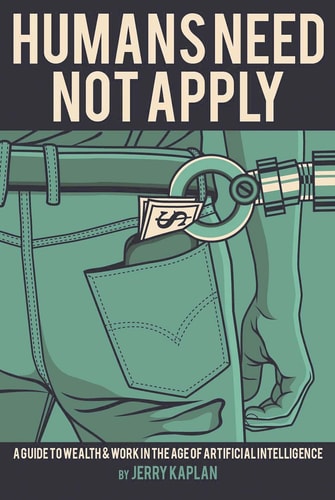
Humans Need Not Apply: A Guide to Wealth and Work in the Age of Artificial Intelligence
Extended Synopsis
After decades of effort, researchers are finally cracking the code on artificial intelligence. Society stands on the cusp of unprecedented change, driven by advances in robotics, machine learning, and perception powering systems that rival or exceed human capabilities. Driverless cars, robotic helpers, and intelligent agents have the potential to usher in a new age of affluence and leisure.
However, as AI expert and Silicon Valley entrepreneur Jerry Kaplan warns, this transition may be protracted and brutal unless we address two great scourges of the modern developed world: volatile labor markets and income inequality. In Humans Need Not Apply, Kaplan proposes innovative, free-market adjustments to our economic system and social policies to avoid an extended period of social turmoil. This timely and accessible analysis of the promises and perils of AI is an essential framework for navigating the future of work.
Author Biography
Jerry Kaplan is a widely respected artificial intelligence expert, Silicon Valley entrepreneur, and technical innovator. Drawing upon his extensive background in computer science and the tech industry, Kaplan provides a grounded, realistic perspective on the socio-economic impacts of emerging technologies, avoiding hyperbolic tech-utopianism in favor of pragmatic, policy-driven solutions.
Reader Targeting
- Business leaders, executives, and corporate strategists navigating automation.
- Policy makers, economists, and public administrators addressing labor markets.
- Academics and students in Technology Studies, Sociology, and Economics.
- General readers interested in pragmatic solutions to the shrinking pool of traditional jobs.
Accolades & Critical Acclaim
- "An intriguing, insightful look at how algorithms and robots could lead to social unrest—and how to avoid it." —The Economist (Books of the Year)
- "Kaplan…sidesteps the usual arguments of techno-optimism and dystopia, preferring to go for pragmatic solutions to a shrinking pool of jobs." —Financial Times
- "A reminder that AI systems don’t need red laser eyes to be dangerous." —Times Higher Education Supplement
Bibliographic & Physical Specifications
| Publisher | Yale University Press (Imprint: Yale University Press) |
|---|---|
| Publication Date | November 22, 2016 (Reprint Trade Paperback Edition) |
| Edition Details | First Yale University Press Trade Paperback Edition / First Printing Thus |
| Format & Binding | Trade Paperback (Perfect bound with premium softcover cardstock wrap and a smooth matte protective finish) |
| ISBN-13 / ISBN-10 | 9780300223576 / 0300223579 |
| Page Count | 256 (Includes investigative multi-part chapters, socioeconomic data indices, policy frameworks, and index) |
| Illustrations | Yes (Features analytical graphs, economic trend lines, and technical conceptual flow diagrams) |
| Dimensions & Weight | 8.30 x 5.10 x 0.60 inches | 10.2 oz (289 grams) |
| BISAC Categories | BUSINESS & ECONOMICS / Labor / General COMPUTERS / Artificial Intelligence / General SOCIAL SCIENCE / Technology Studies |
| BIC/Thema Classifications | UB (Information technology: general issues) JFD (Sociology: work & labour) KC (Economics) |
| LCCN | 2015934571 (For Original Layout) |
Frequently Asked Questions
Does this book offer practical solutions to job displacement by AI?
Yes. Rather than just diagnosing the problem, Jerry Kaplan proposes innovative, free-market adjustments to our current economic systems and social policies specifically designed to mitigate volatile labor markets and prevent extended social turmoil.
Is this book purely a dystopian warning about robots taking over?
No, it is a highly pragmatic analysis. As reviewers note, Kaplan deliberately sidesteps both extreme techno-optimism and dark dystopia, opting instead to focus on actionable, pragmatic solutions to the shrinking pool of traditional jobs and the realities of income inequality.
Bust-Down Books: More Than a Bookstore
Share