Bust-Down Books
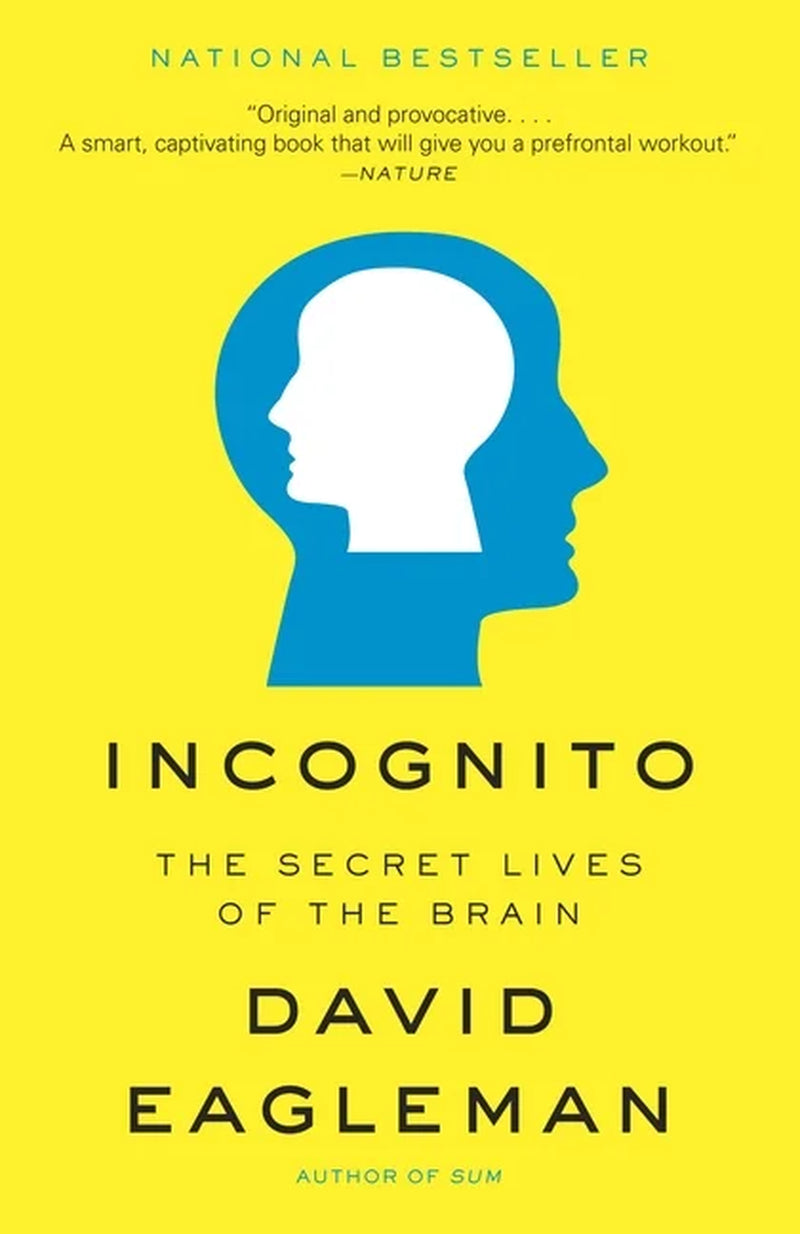
Incognito: The Secret Lives of The Brain | David Eagleman
Incognito: The Secret Lives of The Brain | David Eagleman
Couldn't load pickup availability
“Taking in brain damage, drugs, beauty, infidelity, synesthesia, criminal law, artificial intelligence and visual illusions - INCOGNITO is a thrilling subsurface exploration of the mind and all its contradictions.”
Book Overview
Why can your foot move halfway to the brake pedal before you're consciously aware of danger? Why do you notice when your name is mentioned in a conversation that you didn't think you were listening to? Renowned neuroscientist David Eagleman navigates the depths of the subconscious brain to illuminate these surprising mysteries.
Incognito: The Secret Lives of the Brain is a bestselling nonfiction book that exposes a fascinating, humbling reality: your conscious mind is just a tiny passenger on a massive ocean liner of biological machinery. Almost all of your thoughts, choices, attractions, and behaviors are driven entirely by unconscious neural programs running beneath the surface of awareness.
Blending brain science, optical illusions, medical history, and philosophical inquiry, this thrilling exploration shatters conventional notions of identity, free will, and how we experience the world around us.
About the Author
David Eagleman is an American neuroscientist and author. He received undergraduate degrees in British and American literature from Rice University in 1993, followed by a PhD in neuroscience at Baylor College of Medicine in 1998 and a postdoctoral fellowship at the Salk Institute. He directs the Laboratory for Perception and Action and the Initiative on Neuroscience and Law at Baylor College of Medicine. His bestselling books include Wednesday Is Indigo Blue, Live-Wired, and Sum: Tales from the Afterlives, and his writing has appeared in Science, Nature, and the New York Times.
Core Audience & Intended Use
- Neuroscience & Psychology Enthusiasts: Readers seeking engaging, scientifically rigorous breakdowns of cognitive mechanics and brain function.
- Philosophy & Cognitive Science Scholars: Academics and students exploring consciousness, the illusion of free will, and the mind-body connection.
- Curious Non-Fiction Readers: Individuals fascinated by popular science titles that challenge everyday perceptions of human behavior.
Product Specifications
| Full Title | Incognito: The Secret Lives of the Brain |
|---|---|
| Author(s) | David Eagleman |
| Publisher & Imprint | Vintage Books (An imprint of Knopf Doubleday Publishing Group / Penguin Random House) |
| Publication Date | May 15, 2012 |
| Binding Format | Trade Paperback (PB) |
| Print Length | 304 Pages (Includes integrated anatomical diagrams and visual illusion graphics) |
| Language | English |
| ISBN-13 / ISBN-10 | 9780307389923 / 0307389928 |
| Primary Genre (BISAC) | SCI089000 / SCIENCE / Life Sciences / Neuroscience |
| Sub-Genres (BISAC) | PSY008000 / PSYCHOLOGY / Cognitive Psychology & Cognition; PHI015000 / PHILOSOPHY / Mind & Body; SEL021000 / SELF-HELP / Personal Growth / Success |
| Item Condition | Pre-Owned / Very Good |
| Dimensions & Weight | 5.18 x 0.65 x 8.00 inches | 8.8 oz (approx. 0.55 lbs) |
Frequently Asked Questions About Incognito
What is the main narrative hook and core neurological premise driving the book?
The book exposes a fascinating, humbling reality: your conscious mind is just a tiny passenger on a massive ocean liner of biological machinery. David Eagleman demonstrates that almost all of your thoughts, choices, attractions, and behaviors are driven entirely by unconscious neural programs running beneath the surface of awareness, revealing that who you are is dictated by a complex, hidden ecosystem you have no direct access to.
What specific structural layout does the author use to explain cognitive science?
The book avoids dry textbook abstractions by formatting its chapters like an interactive cognitive laboratory. Eagleman systematically guides readers through a series of built-in optical illusions, psychological paradoxes, and historical medical cases (such as split-brain surgeries and sudden behavioral changes caused by micro-tumors), visually demonstrating how easily our conscious perception of reality can be shattered, re-engineered, or tricked.
What primary psychological and philosophical themes are explored in the text?
The text delivers a profound investigation into the illusion of free will, cognitive biology, and the “team of rivals” model of the mind. Eagleman challenges standard notions of blame and identity, demonstrating that the human brain operates as a collection of conflicting subconscious networks that constantly battle one another for control over your body, altering how we view everything from simple daily mistakes to macro-level social behavior.
Does the narrative connect brain biology to modern social issues like the legal system?
Yes, directly and provocatively. The final chapters shift from raw neuroscience into a progressive critique of the criminal justice system. Eagleman argues that our legal structures rely on an outdated, unscientific assumption that all criminals possess equal free will, proposing instead a neuroscience-compatible legal system focused on custom rehabilitation, brain-based sentencing, and modern prefrontal cortex training rather than blind, retributive punishment.
Why is this book uniquely significant to the author's broader career trajectory and real-world impact as a scientist?
This work represents an extraordinary, definitive milestone because it served as the catalyst that transformed David Eagleman from an elite academic researcher into a premier global public intellectual. Having spent years running a major neuroscience lab at Baylor College of Medicine, Eagleman realized that understanding the subconscious could completely alter human empathy and social policy. This volume marks the exact turning point where his talent for translating abstract brain mechanics into gripping prose captured the mainstream public imagination, launching his global career as a PBS television host, a multi-million-copy bestseller, and a highly sought-after legal advisor, single-handedly bridging the massive gap between cutting-edge laboratory science and the everyday human experience.
Condition Notice: Pre-Owned / Second-Hand Product
All books, box sets, and multi-volume collections offered by Bust-Down Books are sold in pre-owned, used, and second-hand condition, unless explicitly designated as new in the individual product listing.
Condition Details & Grading:
- Previous Ownership: These items have been previously owned, handled, and read. As such, copies may exhibit typical signs of shelf wear, including but not limited to minor creasing, scuffing, edge wear, bent page corners, remainder marks, or spine softening. Paperback editions may show minor cover curling, spine creasing, or edge rubbing.
- Markings & Personalization: Items may occasionally contain inscriptions, library stamps, owner names, marginalia, or highlighting. Individual item descriptions reflect significant deviations from standard acceptable condition.
- Supplemental Materials: Secondary and digital components—such as publisher access codes, CD-ROMs, bonus inserts, registration keys, or workbook activity pages—are not guaranteed to be included, active, or unredeemed unless specifically stated in the product description.
First Sale Doctrine & Non-Affiliation Statement:
All items sold on this platform are original, lawfully acquired copies being resold under the protection of the First Sale Doctrine (codified under U.S. copyright law, 17 U.S.C. § 109, and applicable international equivalents permitting the secondary resale of lawfully manufactured goods).
Bust-Down Books, LTD. is an independent, secondary-market bookseller. We are not affiliated with, endorsed by, authorized by, or sponsored by the original authors, copyright holders, publishers, or trademark owners of the titles offered for sale. All registered trademarks, author names, book titles, and publisher imprints remain the sole property of their respective owners and are used strictly for nominative identification and descriptive purposes.
Share