Bust-Down Books
The Inner Game of Tennis | W. Timothy Gallwey
The Inner Game of Tennis | W. Timothy Gallwey
Couldn't load pickup availability
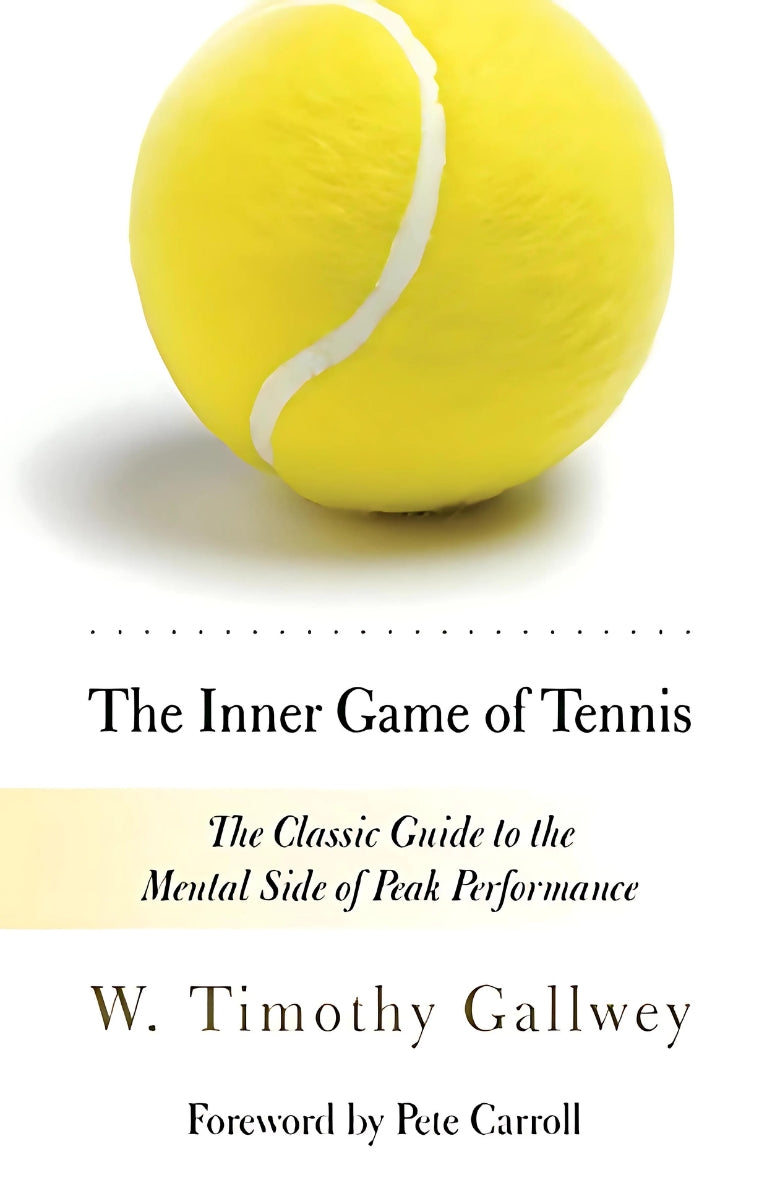
The Inner Game of Tennis: The Classic Guide to the Mental Side of Peak Performance
Extended Synopsis
Discover the timeless masterpiece that revolutionized athletic coaching, corporate management, and performance psychology. In The Inner Game of Tennis, W. Timothy Gallwey demonstrates that the primary battlefield of sports and life does not lie in physical technique alone, but within the mind itself. Spanning 166 pages of insightful cognitive-behavioral methodologies, this definitive Vintage edition teaches readers how to achieve a state of “relaxed concentration” to eliminate self-doubt, overcome mental hurdles, and tap into intuitive internal wisdom.
Gallwey breaks down the mechanics of human motor skills and mental self-regulation into three central conceptual pillars:
- The Dual Self Paradigm (Self 1 vs. Self 2): The text maps out the internal dialogue that disrupts peak performance under pressure. “Self 1” is the conscious, analytical, and judgmental voice that issues rigid commands and generates performance anxiety. “Self 2” represents the subconscious, natural doer—the physical body and its inherent motor intelligence. This book shows how to systematically quiet Self 1 so that Self 2 can execute movements flawlessly without internal interference.
- Non-Judgmental Awareness and Relaxed Concentration: Gallwey explains how labeling performance metrics as strictly “good” or “bad” induces emotional tension, which tightens muscles and fractures fluid mechanics. By training the mind to focus entirely on concrete physical realities—such as the exact spin of a tennis ball's seams or the precise audio cue of contact—the individual achieves non-judgmental concentration that bypasses the self-critical ego.
- Natural Learning Systems vs. Technical Over-Instruction: Traditional coaching methods often overload the brain with verbal instructions and intellectual rules. Gallwey proves that human performance is optimized through visual imagery, direct sensory feedback loops, and intuitive experimentation, allowing sustainable habits to develop naturally.
Accolades & Cultural Impact
Fiftieth-Anniversary Milestone: A cross-disciplinary classic endorsed by sports legends, global executives, and classical musicians as the definitive manual for unlocking potential.
“Groundbreaking... the best guide to getting out of your own way... Its profound advice applies to many other parts of life.”
— Bill Gates, GatesNotes
Author & Contributor Biographies
W. Timothy Gallwey is a pioneer of modern sports psychology and the corporate coaching movement. A graduate of Harvard University and a former captain of the Harvard tennis team, his *Inner Game* series fundamentally changed instructional paradigms across sports, business, and healthcare globally.
Pete Carroll (Foreword Contributor) is an elite American football coach known for his champion tenures in both collegiate football and the NFL, heavily implementing Gallwey's mindfulness and cognitive models into high-pressure professional athletic systems.
Reader Targeting
- Tennis players and competitive athletes looking to eliminate choking, performance anxiety, and internal psychological blocks during high-stakes matches.
- Corporate executives, entrepreneurs, and team leaders seeking to implement stress-reduction frameworks and enhance operational flow states.
- Musicians, public speakers, and creative professionals demanding techniques to silence severe inner critics and rely on muscle memory.
Bibliographic & Physical Specifications
| Specification | Bibliographic & Physical Details |
|---|---|
| ISBN-13 / ISBN-10 | 9780679778318 / 0679778314 |
| Publisher / Imprint | Vintage Books / Vintage Books (Random House, Inc.) |
| Publication Date | May 27, 1997 |
| Edition / Monograph Series | Vintage Books Trade Paperback Edition (Revised Reissue) / Inner Game Series |
| Format & Binding | Paperback (Trade); perfect bound with a flexible gloss-laminate protective film coating |
| Paper Stock & Page Count | High-opacity acid-free recycled cream book paper stock / 166 pages |
| Illustrations & Graphics | Includes strategic behavioral concept diagrams, psychological split-identity graphics, and tennis stroke focus charts |
| Dimensions & Weight | 7.95 x 5.15 x 0.45 inches (202 x 131 x 11 mm) / 5.6 oz (0.35 lbs / 159 grams) |
Frequently Asked Questions
What exactly is the difference between Self 1 and Self 2 in performance psychology?
Self 1 is the analytical, critical mind that constantly labels actions, judges mistakes, and issues strict commands. This mental chatter generates stress and muscle tension. Self 2 is the subconscious physical entity containing inherent motor intelligence. Gallwey teaches performers how to quiet Self 1 so that Self 2 can react fluidly and operate uninhibited.
How do you practice non-judgmental awareness according to Gallwey?
Instead of correcting errors with negative feedback (e.g., “that was a terrible shot”), performers are taught to track objective, physical metrics with zero judgment. For example, a tennis player focuses strictly on the visual spin of the ball's seams or the clear sound made upon contact, instantly anchoring the mind in the present moment.
Bust-Down Books: More Than a Bookstore
Share