Bust-Down Books
The Inside History of the Carnegie Steel Company | James Bridge
The Inside History of the Carnegie Steel Company | James Bridge
Couldn't load pickup availability
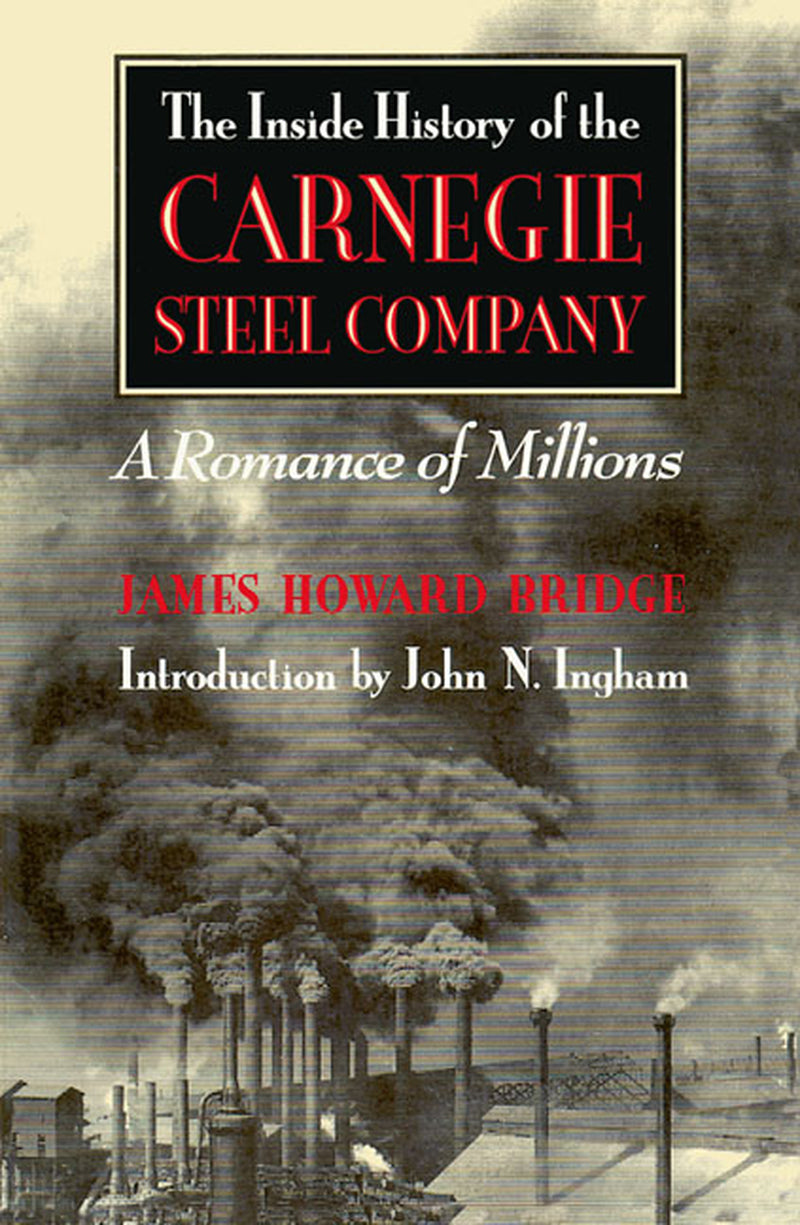
The Inside History of the Carnegie Steel Company: A Romance of Millions
Extended Synopsis
Originally published in 1903 and preserved here in the definitive facsimile edition by the University of Pittsburgh Press, The Inside History of the Carnegie Steel Company: A Romance of Millions offers an unparalleled, controversial insider account of the corporate machinations that shaped American industrial capitalism. Spanning 432 pages, this critical text is written by James Howard Bridge, who served as Andrew Carnegie’s personal literary assistant and confidential secretary. Utilizing primary boardroom data, internal correspondence, and unvarnished historical records, Bridge systematically strips away the polished veneer of Gilded Age corporate politics to reveal the ruthless strategy that built the world's primary steel empire.
The comprehensive text deconstructs the rise and consolidation of the industrial monopoly across three definitive historical themes:
- The Deconstruction of the Philanthropic Myth: Bridge provides an unfiltered look into the boardroom dynamics of Andrew Carnegie. The narrative details how Carnegie routinely squeezed market competitors, leveraged secret railroad shipping rebate networks, and structured internal partnership agreements to aggressively protect his equity margins at the expense of his own close business associates.
- The Homestead Crisis and Corporate Fracture: The book uncovers the hidden tactical communication between Carnegie, who was monitoring events from his remote estate in Scotland, and his executive officer, Henry Clay Frick, during the bloody Homestead Strike of 1892. Bridge presents documentation demonstrating that the deployment of armed Pinkerton detectives to suppress organized labor was a calculated institutional directive rather than a rogue operational choice by Frick.
- The Frick Feud and the Dawn of U.S. Steel: The final third of the volume charts the high-stakes, multi-million dollar legal warfare that erupted between Carnegie and Frick. The text exposes the internal accounting maneuvers utilized to artificially undervalue Frick’s corporate shares, a systemic disruption that ultimately forced a consolidation broker deal with J. Pierpont Morgan, resulting in the creation of the United States Steel Corporation—the world’s first billion-dollar conglomerate.
Accolades & Historical Significance
Selection: Featured Title in the prestigious Pittsburgh Series in Social and Labor History.
“Bridge’s text remains an indispensable primary resource for modern academic research. By delivering an unvarnished account from inside the executive boardroom, it shatters the manicured myths of Gilded Age industrial benevolence.”
— Bust Down Books Academic Review
Author & Contributor Biographies
James Howard Bridge was an author, journalist, and close institutional insider during the height of the American Industrial Revolution. Serving directly as Andrew Carnegie's confidential secretary, Bridge possessed unique, comprehensive access to private corporate letters, executive records, and personal diaries, enabling him to compose this definitive historical exposé.
John N. Ingham, who provides the academic introduction to this facsimile edition, is a highly distinguished historian specializing in American industrial development, elite social structures, and Gilded Age corporate history. His commentary contextualizes Bridge's early 20th-century revelations within modern macroeconomic frameworks.
Reader Targeting
- Labor economists and social historians analyzing union suppression, Gilded Age labor movements, and the systemic realities of the 1892 Homestead Strike.
- Corporate legal scholars and business strategists studying early trust formation, predatory shipping rebates, and high-stakes executive equity disputes.
- Academic researchers seeking primary source accounts, archival business correspondence facsimiles, and structural corporate flowcharts from the 19th century.
Bibliographic & Physical Specifications
| Specification | Bibliographic & Physical Details |
|---|---|
| ISBN-13 / ISBN-10 | 9780822960959 / 0822960958 |
| Publisher / Imprint | University of Pittsburgh Press / University of Pittsburgh Press |
| Publication Date | January 15, 1992 (Original Independent Release: 1903) |
| Edition / Monograph Series | First University of Pittsburgh Press Facsimile Edition / Pittsburgh Series in Social and Labor History |
| Format & Binding | Trade Paperback / Heavyweight flexible softcover cardstock with a matte protective varnish finish, industrial perfect thermal binding |
| Paper Stock & Page Count | Low-acid archival cream text book paper / 432 pages |
| Illustrations & Visual Assets | Yes (Includes complete archival photographic portrait plates, corporate flowcharts, and facsimiles of original business letters) |
| Dimensions & Weight | 9.25 x 6.25 x 1.25 inches (235 x 159 x 32 mm) / 22.4 oz (1.40 lbs / 635 grams) |
Frequently Asked Questions
Why did James Howard Bridge's account cause significant controversy upon its original publication?
During the early 1900s, Andrew Carnegie invested heavily in cultivating a public persona as a benevolent, non-predatory philanthropist. Bridge's book fundamentally disrupted this narrative by exposing primary corporate documentation that detailed Carnegie's aggressive market manipulations, shipping schemes, and strict management tactics.
What unique primary source materials are included in this University of Pittsburgh Press edition?
This facsimile edition preserves all of the original text's critical validation materials, including detailed archival photographic portrait plates of prominent Gilded Age figures, corporate flowcharts tracking the integration of the steel monopoly, and direct facsimiles of private executive business letters.
Bust-Down Books: More Than a Bookstore
Share