Bust-Down Books
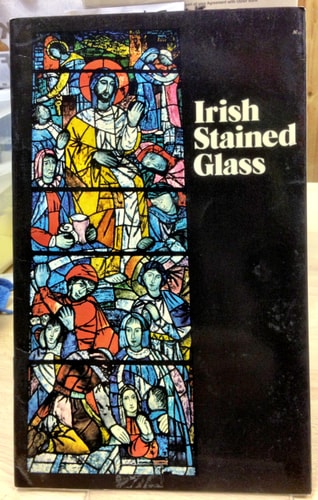
Irish Stained Glass by Michael Wynne
Irish Stained Glass by Michael Wynne
Couldn't load pickup availability
The Irish Heritage Book Series, Book―1
Irish Stained Glass

Written by Michael Wynne
There is abundant evidence to show that windows were glazed, sometimes with glass, long before the eighteenth century.
However, with one exception, it has not been possible so far to claim that any of the stained glass was actually made in Ireland.
The exception is glass for Lismore Castle, Co. Water ford, including a window of the Four Evangelists for the chapel there. In 1631 a payment for this glass was made to Harman Catts, evidently a member of a family of glaziers working in that area in the seventeenth century. Unfortunately, no trace of this glass survives today.
In the eighteenth century one has to wait until the second half of the century to find the first reference to an Irish-man who made stained glass.

Thomas Jervais, a native of Dublin, practiced the art of painting on glass, and in 1760 he read a Memorial relating to the Staining of Glass to the Dublin Society.
According to Strickland's Dictionary of Irish Artists, he made several windows for distinguished Irish patrons, working at Leinster House for the Duke of Leinster; at Marino for Lord Charle mont; and at Rathfarnham Castle for the Loftus family. None of this work survives. However, in the Church of Ireland at Agher, Co. Meath, the east window is an interesting example of his work.
It depicts St Paul Preaching to the Athenians (2) in a composition directly inspired by a section of one of the most famous Raphael cartoons (1) in the English Royal Collection, now on loan to the Victoria and Albert Museum in London.
The window in Agher Church was not commissioned for it, but came from Dangan Castle near by, the now-ruined home of the Wellesley family, of which the Duke of Wellington was to be the most famous member.
Thomas Jervais, like so many other Irish eighteenth-century artists, went to London. He had a letter of in-troduction from the influential Lord Charlemont to the equally influential patron of the arts, Horace Walpole. What direct benefit this introduction was to Jervais we are unable to ascertain, but it cannot fail to have been helpful.
Thomas Jervais not only made large 1. Raphael. St Paul Preaching to the Athenians.
Detail of cartoon in the Victoria and Albert Museum, London.
Photo: Victoria and Albert Museum. Crown Copyright.
Reproduced by gracious permission of Her Majesty Queen Elizabeth II.