Bust-Down Books
Language, Cognition, and Human Nature | Steven Pinker
Language, Cognition, and Human Nature | Steven Pinker
Couldn't load pickup availability
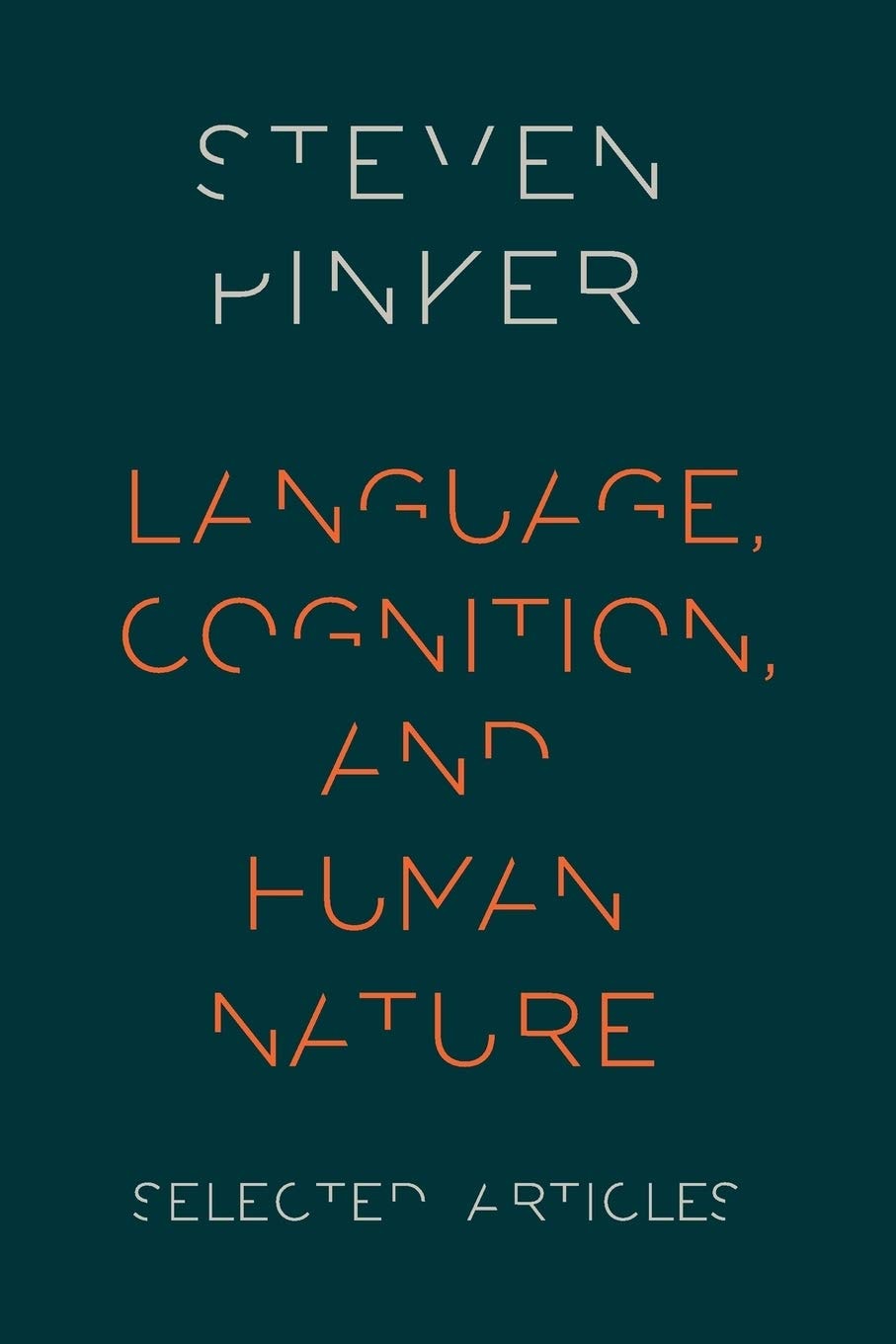
Language, Cognition, and Human Nature: Selected Articles
| ISBN-13 | 9780190259280 |
|---|---|
| Author | Steven Pinker |
| Format | Trade Paperback |
| Publisher | Oxford University Press |
| Publication Date | October 29, 2015 |
| Page Count | 378 |
| Subjects | Cognitive Psychology, Psycholinguistics, Cognitive Science |
Extended Synopsis
Language, Cognition, and Human Nature collects together for the first time much of Steven Pinker's most influential scholarly work. Pinker's seminal research explores the intricate workings of language and its deep connections to human cognition, perception, social relationships, child development, and evolutionary theories of human nature.
This eclectic collection spans Pinker's thirty-year career, examining his favorite themes in greater depth and rigorous scientific detail. It includes thirteen classic articles covering vast topics such as language development in children, mental imagery, shape recognition, the computational architecture of the mind, the meaning and uses of verbs, and the logic of innuendo and euphemism. Within these pages, Pinker outlines major theories and engages in intellectual debates with other prominent scholars, including Stephen Jay Gould, Noam Chomsky, and Richard Dawkins.
Reader Targeting
- Students, researchers, and professionals in cognitive science, psychology, and linguistics.
- Readers seeking foundational academic texts on evolutionary psychology and human development.
- Followers of Steven Pinker's career and anyone fascinated by the intersection of language and the human mind.
About the Author
Steven Pinker is an experimental psychologist, cognitive scientist, and one of the world's leading public intellectuals. His extensive research on visual cognition and the psychology of language has won numerous awards and profoundly shaped modern cognitive science.
Accolades & Features
Featuring a brand-new introduction by the author discussing his body of scholarly work, this edition is richly illustrated with deep computational mind architecture maps, psychological shape-recognition matrices, and experimental phrase-structure trees. It also includes comprehensive original technical data tables, mathematical learning proofs, and an expansive index.
Bust-Down Books: More Than a Bookstore
Share