

Bust-Down Books
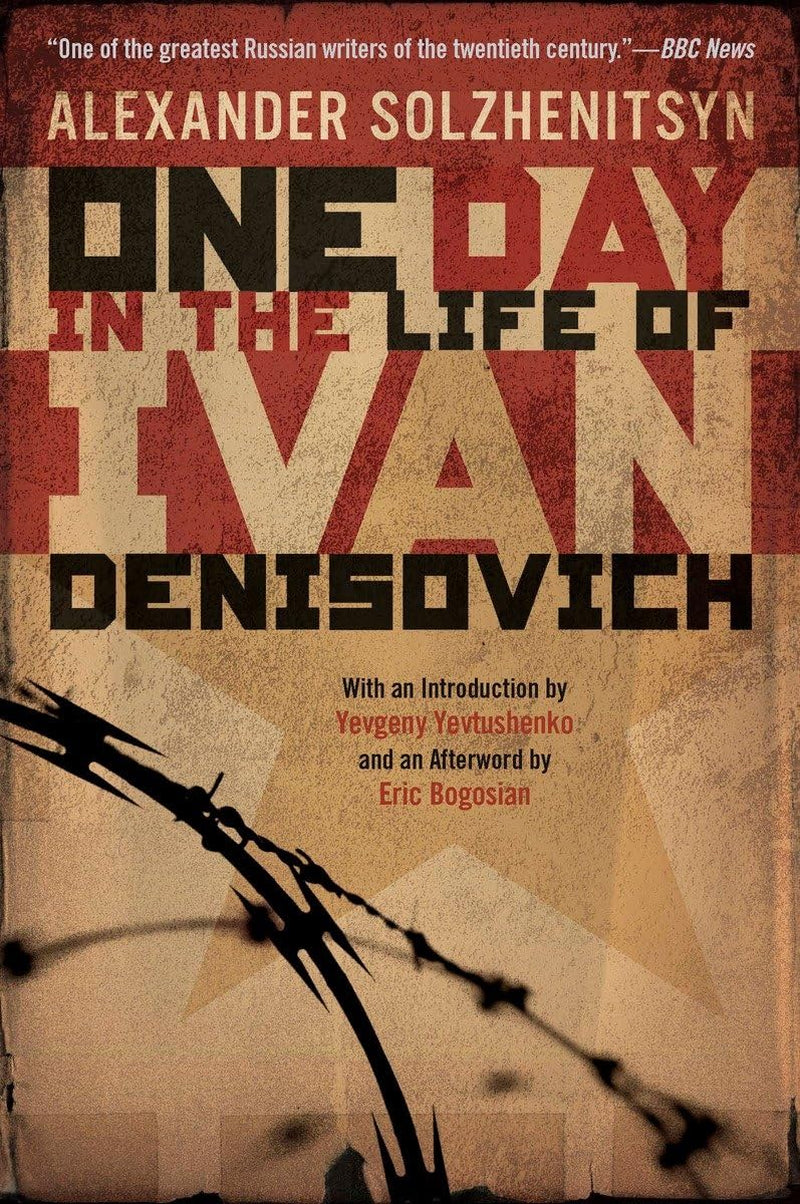
One Day in the Life of Ivan Denisovich | Alexander Solzhenitsyn
One Day in the Life of Ivan Denisovich | Alexander Solzhenitsyn
Couldn't load pickup availability
A defining masterpiece of twentieth-century literature, One Day in the Life of Ivan Denisovich shattered the silence surrounding the Soviet Gulag labor camp system. Drawing directly from his own harrowing experiences as a political prisoner, Nobel Prize winner Alexander Solzhenitsyn delivers a stark, graphic, and deeply moving portrayal of a single day in a Siberian forced-labor camp.
Extended Synopsis & Core Themes
First published in 1962 during Nikita Khrushchev's De-Stalinization era, this landmark novel plunges readers into the brutal realities of freezing temperatures, backbreaking labor, and systemic starvation through the eyes of inmate Ivan Denisovich Shukhov. Falsely accused of treason during World War II and sentenced to ten years of hard labor, Shukhov’s minute-by-minute struggle focuses not merely on physical survival, but on the quiet preservation of dignity and moral integrity in an environment designed to strip them away entirely.
Key themes and literary elements examined in this work include:
- The unvarnished, authentic documentation of forced labor and totalitarian oppression.
- The preservation of human dignity, camaraderie, and self-respect amidst extreme physiological deprivation.
- The historical breakthrough of publishing the first officially permitted, uncensored depiction of Stalinist repressions.
- Sparse, understated prose translated by Ralph Parker, featuring an introduction by Yevgeny Yevtushenko.
Author Biography
Alexander Solzhenitsyn (1918–2008) was a controversial and highly influential Russian novelist, historian, and outspoken critic of the Soviet Union. After serving eight years in the Gulag for criticizing Joseph Stalin in a private letter, he used his literary genius to document the atrocities of the camp system. Awarded the Nobel Prize in Literature in 1970 for the ethical force of his writing, Solzhenitsyn's courage ultimately led to his exile from the USSR in 1974 following the publication of The Gulag Archipelago.
Reader Targeting & Intended Use
- Students of History & Political Science: An essential text for academics researching 20th-century authoritarianism, Soviet history, and the penal system.
- Classic Literature Enthusiasts: A foundational work for readers of modern Russian literature alongside Dostoyevsky, Tolstoy, and Gorky.
- Human Rights Advocates: A crucial historical document chronicling political imprisonment and the triumph of the human spirit.
Accolades & Critical Praise
- Winner of the Nobel Prize in Literature (1970).
- Hailed by BBC News as the work of "one of the greatest Russian writers of the twentieth century."
- Compared favorably by The New York Times to the legendary works of Dostoyevsky, Turgenev, Tolstoy, and Gorky.
Product Specifications
| Full Title | One Day in the Life of Ivan Denisovich |
|---|---|
| Author(s) | Alexander Solzhenitsyn (Translated by Ralph Parker; Introduction by Yevgeny Yevtushenko) |
| Publisher & Imprint | Signet Classics (An imprint of Penguin Random House) |
| Publication Date | September 1, 2009 (Reprint Edition) |
| Binding Format | Mass Market Paperback (PB) |
| Print Length | 208 Pages |
| Language | English |
| ISBN-13 / ISBN-10 | 9780451228147 / 0451228146 |
| Primary Genre (BISAC) | FIC004000 / FICTION / Classics |
| Sub-Genres (BISAC) | FIC014000 / HISTORICAL; FIC019000 / LITERARY; FIC025000 / POLITICAL |
| Item Condition | Pre-Owned / Very Good |
| Dimensions & Weight | 4.19 x 0.52 x 6.75 inches | 3.8 oz (approx. 0.24 lbs) |
Frequently Asked Questions About One Day in the Life of Ivan Denisovich
What is the central narrative premise, setting, and plot structure of One Day in the Life of Ivan Denisovich?
One Day in the Life of Ivan Denisovich is set in a Soviet labor camp (Gulag) during the 1950s. The novella chronicles a single, continuous 24-hour day in the life of Ivan Denisovich Shukhov, an ordinary Russian soldier falsely accused of treason during World War II and sentenced to ten years of hard labor. Rather than depicting dramatic political upheavals, the plot focuses on the minute-by-minute struggle for physical and spiritual survival—securing an extra portion of watery soup, hiding a scrap of a hacksaw blade, building a brick wall in freezing sub-zero temperatures, and avoiding the cruelty of camp guards.
How does Alexander Solzhenitsyn use realistic details to portray the dehumanizing nature of the Soviet Gulag system?
Solzhenitsyn draws directly from his own personal experience as a Gulag prisoner to deliver an unvarnished, authentic account of forced labor camps. Through Shukhov's matter-of-fact perspective, the narrative highlights how the totalitarian state reduced human existence to basic physiological needs. Yet, amid extreme deprivation, the novel illustrates how prisoners maintained human dignity, camaraderie, and self-respect through honest work, moral integrity, and small acts of mutual assistance.
What is the historical, political, and censorship-breaking significance of the book's initial publication in 1962?
First published in the Soviet literary magazine Novy Mir in November 1962 during Nikita Khrushchev's "De-Stalinization" era, the novella was a monumental event in 20th-century history. It was the first time Soviet citizens were officially permitted to read an uncensored literary depiction of Stalinist repressions and the labor camp system. The publication sent shockwaves across the globe, bringing the realities of the Gulag into public consciousness and solidifying Solzhenitsyn's role as a major literary voice against political oppression.
How is this classic novella evaluated by literary critics, historians, and international scholars?
Widely recognized as a masterpiece of 20th-century literature and historical fiction, the novella is celebrated for its sparse, understated prose and profound moral resonance. Critics highlight Solzhenitsyn's ability to compress the tragedy of millions of Gulag victims into the quiet endurance of a single ordinary man across one ordinary day, making it a foundational text in Holocaust and totalitarian studies worldwide.
What unique biographical background, Nobel Prize honors, and literary legacy define Alexander Solzhenitsyn?
Alexander Solzhenitsyn (1918–2008) was a Russian novelist, historian, and political dissident who served eight years in the Soviet Gulag for criticizing Joseph Stalin in a private letter. Awarded the Nobel Prize in Literature in 1970 for the ethical force of his writing, Solzhenitsyn was eventually expelled from the USSR in 1974 following the publication of his monumental non-fiction study The Gulag Archipelago. His works remain seminal documents in exposing totalitarian rule and championing human freedom.
Condition Notice: Pre-Owned / Second-Hand Product
All books, box sets, and multi-volume collections offered by Bust-Down Books are sold in pre-owned, used, and second-hand condition, unless explicitly designated as new in the individual product listing.
Condition Details & Grading:
- Previous Ownership: These items have been previously owned, handled, and read. As such, copies may exhibit typical signs of shelf wear, including but not limited to minor creasing, scuffing, edge wear, bent page corners, remainder marks, or spine softening. Paperback editions may show crease lines along the spine, cover edge wear, or minor curling.
- Markings & Personalization: Items may occasionally contain inscriptions, library stamps, owner names, marginalia, or highlighting. Individual item descriptions reflect significant deviations from standard acceptable condition.
- Supplemental Materials: Secondary and digital components—such as publisher access codes, CD-ROMs, bonus inserts, registration keys, or workbook activity pages—are not guaranteed to be included, active, or unredeemed unless specifically stated in the product description.
First Sale Doctrine & Non-Affiliation Statement:
All items sold on this platform are original, lawfully acquired copies being resold under the protection of the First Sale Doctrine (codified under U.S. copyright law, 17 U.S.C. § 109, and applicable international equivalents permitting the secondary resale of lawfully manufactured goods).
Bust-Down Books, LTD. is an independent, secondary-market bookseller. We are not affiliated with, endorsed by, authorized by, or sponsored by the original authors, copyright holders, publishers, or trademark owners of the titles offered for sale. All registered trademarks, author names, book titles, and publisher imprints remain the sole property of their respective owners and are used strictly for nominative identification and descriptive purposes.
Share
Based on the author's personal experience, described is a typical day in the Gulag, in the middle of winter, from the time he wakes up until sleep, he is grateful for the smallest of things. Outstanding.