Bust-Down Books
Other People's Money | John Kay
Other People's Money | John Kay
Couldn't load pickup availability
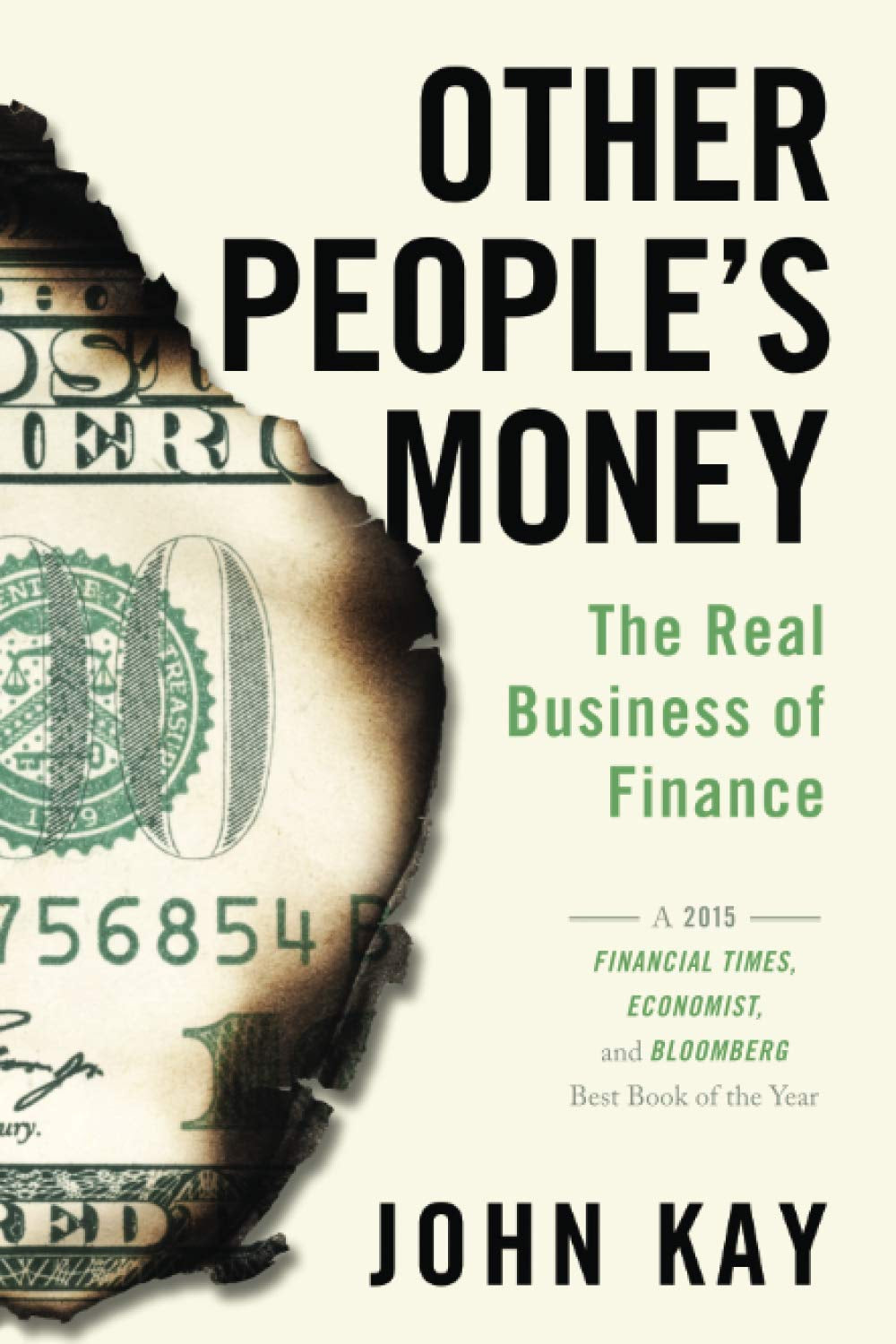
Other People's Money: The Real Business of Finance
| ISBN-13 | 9781610397155 |
|---|---|
| Author | John Kay |
| Format | Trade Paperback |
| Publisher | PublicAffairs |
| Publication Date | September 27, 2016 |
| Page Count | 352 |
| Subjects | Finance, Economics, Banking, Macroeconomics |
Extended Synopsis
In Other People's Money, economist John Kay delivers a piercing critique of the modern financial sector. Over the past three decades, "financialization" has ballooned the size of the industry, diverting the finest mathematical and scientific minds away from productive investment and toward complex, high-frequency trading algorithms that exploit the market rather than serving it. Kay argues that the sector has lost sight of its primary purpose: to manage money for the benefit of businesses and households.
Writing in the wake of the 2008 financial crisis, Kay explains how the industry has become overly focused on secondary-market dealing at the expense of stewardship and long-term value. This revelatory tour of the global financial world challenges the necessity of modern banking giants and calls for a fundamental shift back to responsible, sustainable finance. Other People's Money is essential reading for anyone seeking to understand why the current system fails to serve the real economy and how it might be reformed.
Reader Targeting
- Investors and financial professionals seeking a deeper understanding of market structural flaws.
- Students of economics and public policy interested in the impact of financialization.
- Readers concerned with the intersection of corporate governance, banking, and macroeconomics.
About the Author
John Kay is a prominent British economist, Financial Times columnist, and academic. He has served as a visiting professor at the London School of Economics, a fellow of St John's College, Oxford, and was the founding director of the Said Business School. A fellow of the British Academy and the Royal Society of Edinburgh, Kay is widely recognized for his ability to synthesize complex economic ideas into clear, actionable insights.
Accolades & Awards
Other People's Money was a definitive contribution to economic literature upon its release, earning widespread recognition, including:
- Financial Times Book of the Year (2015)
- The Economist Best Book of the Year (2015)
- Bloomberg Best Book of the Year (2015)
Bust-Down Books: More Than a Bookstore
Share