Bust-Down Books
The Procession by Kahlil Gibran
The Procession by Kahlil Gibran
Couldn't load pickup availability
This is the English Translation of The Procession by Kahlil Gibran, Translated by G. Kheirallah. Some Writings do include the original written Arabic as well.
To the Sons and Daughters of Lebanon
The Procession by Kahlil Gibran
Edited, Translated, and with a Biographical Sketch by George Kheirallah | The Wisdom Library: A Division of the Philosophical Library, New York 1958
Contents:
- The Life of Gibran Khalil Gibran 17
- The Procession of Gibran 51
- The Illusory World 57
- Of Goodness and Station 62
- Of Life and Sorrow 63
- Of Religion 67
- Of Justice 75
- Of Will and Right 83
- Of Science and Knowledge 85
- Of Freedom 87
- Of Happiness and Hope 91
- Of Gentleness 93
- Of Love 95
- Of Soul and Fertility 99
- Of Death and Immortality 106
- The Summing of the Youth 108
- The Capitulation of the Sage 111
The Procession of Gibran
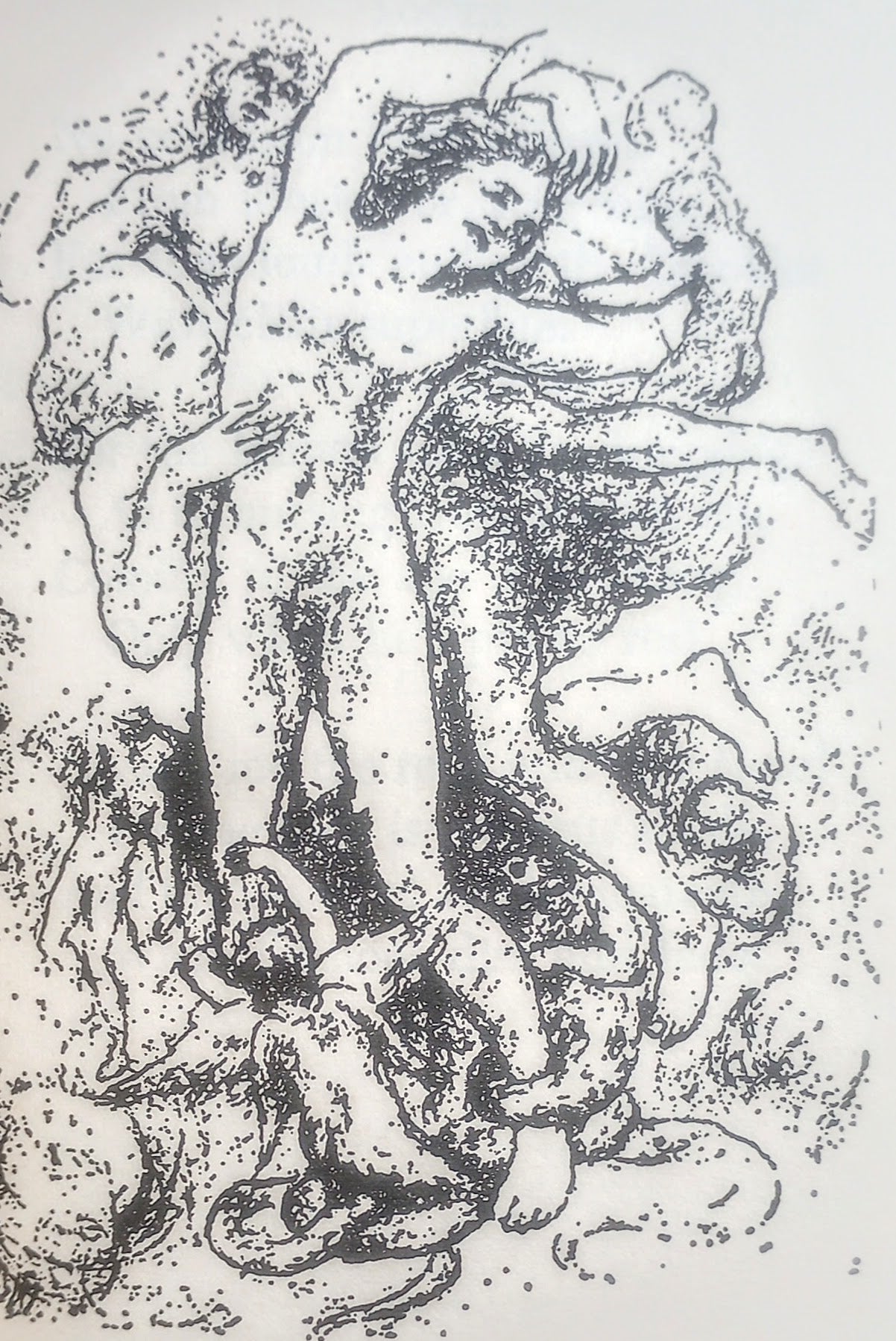
In 1919 Gibran surprised his friends by issuing at his own expense, a beautiful and artistic book containing The Procession—his hidden masterpiece of Arabic poetry. The paper, the type, illustrations and binding all bespoke the tender regard and care that Gibran had bestowed upon this unique child.
The Arabic is a forceful language with a prolific vocabulary of pregnant words of fine shadings. Its delicate tones of warmth and color form with its melodies a symphony, the sound of which moves its listeners to tears or ecstasy. Anyone present at an Arabian gathering where prose or poetry is recited may readily note how the heads and then the bodies of the listeners commence to sway in rhythmic accompaniment to the recitation. In The Procession we often find Gibran carried away by the charm of the lyric and oblivious to the strict continuity in the Kasida.
Nassib 'Arida, the gifted Arabian poet, wrote the introduction to The Procession and explained how the dual discourse came about:
"An old sage, worldly-wise and ripened by experience, had left the city to wander in the countryside, and wearily rested himself at the edge of the forest; a naked, sun-bronzed youth emerged from the forest, reed in hand, to throw himself in abandon beside the sage, and the two unceremoniously commenced their discourse."
The sage pours forth his wisdom in measured logic and a tinge of disappointment while the rebellious youth bursts out with his expressions of the Universality of the Whole.
To this translator, the poem represents the unconscious autobiography of Gibran: Gibran the sage, mellowed beyond his years, and Gibran the rebel, who had come to believe in the Unity and Universality of all existence and who longed for simple, impersonal freedom, merged in harmony with all things.
I feel that it does not behoove one to venture into a critical study of the poem but rather to permit each reader to quaff according to his own cup—his intellectual and emotional capacity. For Gibran himself, a master of both the pen and brush, finds these mediums inadequate: at the end of each refrain he takes refuge in the non-dimensional, limitless medium—the plaint of the reed—or spiritual essence.
Those who read Gibran's life and knew of his yearning for the peace of Wadi-Quadisha and Mar-Sarkis can now read the philosophy of the rebellious child of nature in the following:
Give to me the reed and sing thou!
Forget all the cures and ills;
Mankind is like verses written
Upon the surface of the rills.
What good is there, pray thee tell me
In jostling through the crowd in life
Mid the argumental tumult,
Protestation, and endless strife,
Mole-like burrowing in darkness,
Grasping for the spider's thread,
Always thwarted in ambition
Until the living join the dead?
And the humane, wounded and battered Gibran, with a tinge of resignation, foretells the end:
Had I the days in hand to string,
Only in forest they'd be strewn,
But circumstances drive us on
In narrow paths by Kismet hewn.
For Fate has ways we cannot change
While weakness preys upon our Will.
We bolster with excuse the self,
And help that Fate ourselves to kill.
—G. Kheirallah
About the Author
Kahlil Gibran: Lebanese-American Writer and Poet
Khalil Gibran (1883–1931) was an essayist, novelist, and mystic poet. He wrote The Prophet, a collection of philosophical essays that went on to become one of the bestselling books of the twentieth century. Though he was born in Lebanon, he moved to Boston’s South End as a child and studied art with Auguste Rodin in Paris for two years before launching his literary career. Much of Gibran’s work contains themes of religion and Christianity as well as spiritual love.
G. Kheirallah: Author
George Ibrahim Kheirallah (1879-1959), was an author known for his works on Islam and Gibran Khalil Gibran. He wrote Islam and the Arabian Prophet and The Life of Gibran Khalil Gibran and His Procession. He also co-authored Arabia Reborn with Charles O. Naef.
Key works and details
Islam and the Arabian Prophet:
This book offers a comprehensive overview of Islamic history, teachings, and practices, including the life of Prophet Muhammad [Peace be Upon Him].
The Life of Gibran Khalil Gibran and His Procession:
This book, illustrated by Gibran himself, explores the life of the renowned Lebanese-American writer and artist.
Arabia Reborn:
Co-authored with Charles O. Naef, this work focuses on the Arabian Peninsula and its history, with a particular emphasis on Ibn Saʻūd.
Collaboration with Gibran:
Kheirallah was a close associate of Gibran Khalil Gibran and played a role in introducing Gibran's work to the English-speaking world.
Translations and Publications:
Kheirallah was involved in publishing and translating Gibran's work, including The Procession.
Works of Gibran in this Book Series:
- Broken Wings
- Khalil Gibran, Self-Portrait
- Mirrors of the Soul
- The Procession
- Spirits Rebellious
- Spiritual Sayings of Khalil Gibran
- Tears and Laughter
- Thoughts and Meditations
-
Voice of the Master
- Wisdom of Gibran
Share