Bust-Down Books
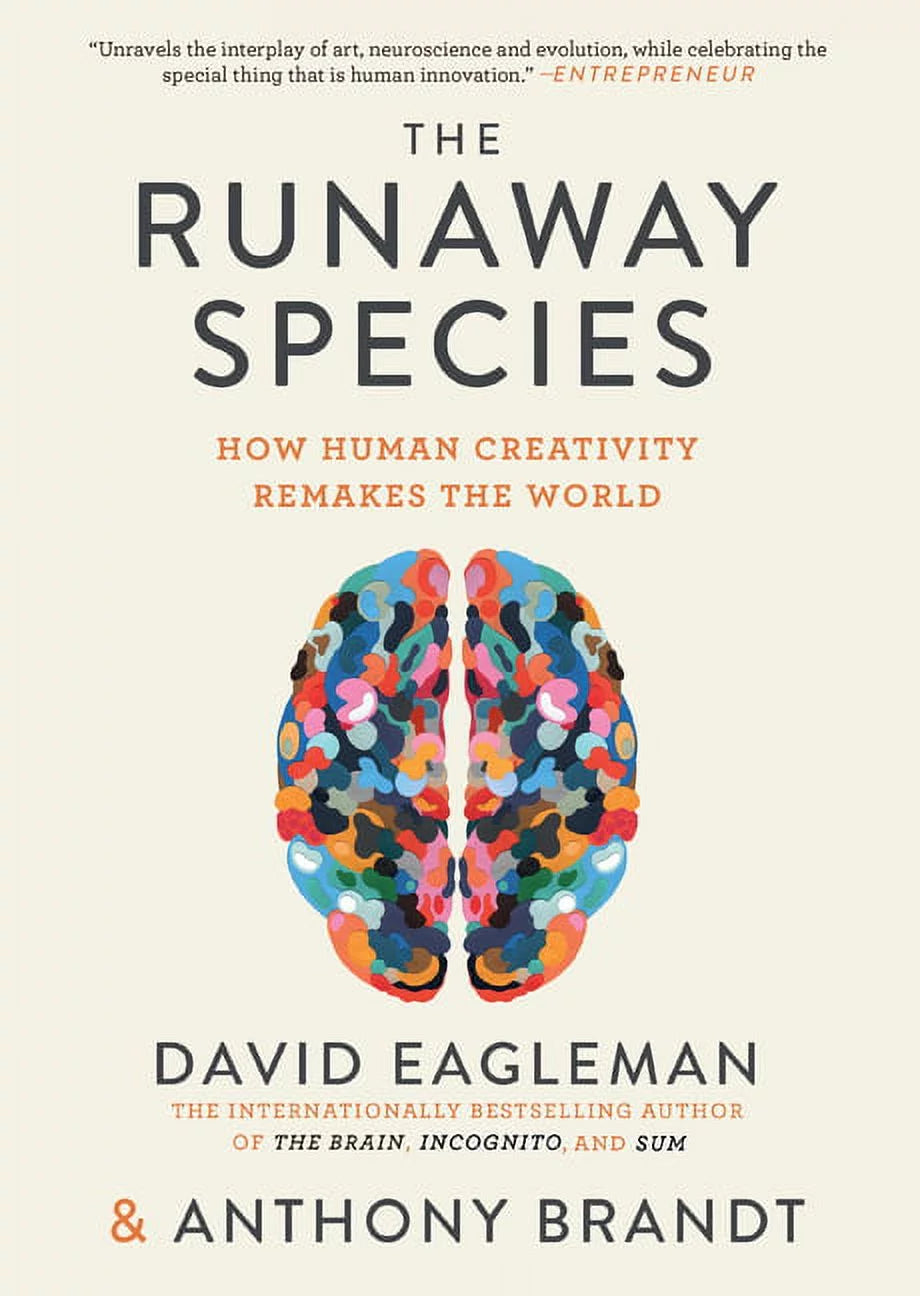
The Runaway Species | David Eagleman & Anthony Brandt
The Runaway Species | David Eagleman & Anthony Brandt
Couldn't load pickup availability
The Runaway Species: How Human Creativity Remakes the World
Extended Synopsis
In The Runaway Species, acclaimed neuroscientist David Eagleman and composer Anthony Brandt bridge the traditional divide between the hard sciences and the fine arts to examine the cognitive infrastructure of human innovation. Blending dramatic storytelling with cutting-edge neuroscience, the authors establish an unyielding narrative thesis: human creativity is not a mystical, divine spark reserved for a select handful of eccentric geniuses. Instead, it is a systemic, evolved algorithmic software built directly into the basic neurocircuitry of the human brain, continuously running past sensory predictions to obsessively remodel our physical and cultural environment.
Rather than formatting their investigation as a loose anthology of creative habits, the authors systematically coordinate their cognitive thesis across three definitive operational pillars. They begin by reducing all human innovation to three core mental tools: bending (modifying an existing template), breaking (fragmenting a whole concept to rebuild from the wreckage), and blending (merging completely disparate ideas into a hybrid concept). The text then evaluates the architecture of risk management, demonstrating how creators navigate the biological tension between the familiar and the foreign to find the optimal "Goldilocks zone" of novelty. Finally, the volume builds to an actionable roadmap, applying these neuro-creative dictates directly to corporate R&D labs, academic structures, and modern educational curricula to foster a more flexible, adaptive future.
Author Biography
David Eagleman is an internationally bestselling neuroscientist, an adjunct professor at Stanford University, and the author of Incognito and The Brain. Anthony Brandt is an acclaimed composer and professor at Rice University's Shepherd School of Music. Together, they bring a unique cross-disciplinary perspective to the science of human expression and innovation.
Reader Targeting
- Professionals, innovators, and corporate strategists looking to build elastic environments that optimize creative output and risk management.
- Students and researchers of cognitive science, brain theory, and the evolutionary psychology of tool development.
- Artists, designers, and educators seeking a scientific framework to understand and teach creative processes.
Accolades
"Looks at art and science together to examine how innovations... build on what already exists and rely on three brain operations: bending, breaking and blending."
— The Wall Street Journal
"Approach[es] creativity scientifically but sensitively, feeling its roots without pulling them out."
— The Economist
Bibliographic & Physical Specifications
| Publisher | Catapult |
|---|---|
| Publication Date | June 19, 2018 |
| Format & Binding | First Catapult Paperback Edition (Trade Paperback with matte laminate finish) |
| ISBN-13 / ISBN-10 | 9781948226035 / 1948226030 |
| Page Count | 304 (Includes extensive color graphic documentation matrices, notes, and index) |
| Dimensions & Weight | 8.40 x 6.00 x 0.90 inches | 20.8 oz (590 grams) |
| BISAC Categories | PSYCHOLOGY / Creative Ability SCIENCE / Cognitive Science & Brain Theory ART / Philosophy & Social Aspects |
Frequently Asked Questions
What are the "Three Bs" mentioned in the text?
The authors define them as Bending, Breaking, and Blending—the core cognitive operations our brains use to turn existing ideas, tools, and structures into entirely new innovations.
Does this paperback edition feature illustrations?
Yes. This volume is fully documented with extensive illustrations, including full-color neurological mapping diagrams, historic fine art reproductions, and architectural design blueprints.
Bust-Down Books: More Than a Bookstore
Share