Bust-Down Books
Shadows of the Mind | Roger Penrose
Shadows of the Mind | Roger Penrose
Couldn't load pickup availability
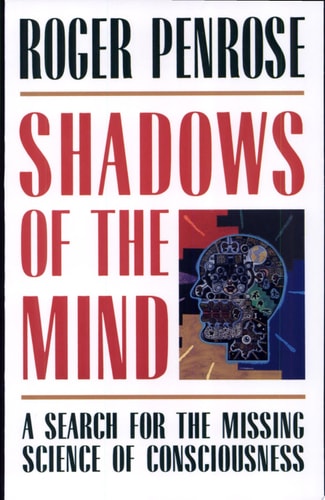
Shadows of the Mind: A Search for the Missing Science of Consciousness
Extended Synopsis
Following the universal acclaim of his 1989 New York Times bestseller The Emperor's New Mind, Roger Penrose delivers another exhilarating examination of modern science in Shadows of the Mind. In this visionary volume, Penrose mounts a rigorous and powerful challenge against the core assumptions of artificial intelligence, pointing the way toward a profoundly new science that may finally explain the physical basis of the human mind.
Penrose contends that certain aspects of human consciousness lie entirely beyond computational simulation. Grounding his arguments in strict scientific inquiry rather than religious or philosophical detachment, he traverses a vast landscape of modern physics and mathematics—from Alan Turing's computational machines to Gödel's theorem of incompleteness. He introduces radical new ideas regarding the mysterious interface where classical and quantum physics converge, notably exploring microbiology and the role of cytoskeletons and microtubules within the brain's neurons. By arguing that collective quantum effects within these minute substructures are responsible for consciousness, Penrose suggests that accommodating the mind will require a profound change in the very underpinnings of our physical and philosophical understanding of reality.
Author Biography
Roger Penrose is a world-renowned mathematician, theoretical physicist, and philosopher of science. Celebrated for his groundbreaking work in mathematical physics, particularly regarding general relativity, cosmology, and black holes, he is a Nobel Laureate in Physics. He is widely recognized for his ability to translate the most complex theoretical frameworks of quantum mechanics and cognitive philosophy into accessible, paradigm-shifting literature.
Reader Targeting
- Physicists, mathematicians, and scholars of quantum mechanics exploring the theoretical bounds of the universe.
- Cognitive scientists, neurologists, and philosophers investigating the physical origins of human consciousness.
- Artificial intelligence researchers and developers seeking critical perspectives on the limitations of computational models.
- Readers of advanced popular science who enjoyed The Emperor's New Mind.
Accolades & Critical Acclaim
- Direct follow-up to the New York Times bestselling masterwork, The Emperor's New Mind.
- Recognized as a foundational, albeit highly debated, text in the field of quantum mind theory and cognitive physics.
Bibliographic & Physical Specifications
| Publisher | Oxford University Press |
|---|---|
| Publication Date | August 22, 1996 |
| Edition Details | First Oxford University Press Trade Paperback Edition / First Printing Thus |
| Format & Binding | Trade Paperback (Perfect bound with premium softcover cardstock wrap and a smooth matte texture layer) |
| ISBN-13 / ISBN-10 | 9780195106466 / 0195106466 |
| Page Count | 480 (Includes mathematical appendices, structural biological diagrams, and index) |
| Illustrations | Yes (Features precise mathematical formulas, quantum wave-function charts, and neurobiological diagrams) |
| Dimensions & Weight | 9.50 x 6.25 x 1.00 inches | 23.6 oz (669 grams) |
| BISAC Categories | SCIENCE / Physics / Quantum Theory COMPUTERS / Artificial Intelligence / General PHILOSOPHY / Mind & Body |
| BIC / Thema Classifications | PD (Physics) UB (Information technology: general issues) HP (Philosophy of mind) |
| LC Classification | Q335 .P417 1994 |
| Dewey Decimal | 006.3 |
Frequently Asked Questions
Do I need to read The Emperor's New Mind before reading this book?
While Shadows of the Mind is a direct expansion of the themes presented in The Emperor's New Mind, it is written to be comprehensible as a standalone text. However, readers familiar with Penrose's earlier work will find a deeper appreciation for how his theories on the physics of consciousness have evolved.
Is this book highly technical?
Yes, the book contains extensive theoretical physics, deep mathematics, and neurobiology. Penrose does an excellent job explaining his concepts to the diligent layperson, but readers should be prepared to encounter complex wave-function charts, mathematical formulas, and rigorous philosophical logic.
Bust-Down Books: More than a Bookstore
Share