Bust-Down Books
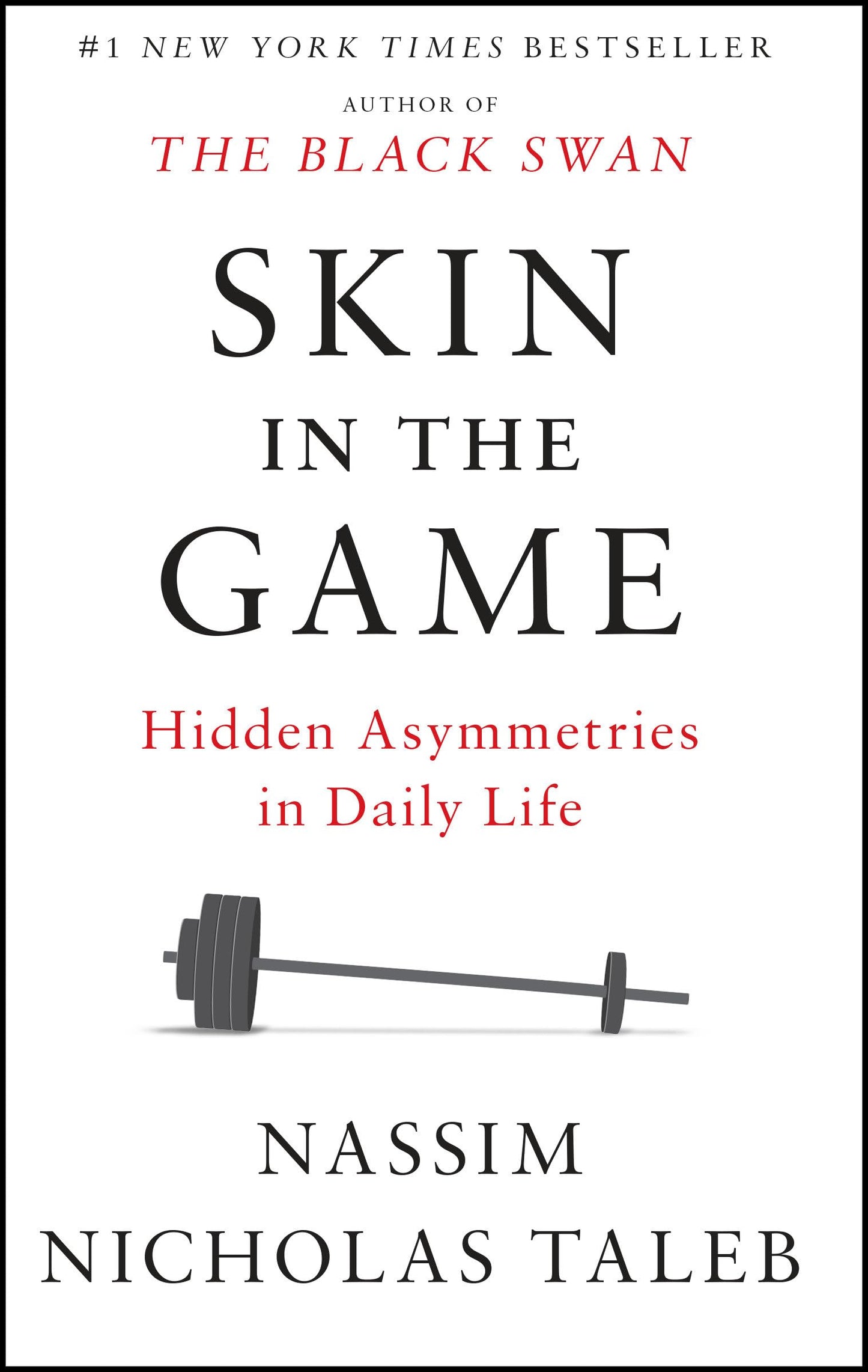
Skin in the Game | Nassim Nicholas Taleb
Skin in the Game | Nassim Nicholas Taleb
Couldn't load pickup availability
Skin in the Game: Hidden Asymmetries in Daily Life
Extended Synopsis
In Skin in the Game: Hidden Asymmetries in Daily Life, renowned risk analyst and philosopher Nassim Nicholas Taleb delivers the definitive operational climax to his multi-volume Incerto series. This 304-page treatise presents an unfiltered critique of contemporary institutional structures, challenging orthodox models of governance, economics, and ethical philosophy. Taleb argues that having “skin in the game”—the structural necessity of bearing personal downside risk for one’s decisions—is an absolute prerequisite for systemic stability, efficiency, and basic justice.
The analytical framework evaluates structural risk transfer and ethics across three key dimensions:
- Asymmetry and the Problem of Transferred Risk: Taleb identifies the core vulnerability of modern civilization as the systematic decoupling of authority from consequence. Focusing on bureaucrats, corporate managers, and interventionist intellectuals, the text demonstrates how detached decision-makers transfer catastrophic tail risk onto the public while insulating themselves from the downsides of their own policy failures.
- The Ethics of Dynamic Risk-Taking: True expertise and honor cannot exist in an academic vacuum. Taleb demonstrates that real-world knowledge is systematically forged through the feedback loops of trial and error. Elevating accountability, he introduces the “Silver Rule”—Do not do unto others what you would not have them do unto you—as a robust filter designed to prevent individuals from generating personal profit by exposing others to hidden, unvetted vulnerabilities.
- Systemic Resilience and Minority Rules: Moving from individual psychology to macro sociology, the text outlines the “minority rule,” showing how a small, highly rigid, and uncompromising subsegment of the population can dictate the behavioral baselines of a flexible majority. Ultimately, rationality is redefined not by what appears logical on a whiteboard, but by what successfully protects a system from catastrophic ruin over time.
Accolades & Praise
“A must-read for anyone seeking a deeper understanding of power, risk, and responsibility.”
— The Economist
“Taleb’s finest work yet—full of sharp insights and provocative wisdom.”
— Financial Times
Author Biography
Nassim Nicholas Taleb is a distinguished mathematical researcher, veteran derivatives trader, and philosophical essayist specializing in the epistemological, financial, and cognitive problems of probability. He spent over two decades as a risk practitioner before transitioning into academia, currently serving as a Distinguished Professor of Risk Engineering at New York University’s Tandon School of Engineering. His seminal multi-volume work, the Incerto, explores random events, asset fragility, and structural decision-making frameworks under deep uncertainty.
Reader Targeting
- Investors, quantitative risk managers, corporate executives, and entrepreneurs seeking to insulate operations from asymmetric liabilities.
- Policymakers, public commentators, and social scientists tracking the structural flaws within public administration and institutional design.
- Students of behavioral economics, moral philosophy, probability theory, and complex systems architecture.
Bibliographic & Physical Specifications
| Specification | Bibliographic & Physical Details |
|---|---|
| ISBN-13 / ISBN-10 | 9780425284643 / 0425284646 |
| Publisher / Imprint | Berkley Books / Random House (Penguin Random House) |
| Publication Date | January 7, 2020 (Original Hardcover: February 20, 2018) |
| Edition / Book Series | First Berkley Trade Paperback Edition / Incerto Series |
| Binding & Materials | High-quality flexible cardstock softcover, fine matte protective finish, traditional trade perfect thermal binding, premium acid-free off-white text stock |
| Page Count & Illustrations | 304 pages / Yes (Includes isolated diagrams, mathematical tables, and structural charts mapping probability matrices) |
| Dimensions (Imperial & Metric) | 8.16 x 5.43 x 0.69 inches (207 x 138 x 18 mm) |
| Weight | 8.8 oz (0.55 lbs / 249 grams) |
Frequently Asked Questions
What exactly is the “minority rule” explained in the text?
The minority rule refers to a structural asymmetry where a tiny, inflexible subset of the population (typically around 3% to 4%) refuses to compromise on specific requirements. Because the flexible majority accommodates their strict preferences to minimize friction, the entire group eventually adapts to the baseline established by the uncompromising minority.
How does the text distinguish the Silver Rule from the classic Golden Rule?
Taleb argues that the Golden Rule (Do unto others as you would have them do unto you) can lead to intrusive, uninvited behavior by assuming others share your exact desires. The Silver Rule (Do not do unto others what you would not have them do unto you) acts as a robust negative filter, strictly preventing decision-makers from transferring unrecognized risk or hidden harms onto vulnerable external groups.
Bust-Down Books: More Than a Bookstore
Share