

Bust-Down Books
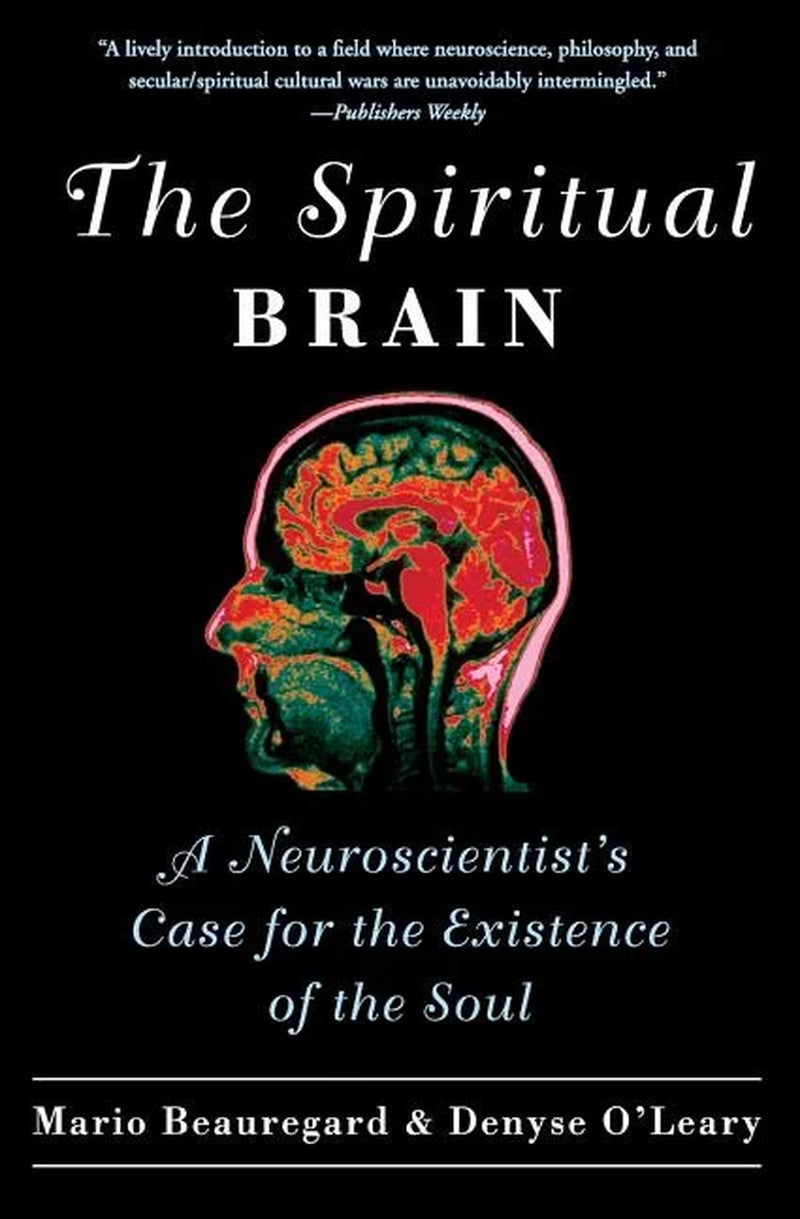
The Spiritual Brain | Mario Beauregard & Denyse O'Leary
The Spiritual Brain | Mario Beauregard & Denyse O'Leary
Couldn't load pickup availability
The Spiritual Brain: A Neuroscientist’s Case for the Existence of the Soul
Extended Synopsis
In The Spiritual Brain, neuroscientist Dr. Mario Beauregard and journalist Denyse O'Leary present a rigorous and controversial scientific critique of mechanical biological reductionism. Challenging the mainstream materialist dogma that dismisses religious experience as an evolutionary glitch or random neural misfiring, the authors establish a compelling alternative thesis: the human brain does not organically manufacture spiritual experiences, mystical insights, or conscious self-awareness out of material mechanics. Instead, it functions as a highly sophisticated biological receiver engineered to process an objective, non-physical reality that exists outside the physical body.
Rather than arranging their arguments as a casual theological essay, the authors structure their investigative critique across three rigorous empirical and philosophical pillars. They begin by systematically breaking down popular “neuro-reductivist” theories that attempt to explain away faith via a singular “God gene” or a specific “God spot” in the temporal lobes. The core of the volume delivers Dr. Beauregard's groundbreaking neuroimaging research conducted at the University of Montreal, detailing laboratory protocols used to record the brain activity of contemplative Carmelite nuns during states of deep mystical union. Utilizing both fMRI and advanced electroencephalography (EEG) data, Beauregard demonstrates that mystical experiences do not activate a solitary switch but illuminate a widely distributed network spanning multiple cortical and subcortical brain structures.
The book reaches its operational conclusion by outlining a non-materialist cognitive framework that allows researchers to better understand anomalous psychological phenomena—ranging from the placebo effect and the clinical successes of cognitive behavioral therapy to near-death experiences (NDEs) on the operating table. This extensive volume serves as an essential reference resource for university libraries, neuropsychology research collections, and serious readers tracking the complex boundaries separating the physical brain from the human mind.
Author Biography
Dr. Mario Beauregard, Ph.D. is a researcher and neuroscientist who has held affiliations with institutions such as the University of Montreal. He is recognized internationally for his functional neuroimaging experiments exploring the neural correlates of emotional regulation and mystical states. Denyse O'Leary is an award-winning Canadian journalist and author specializing in science, religion, and the broader social and philosophical implications of modern cognitive theories.
Reader Targeting
- Researchers, academics, and students in cognitive science, neuropsychology, and the philosophy of mind.
- Readers exploring serious, data-driven critiques of scientific materialism and reductionist biological frameworks.
- Theology scholars, institutional libraries, and general readers interested in empirical investigations into near-death experiences and spiritual practices.
Bibliographic & Physical Specifications
| Publisher | HarperOne (An imprint of HarperCollins Publishers) |
|---|---|
| Publication Date | September 30, 2008 |
| Format & Binding | Reprint / Trade Paperback Edition (Standard perfect binding with smooth matte laminate finish) |
| ISBN-13 / ISBN-10 | 9780061625985 / 0061625984 |
| Page Count | 384 (Includes multi-part research narrative, empirical data summaries, technical reference notes, and index) |
| Dimensions & Weight | 8.00 x 5.31 x 0.86 inches | 10.4 oz (295 grams) |
| BISAC Categories | SCIENCE / Cognitive Science & Brain Theory RELIGION / Religion & Science PSYCHOLOGY / Cognitive Psychology & Cognition |
Frequently Asked Questions
What specific research serves as the empirical foundation of this book?
The book is built around Dr. Beauregard’s functional neuroimaging studies evaluating the brain activity of contemplative Carmelite nuns. By using fMRI and EEG technologies, the research monitors what happens neurally when individuals actively experience states of deep spiritual connection.
What is the primary scientific argument against materialist neuro-reductionism?
The authors show that mystical encounters do not rely on a singular neurological spot or “God gene.” Instead, spiritual states activate a widely distributed, complex network across multiple brain structures, suggesting that the brain operates as a receptor processing external spiritual phenomena rather than generating them internally.
Bust-Down Books: Armed With Education
Share
Surprise, you aren't your brain, you're not your body, something else maybe. Mario Beauregard has been looking at a lot of case histories, and has come to some new conclusions. Be prepared to be surprised.