Bust-Down Books
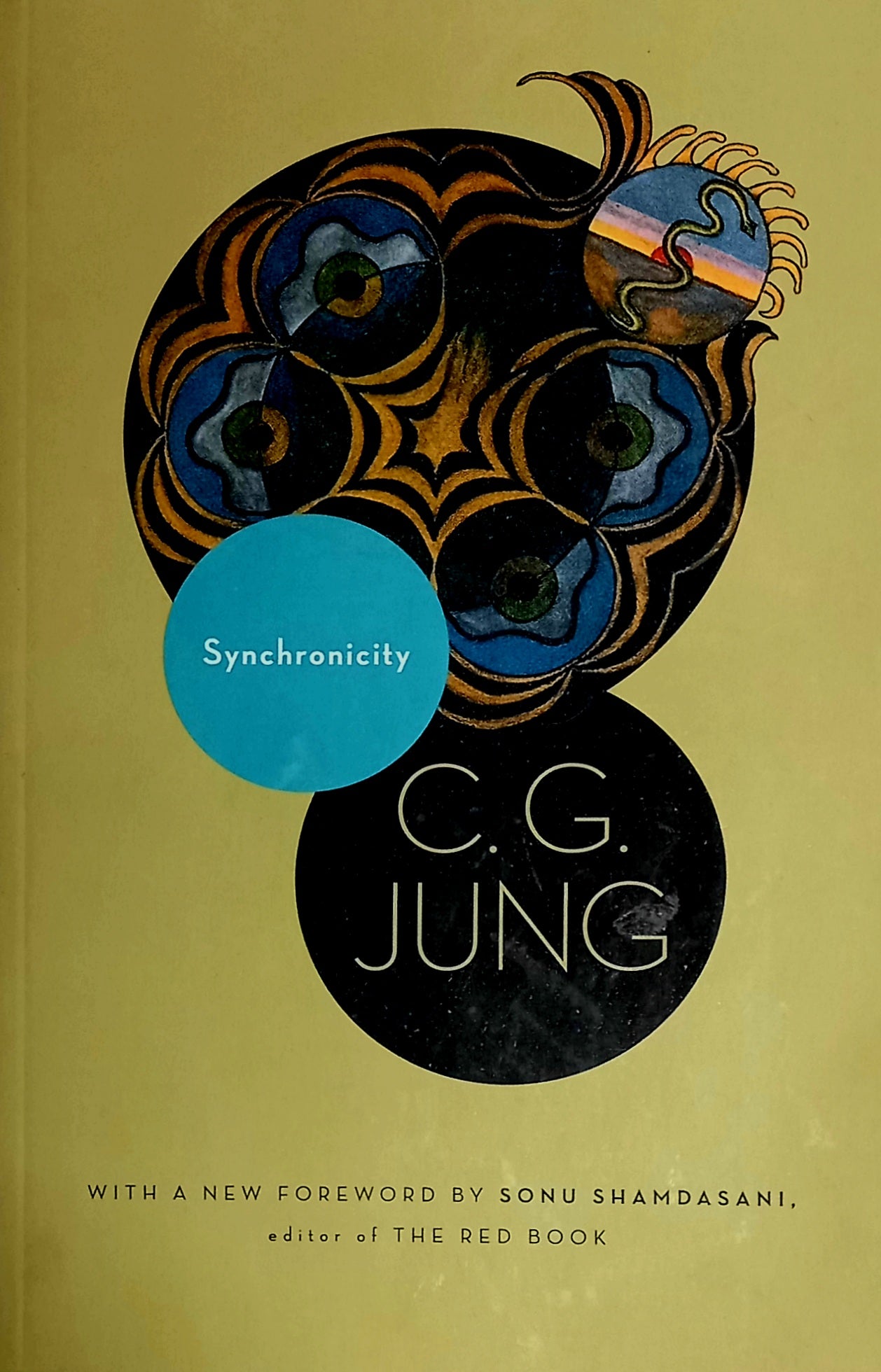
Synchronicity by C.G. Jung
Synchronicity by C.G. Jung
Couldn't load pickup availability
Synchronicity: An Acausal Connecting Principle by C.G. Jung
With a Few Foreword by Sonu Shamdasani & Translated by R.F.C. Hull
A Bollingen Series Book | From Vol. 8. of The Collected Works of C.G. Jung
Princeton University Press | Princeton & Oxford
Overview / Synopsis
Jung was intrigued from early in his career with coincidences, especially those surprising juxtapositions that scientific rationality could not adequately explain.
He discussed these ideas with Albert Einstein before World War I, but first used the term "synchronicity" in a 1930 lecture, in reference to the unusual psychological insights generated from consulting the I Ching.
A long correspondence and friendship with the Nobel Prize-winning physicist Wolfgang Pauli stimulated a final, mature statement of Jung's thinking on synchronicity, originally published in 1952 and reproduced here.
Together with a wealth of historical and contemporary material, this essay describes an astrological experiment Jung conducted to test his theory.
Synchronicity reveals the full extent of Jung's research into a wide range of psychic phenomena.
This edition of Jung's classic work includes a new foreword by Sonu Shamdasani, Philemon Professor of Jung History at University College London.
Table of Contents
Foreword to the 2010 Edition vii
Editorial Preface xi
Foreword 3
1. Exposition 5
2. An Astrological Experiment 43
3. Forerunners of the Idea of Synchronicity 69
4. Conclusion 89
Appendix: On Synchronicity 104
Bibliography 117
Index 125
Book Data
- Title: Synchronicity An Acausal Connecting Principle
- Edition: Vol. 8. of the Collected Works of C. G. Jung
- ISBN-13: 9780691150505
- ISBN-10: 0691150508
- Language: English
- Author: C. G. Jung
- Edition: Revised
- Book Binding: Paperback
- Publisher: Princeton University Press
- Published: 2010-11-14
Excerpt: Synchronicity by CG Jung
The Structure and Dynamics of the Psyche
All the events in a man's life would accordingly stand in two fundamentally different kinds of connection: firstly, in the objective, causal connection of the natural process; secondly, in a subjective connection which exists only in relation to the individual who experiences it, and which is thus as subjective as his own dreams. That both kinds of connection exist simultaneously, and the selfsame event, although a link in two totally different chains, nevertheless falls into place in both, so that the fate of one individual invariably fits the fate of the other, and each is the hero of his own drama while simultaneously figuring in a drama foreign to him-this is something that surpasses our powers of comprehension, and can only be conceived as possible by virtue of the most wonderful pre-established harmony.
In his view "the subject of the great dream of life one," the transcendental Will, the prima causa, from which all causal chains radiate like meridian lines from the poles and, because of the circular parallels, stand to one another in a meaningful relationship of simultaneity. 18 Schopenhauer believed in the absolute determinism of the natural process and furthermore in a first cause. There is nothing to warrant either assumption. The first cause is a philosophical mythologem which is only credible when it appears in the form of the old paradox Ἓν τὸ πᾶν, as unity and multiplicity at once. The idea that the simultaneous points in the causal chains, or meridians, represent meaningful coincidences would only hold water if the first cause really were a unity. But if it were a multiplicity, which is just as likely, then Schopenhauer's whole explanation collapses, quite apart from the fact, which we have only recently realized, that natural law possesses a merely statistical validity and thus keeps the door open to indeterminism.
Neither philosophical reflection nor experience can provide any evidence for the regular occurrence of these two kinds of connection, in which the same thing is both subject and object. Schopenhauer thought and wrote at a time when causality held sovereign sway as a category a priori and had therefore to be dragged in to explain meaningful coincidences. But, as we have seen, it can do this with some degree of probability only if we have recourse...
Synchronicity: An Acausal Connecting Principle | C.G. Jung
Share