Bust-Down Books
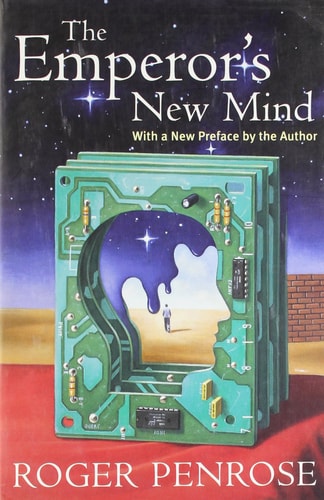
The Emperor's New Mind | Roger Penrose
The Emperor's New Mind | Roger Penrose
Couldn't load pickup availability
The Emperor's New Mind: Concerning Computers, Minds, and the Laws of Physics
Extended Synopsis
For decades, the dominant narrative in artificial intelligence has been that computers will soon possess the capability to perform any task a human mind can. While computational power continues to scale, a fundamental question remains: does a machine that "plays chess at the grandmaster level" actually understand the game, or is it merely executing a complex algorithm? In this absorbing and frequently contentious work, eminent physicist and Wolf Prize winner Roger Penrose challenges the prevailing dogma, arguing that critical facets of human thinking—specifically consciousness—can never be fully emulated by current computational models.
Penrose explores what physics and mathematics reveal about the nature of the mind, positing that laws even deeper than quantum mechanics are essential for understanding human cognition. To support his thesis, he leads the reader on a rigorous intellectual journey through complex numbers, Turing machines, complexity theory, Gödel’s undecidability, black holes, and the physical structure of the brain itself. This is an essential read for anyone navigating the deep philosophical and scientific debate surrounding the limits of artificial intelligence.
Author Biography
Roger Penrose is a renowned mathematical physicist, philosopher, and Nobel Laureate. A seminal figure in the study of general relativity and cosmology, he has made foundational contributions to our understanding of black holes and the geometric structure of the universe. He has long served as a critical voice in the discourse on the nature of consciousness and the limitations of algorithmic intelligence.
Reader Targeting
- Physicists, mathematicians, and researchers studying the intersection of quantum mechanics and cognitive science.
- Philosophers of mind examining the materialist vs. non-computational views of consciousness.
- AI practitioners and computer scientists interested in the theoretical barriers to strong AI.
- Academics and students of the history of mathematics and scientific theory.
Bibliographic & Physical Specifications
| Publisher | Oxford University Press |
|---|---|
| Publication Date | March 04, 1999 |
| Edition Details | Reprint Edition (With a New Preface by the Author) |
| Format & Binding | Paperback (Perfect bound softcover with high-density laminated cardstock) |
| ISBN-13 / ISBN-10 | 9780192861986 / 0192861980 |
| Page Count | 640 (Extensive mathematical proofs, historical physics charts, and index) |
| Illustrations | Yes (Line drawings, mathematical charts, topological models, fractal diagrams) |
| Dimensions & Weight | 7.72 x 5.08 x 1.30 inches | 17.6 oz (500 grams) |
| BISAC Categories | SCIENCE / Physics / Mathematical & Computational COMPUTERS / Artificial Intelligence / General PHILOSOPHY / Mind & Body |
| BIC / Thema Classifications | PHM (Mathematical physics) UYQ (Artificial intelligence) |
| LC Classification | Q335 .P46 |
| Dewey Decimal | 006.3 |
Frequently Asked Questions
Is this book only for physicists?
While the content is rigorous, it is written for a broad audience of "serious interest." Penrose guides the reader through complex concepts, making it accessible to mathematicians, philosophers, and AI researchers alike, though it does not shy away from dense scientific proofs.
Does Penrose believe AI will never be possible?
Penrose argues that current algorithmic approaches are insufficient for genuine human-like consciousness. He contends that our understanding of physical laws—specifically quantum mechanics—is incomplete, and that a new, deeper physics will be required to account for the phenomenon of the mind.
Bust-Down Books: More Than a Bookstore
Share