Bust-Down Books
The Lucifer Effect | Philip Zimbardo
The Lucifer Effect | Philip Zimbardo
Couldn't load pickup availability
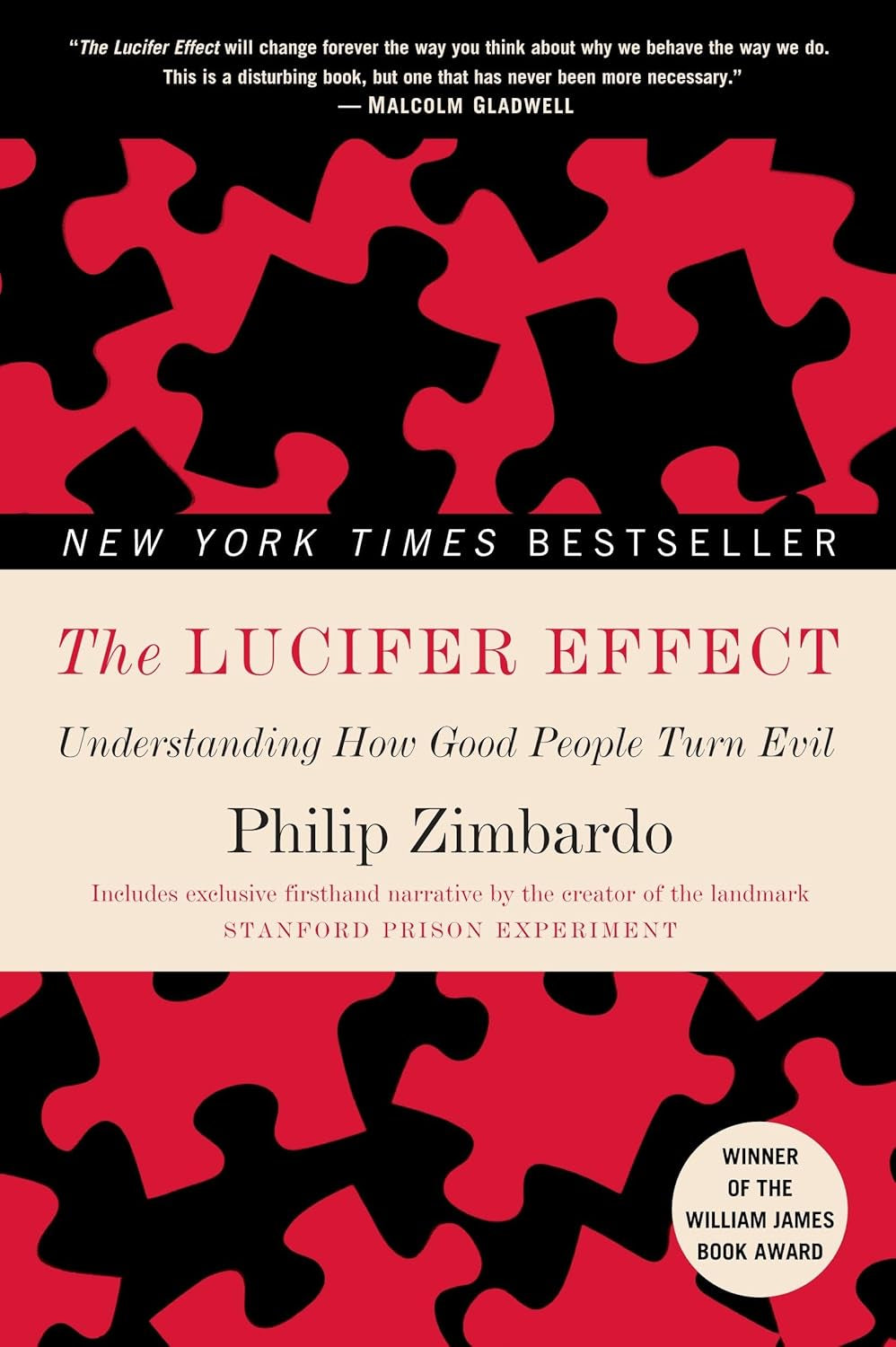
The Lucifer Effect: Understanding How Good People Turn Evil | Philip Zimbardo
How do good people transform into perpetrators of evil under powerful situational pressures? Philip Zimbardo investigates in The Lucifer Effect.
About the Book:
The definitive firsthand account of the groundbreaking research of Philip Zimbardo—the basis for the award-winning film The Stanford Prison Experiment
Renowned social psychologist and creator of the Stanford Prison Experiment Philip Zimbardo explores the mechanisms that make good people do bad things, how moral people can be seduced into acting immorally, and what this says about the line separating good from evil.
The Lucifer Effect explains how—and the myriad reasons why—we are all susceptible to the lure of “the dark side.”
Drawing on examples from history as well as his own trailblazing research, Zimbardo details how situational forces and group dynamics can work in concert to make monsters out of decent men and women.
Here, for the first time and in detail, Zimbardo tells the full story of the Stanford Prison Experiment, the landmark study in which a group of college-student volunteers was randomly divided into “guards” and “inmates” and then placed in a mock prison environment.
Within a week the study was abandoned, as ordinary college students were transformed into either brutal, sadistic guards or emotionally broken prisoners.
By illuminating the psychological causes behind such disturbing metamorphoses, Zimbardo enables us to better understand a variety of harrowing phenomena, from corporate malfeasance to organized genocide to how once upstanding American soldiers came to abuse and torture Iraqi detainees in Abu Ghraib.
He replaces the long-held notion of the “bad apple” with that of the “bad barrel”—the idea that the social setting and the system contaminate the individual, rather than the other way around.
This is a book that dares to hold a mirror up to mankind, showing us that we might not be who we think we are. While forcing us to reexamine what we are capable of doing when caught up in the crucible of behavioral dynamics, though, Zimbardo also offers hope.
We are capable of resisting evil, he argues, and can even teach ourselves to act heroically.
Like Hannah Arendt’s Eichmann in Jerusalem and Steven Pinker’s The Blank Slate, The Lucifer Effect is a shocking, engrossing study that will change the way we view human behavior.
Praise for The Lucifer Effect:
“The Lucifer Effect will change forever the way you think about why we behave the way we do—and, in particular, about the human potential for evil. This is a disturbing book, but one that has never been more necessary.”
—Malcolm Gladwell
“An important book . . . All politicians and social commentators . . . should read this.”
—The Times (London)
“Powerful . . . an extraordinarily valuable addition to the literature of the psychology of violence or ‘evil.’”
—The American Prospect
“Penetrating . . . Combining a dense but readable and often engrossing exposition of social psychology research with an impassioned moral seriousness, Zimbardo challenges readers to look beyond glib denunciations of evil-doers and ponder our collective responsibility for the world’s ills.”
—Publishers Weekly
“A sprawling discussion . . . Zimbardo couples a thorough narrative of the Stanford Prison Experiment with an analysis of the social dynamics of the Abu Ghraib prison in Iraq.”
—Booklist
“Zimbardo bottled evil in a laboratory. The lessons he learned show us our dark nature but also fill us with hope if we heed their counsel. The Lucifer Effect reads like a novel.”
—Anthony Pratkanis, Ph.D., professor emeritus of psychology, University of California
Frequently Asked Questions About The Lucifer Effect:
-
Q: What specific landmark psychological experiment forms the foundation of this book?
A: This text features the first exhaustive, detailed firsthand account of the famous 1971 Stanford Prison Experiment written directly by its mastermind, Philip Zimbardo. The study assigned healthy, ordinary college volunteers to act as guards or inmates in a mock jail, resulting in shocking psychological transformations that forced the entire study to be permanently shut down after just six days. -
Q: What is the core psychological thesis or theory presented by the author?
A: The book introduces the "Bad Barrel" theory, challenging the traditional belief that evil is strictly caused by a few inherently "bad apples" (dispositional traits). Instead, Zimbardo demonstrates how intense situational pressures, systemic institutional incentives, and specific environmental roles can completely corrupt an otherwise moral person's ethical compass. -
Q: Does the book apply these structural concepts to modern historical atrocities?
A: Yes. Moving far beyond the 1971 laboratory data, Zimbardo explicitly applies his situational psychology frameworks to major real-world crises. He details deep analyses explaining corporate malfeasance, historical state-sponsored genocides, and specifically traces the structural setup behind the 2003 military prisoner abuses at Abu Ghraib. -
Q: What dangerous psychological traps are identified as driving factors for cruel behavior?
A: The text heavily breaks down the mechanics of deindividuation (how anonymity, masks, or military uniforms strip away personal responsibility) and dehumanization (how labeling groups as abstract threats or numbers makes cruelty simple to execute). It also explores how silent bystander inaction and absolute obedience to institutional authority solidify systemic evil. -
Q: Is this text entirely dark and cynical, or does it offer positive solutions?
A: It balances darkness with profound hope. While forcing consumers to look directly at human vulnerability under extreme peer pressure, the final chapters serve as a practical guide for cultivating "everyday heroism." Zimbardo delivers direct psychological strategies for resisting groupthink, defying unjust authorities, and maintaining personal integrity in high-pressure social settings.
About the Author:
Philip Zimbardo: American Psychologist and Professor
Philip G. Zimbardo, PhD, was a professor of psychology emeritus at Stanford University and a former president of the American Psychological Association. Zimbardo became a public face of psychology as host and a co-creator of the Discovering Psychology television series and telecourse and as author of multiple editions of the textbook Psychology and Life.
He authored over 500 articles, chapters, textbooks, and trade books on topics such as persuasion, dissonance, shyness, time perspective, deindividuation, cults, and obedience to authority. Zimbardo’s popular books have often been reprinted and translated into multiple languages and include The Lucifer Effect, Shyness, and The Time Paradox. He received numerous awards for his distinguished teaching, creative research, dedication to social action, and career-long contributions to social psychology.
Zimbardo founded the nonprofit Heroic Imagination Project (2010–present), which organizes educational programs globally.
Bibliographic Data:
- Full Title: The Lucifer Effect: Understanding How Good People Turn Evil (Alternative Cover / Global Variant Title: The Lucifer Effect: How Good People Turn Evil)
- Author(s): Philip Zimbardo
- Publisher & Imprint: Random House Trade Paperbacks
- Publication Date: January 22, 2008
- Book Binding: Paperback
- Condition: Pre-Owned / Very Good
- Edition: Trade Paperback
- Pages: 576
- Language: English / en-US
- ISBN-13: 9780812974447
- ISBN-10: 0812974441
- Library of Congress (LCCN): 2006034107
- Primary Genre (BISAC): PSYCHOLOGY / Social Psychology
- Sub-Genres (BISAC): PSYCHOLOGY / Mental Health; SOCIAL SCIENCE / Criminology; PHILOSOPHY / Ethics & Moral Philosophy
- Dimensions: 5.49 x 1.20 x 8.24 inches
- Weight: 17.6 oz (approx. 1.10 lbs)
Explore the psychology of evil and the Stanford prison experiment. Tap to discover Philip Zimbardo's groundbreaking book The Lucifer Effect today!
Share