Bust-Down Books
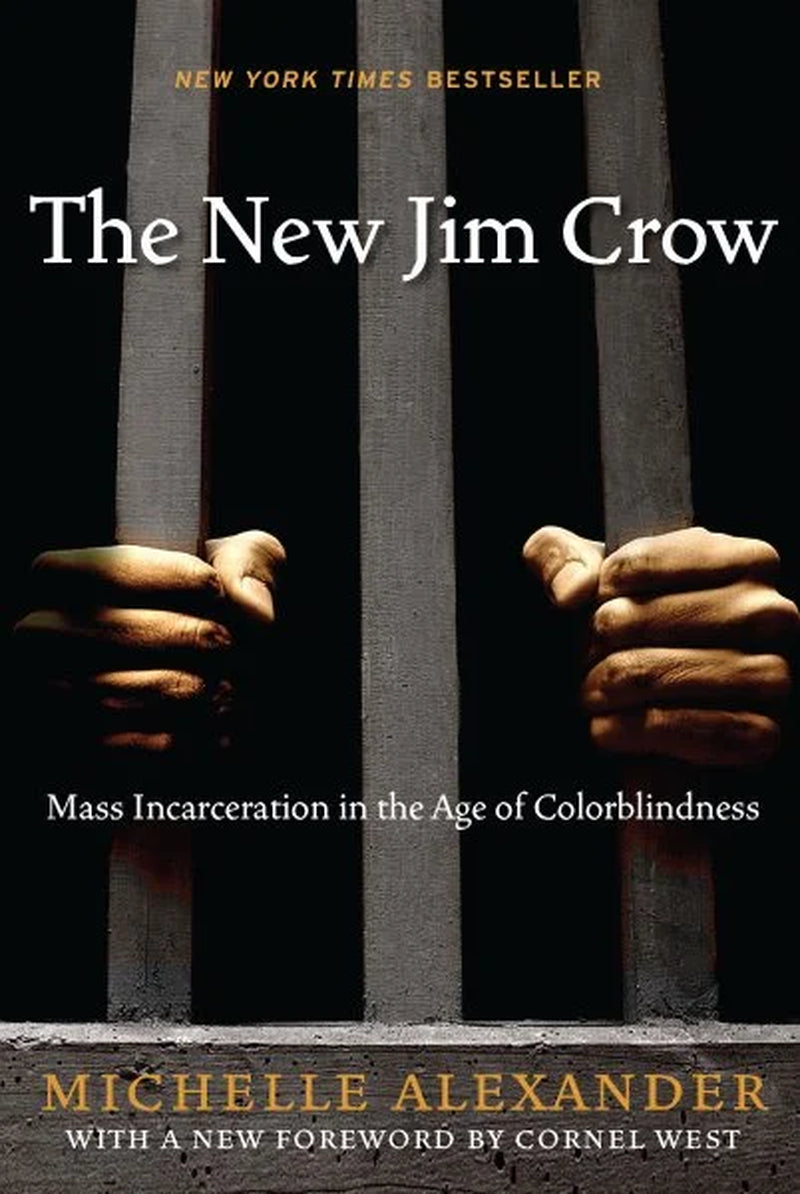
The New Jim Crow: Mass Incarceration in the Age of Colorblindness | Michelle Alexander
The New Jim Crow: Mass Incarceration in the Age of Colorblindness | Michelle Alexander
Couldn't load pickup availability
“Racial caste systems do not require racial hostility or overt bigotry to thrive. They need only racial indifference, as Martin Luther King Jr. warned more than forty-five years ago.”—Michelle Alexander
Book Overview
A groundbreaking work that examines the systemic racism embedded within the American criminal justice system. Published in 2010, the book argues that the war on drugs and the subsequent rise of mass incarceration have created a new form of racial caste system in the United States, effectively relegating millions of African Americans to permanent second-class citizenship.
Alexander meticulously details how the criminal justice system disproportionately targets Black communities, leading to their overrepresentation in prisons and their subsequent disenfranchisement through felony disenfranchisement laws. The book's cultural significance lies in its powerful critique of the colorblindness ideology which claims that race no longer matters in a post-civil rights era, serving instead to mask the continued existence of racial inequality.
The New Jim Crow has been instrumental in mobilizing activists, legal scholars, and policymakers to challenge systemic racism and advocate for profound structural reforms that address the root causes of mass incarceration.
About the Author
Michelle Alexander is a civil rights litigator, legal scholar, and author. A graduate of Stanford Law School, she formerly served as the Director of the Racial Justice Project for the ACLU of Northern California and has dedicated her career to exposing and dismantling institutional inequalities within the American legal framework.
Core Audience & Intended Use
- Social Science & Criminology Readers: Individuals studying the mechanics of the criminal justice system, penology, and the impact of the war on drugs.
- Civil Rights & History Enthusiasts: Readers seeking deep analytical insight into 21st-century racial caste dynamics and civil rights history.
- Activists & Legal Scholars: Practitioners and organizers dedicated to policy reform and dismantling institutional discrimination.
Product Specifications
| Full Title | The New Jim Crow: Mass Incarceration in the Age of Colorblindness |
|---|---|
| Author(s) | Michelle Alexander |
| Publisher & Imprint | The New Press |
| Publication Date | January 5, 2010 |
| Binding Format | Hardcover (HC) with Dust Jacket |
| Print Length | 290 Pages (Includes extensive reference notes and index layers) |
| Language | English |
| ISBN-13 / ISBN-10 | 9781595581037 / 1595581035 |
| Primary Genre (BISAC) | SOC004000 / SOCIAL SCIENCE / Criminology |
| Sub-Genres (BISAC) | SOC001000 / SOCIAL SCIENCE / Discrimination & Race Relations; LAW / Criminal Law / Sentencing & Punishment; HIST036000 / HISTORY / United States / 21st Century |
| Item Condition | Pre-Owned / Very Good |
| Dimensions & Weight | 6.13 x 1.10 x 9.25 inches | 19.2 oz (approx. 1.20 lbs) |
Frequently Asked Questions About The New Jim Crow
What is the main narrative hook and core sociological thesis driving the book?
The book delivers a powerful, devastating investigation into the American criminal justice system. Michelle Alexander forcefully argues that mass incarceration has structurally replaced segregation as a comprehensive system of racial control in the United States. The narrative demonstrates how the War on Drugs has been systematically deployed to target Black communities, trapping millions of individuals in a permanent, legal underclass.
What specific structural layout does the author use to build her legal argument?
Bypassing dry academic textbooks, the book is organized into a highly disciplined, six-chapter historical and legal progression. Alexander traces the evolution of racial caste systems from slavery and Jim Crow down to the modern prison boom. She carefully maps out the mechanics of police discretion, the dilution of Fourth Amendment rights, the financial architecture of private prison systems, and the lifelong collateral consequences of felony convictions.
What primary psychological and social themes are explored in the text?
The text delivers a profound investigation into institutional blindness, systemic racism, and social invisibility. Alexander deeply analyzes the myth of “colorblindness” in modern politics, demonstrating how the legal system uses race-neutral language to hide structural biases. The narrative explores the crushing psychological toll of a felony record, exposing how individuals are legally stripped of voting rights, housing access, and job opportunities, effectively rendering them second-class citizens.
Did this groundbreaking social critique receive any major national milestones or accolades?
Yes, exceptionally so. The New Jim Crow achieved monumental success, spending nearly 250 weeks on the New York Times Bestseller list and winning the prestigious 2011 NAACP Image Award for Outstanding Literary Work (Nonfiction). It single-handedly transformed the national conversation surrounding prison reform, cited globally by policymakers, civil rights activists, and legal scholars as one of the most influential works of social reporting published in the 21st century.
Why is this book uniquely significant to the author's personal background and professional trajectory as a civil rights litigator?
This work represents an extraordinary, radical milestone because it records Michelle Alexander’s profound ideological awakening and the total unmaking of her traditional legal training. As an elite, Stanford-educated attorney and the Director of the Racial Justice Project for the ACLU of Northern California, Alexander originally believed that systemic racism could be dismantled through standard courtroom litigation, affirmative action, and civil rights laws. However, her years of face-to-face interactions with devastated families forced her to realize that the legal establishment was completely missing the larger picture. This book marks the exact turning point where she stepped away from her career as a litigation specialist to become a radical public writer, discovering that the courtroom strategies she had spent her life perfecting were completely obsolete against a massive, self-perpetuating penal machine that required a broad social revolution to overthrow.
Condition Notice: Pre-Owned / Second-Hand Product
All books, box sets, and multi-volume collections offered by Bust-Down Books are sold in pre-owned, used, and second-hand condition, unless explicitly designated as new in the individual product listing.
Condition Details & Grading:
- Previous Ownership: These items have been previously owned, handled, and read. As such, copies may exhibit typical signs of shelf wear, including but not limited to minor creasing, scuffing, edge wear, bent page corners, remainder marks, or spine softening. Paperback editions may show minor cover curling, spine creasing, or edge rubbing.
- Markings & Personalization: Items may occasionally contain inscriptions, library stamps, owner names, marginalia, or highlighting. Individual item descriptions reflect significant deviations from standard acceptable condition.
- Supplemental Materials: Secondary and digital components—such as publisher access codes, CD-ROMs, bonus inserts, registration keys, or workbook activity pages—are not guaranteed to be included, active, or unredeemed unless specifically stated in the product description.
First Sale Doctrine & Non-Affiliation Statement:
All items sold on this platform are original, lawfully acquired copies being resold under the protection of the First Sale Doctrine (codified under U.S. copyright law, 17 U.S.C. § 109, and applicable international equivalents permitting the secondary resale of lawfully manufactured goods).
Bust-Down Books, LTD. is an independent, secondary-market bookseller. We are not affiliated with, endorsed by, authorized by, or sponsored by the original authors, copyright holders, publishers, or trademark owners of the titles offered for sale. All registered trademarks, author names, book titles, and publisher imprints remain the sole property of their respective owners and are used strictly for nominative identification and descriptive purposes.
Share